Within milliseconds the drawbridge – we each have one – may go down with a hearty welcome or remain up and sealed shut.
There may be Immediate comfort or discomfort, or levels of both.
Suspicions may be endorsed or deleted.
Information and misinformation transmission occurs at a speedy rate.
We read and misread and read and misread each other constantly – all within the backdrop of our unique experiences and training, our hurts, pains, goals, and desires – known and unknown.
The accent (if one party is not from “here”) is loaded with meaning. Clothes (anything unusual); laid-back or dominant stance; voice tone, volume, intonations; levels of energy or lack thereof, are cumulatively processed.
Triggers can be triggered. Stereotypes ignited. Warmth flows, or doesn’t.
The wave, the handshake, the hug, smile or frown, degrees of sincerity or insincerity are downloaded by the “who-are-you” antenna and the “can I trust you” antenna issued to all at birth to be processed with the morass of stored history, experience, memories, good and bad.
Every encounter is a miracle.
And, yes, with all that, we — you and I – are called to be neighbors and to love one another.
The “outside world” can be a dangerous place for children.
Another exceedingly dangerous environment for children can also be their own homes. While medicine cabinets, cleaning materials and unlocked swimming pool gates are a legitimate threat to the child-safety, the unguarded mouth of an angry adult can inflict grievous harm to a child.
A vigilant parent might install childproof locks yet leave a totally exposed web of anger in every room of the house. Unresolved anger in a parent, expressed through unpredictable displays of frustration and annoyance or rage, can quite effectively sabotage a childhood and even pass a baton of anxiety and rage to unborn generations. It is in their own homes that children might be at most in danger. At home they learn about trust, and exercise the most trust. It is at home they will learn, or fail to learn, by watching and experiencing, almost everything they will ever know about love.
It is at home they will make the most mistakes and receive the most affirmation and correction. It is at home that children will learn about fear and hurt and rejection and empathy and love and acceptance.
Children are constantly seeing, feeling, learning, trying, sometimes succeeding, sometimes failing, watching, waiting and taking it all in.
Monitoring diets is a crucial aspect of childhood health. Another “diet” is the calm, security, predictability and warmth healthy parents can provide.
If you have the opportunity to see “The King of Broken Things” run at it.
A few years back my sons and I attended a Birth Mother’s Day Dinner with about 19 brave birth moms, women who’d chosen to place their babies for adoption.
They lit candles.
Some held treasured ear-marked photographs.
There was talk about their love and support of all moms everywhere who have made the powerful choice of adoption.
All were deeply contemplative – for a few, memories from hard choices made 50-plus years ago were revisited.
A few women remained silent, holding tightly to affirmed, supported anonymity.
Mothers who have chosen adoption for their babies are often ignored on Mothers Day.
And, how their hearts must surely ache.
May 12, 2024, several nations, including South Africa, will celebrate Mothers Day and an unseen army of brave women will quietly witness other families rightfully celebrating Mothers Day and find no place at the tables with the children whom they generously offered to families eager to love their babies.
I admit, my awareness of birth mothers is acute.
These women, often shamed, labeled as irresponsible, hard, or uncaring, have radically shifted my life. Each of my boys’ mothers fought untold difficulties – unknown to me – while carrying her child to full term, in full knowledge other options existed.
Despite abandonment, derision from family members, financial difficulties, and who knows what other pressures, each delivered a beautiful baby and made the hard choice to forever enrich my life by allowing me, a single man, to adopt her infant son.
I know you are not forgotten – not on Mothers Day weekend or any other day.
You are so deeply etched into their individual psyches and into our family experience that you are regularly part of our awareness and conversation.
So deep is their desire for you, so deep is the urge for a mother that my boys sometimes called me “mom”.
I have never stopped them. I let it go because I think I know what it’s about.
It’s a primal urge.
It expresses a heartfelt longing.
To stop them, when each was learning to talk, seemed unwise, as if I were stopping something deep, powerful within each.
“Mama” or “mom” and even “mother” seemed to come as easily as rolling over, as cooing, as first steps, and as all those things that come with early development – and so I let it go.
It was as if “mother” and all forms of Her names were buried within each boy to emerge and be attached to the nearest, warmest person no matter what his or her gender.
Yes, the woman waiting your table at your Mothers Day lunch, the teacher whom your child adores, the woman co-worker who goes silent for no identifiable reason or who appears to be sometimes lost in another world when the conversation turns to babies or showers or Mother’s Day, just may be a member of that unseen army of birth-mothers. She may be one of the gracious, brave women who have made Mother’s Day complete for countless women around the world and given a man like me the unique pleasure of sometimes being called “mom.”
I ache for the millions of women whose Mothers Day is tainted with shame, loneliness, disconnection, for having made the tough choice for adoption.
If that’s you or almost you, and are in KZN, and your adoption was recent or decades ago, I have an invitation for you.
Please join me for lunch or an early dinner on May 11, 2024 – yes, the day before Mothers Day is referred to as Birth Mothers Day.
Come alone or bring a friend. I shall speak briefly, simply to thank you and honor your bravery.
Expenses for your lunch will be fully covered – I have already received several financial gifts to cover costs.
The venue will be beautiful and private and safe —- details are unfolding.
Please email Shirley@ShirleyWilliams.co.za so we can get you — and a friend — onto the list and get details to you as they unfold.
Generous readers, restaurateurs, sponsors, gift bag creators, please email Shirley you’d like to pay for a meal or sponsor a table or assist in any manner.
Closing note.
I know this is a tough invitation, Birth Mom.
But, you have already demonstrated your strength.
Join me, please.
[if you’re in the USA and want to give, all gifts are tax deductible— contact me and I’ll guide you through the easy process of giving to OpenHand International, a 501C3 corporation]
When receiving texts — except texts of a purely perfunctory nature — do you read between, behind the lines?
We offer affirming eye contact during face-to-face conversations.
Timing, tone, cadence, clarify meaning in voice calls.
Are we listening to texts?
You may engage with the person who responds to texts as if anxiously awaiting, even aching for human contact. Prior knowledge may inform your understanding of your quick-to-reply friend.
I find it helpful, early in any text exchange, to declare my level of availability. I am unlikely to ignore a verbal approach and I try to acknowledge texts.
Apparent indifference can be cruel.
Respond in kind: words for words, sentences for sentences, emojis for emojis. One who composes a paragraph deserves a like-response. A thumbs up emoji or hand clapping butterflies may come off as dismissive when a friend just spilled his guts.
Grammar rules and sound spelling seem widely ignored with texting. While pedantic perfectionism may reek pretentiousness, effort reveals respect.
Avoid alarm —- can’t wait to tell you something terribly important to you and your future when we meet next month — is hardly fair.
Read between and behind the lines.
Friends might be telling you something of crucial importance (to them) and selected you to be their audience.
Arrived in the USA late last evening from Malaysia.
Your family – blood-, marriage, relatives-by-choice, adoption, and any other means people become family – is vastly more than a list of people on your group-chat or birthdays to try and remember or the ready-made crowd for weddings and funerals.
The hundreds of links (a family of 4 has 16 relationships) in your network – your family – and how you are linked (just right, over-connected, under-connected, loosely-affiliated, cut-off in anger, the “I’ll never talk to him/her-again” kind of connection) is of crucial importance.
How you are connected will either sustain and support and nourish you or drain and exhaust you. And, there is no escaping. Severe disconnections can wield a driving power even in a so-called non-relationship.
We are all “linked” and positioned in a variety of ways within the same extended family and so a family can nourish and support while, at the same time, it can rip to shreds and bleed someone dry.
I’d like to avoid this dramatic contrast but simply look around — listen to people’s family stories — you’ll see it is so.
We are each integral to the health (and un-health) of our family.
We are each a cell-within-the-whole.
The healthier we are, the more “just right” our connections, the more we will be nourishers and be nourished within the unique group of people we each call family.
The healthier I am will lead to a healthier “we” even if it results in hardship* along the way.
* attempts at greater health will be met with resistance from those around, especially those who’ve “benefited” from unhealthy habits and patterns.
Listen to your conversations, yes, eavesdrop on yourself.
I try to do this and I am often embarrassed how regularly I’m on auto-play. I hear the same stuff – the same stories and one-liners – coming out of me over and over again.
It is as if I am bored with myself and those who are part of the “conversation.”
I don’t like this about me and I don’t particularly like it when I’m caught in someone else’s well-worn loop.
Sometimes I hear traces of contempt and sarcasm in my conversations.
I am very careful about avoiding swearing and blasphemy, yet there are times I am apparently okay with using words as clubs and bullying others with snarky sarcasm. These verbal habits are surely at least as toxic as possessing a foul mouth.
The gift of thoughtful conversations, where people listen without waiting to talk and people hear what is really being said is something to which I deeply aspire despite what sometimes comes out of my mouth.
By the way, I am heading to Duban during much of February.
I would be delighted to speak at your school, church, business, or club – and I promise to watch my mouth.
Drop me an email if you are interested.
Let’s see what time permits.
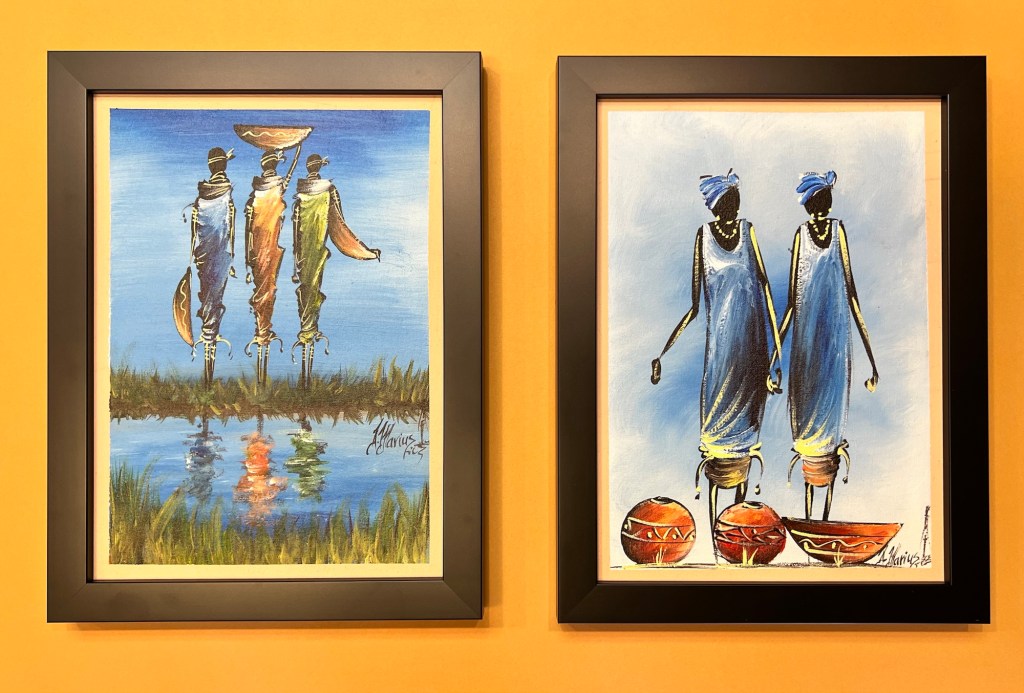
Two new pieces in our home — picked up in Lome, Togo and framed locally.
No matter how good or qualified your therapist — therapy will be of no help:
If you’re seeking help with your intimate relationship but you’re living with your mind made up, bags packed, and a heart full of blame and complaints.
It’s therapy, not arm-wrestling.
If you’re having an extramarital affair and you want to improve your relationship with your spouse so your divorce can be cordial.
It’s therapy, not help with deception and manipulation.
If you’re coming to change or influence a relationship you’re not directly a part of, for instance, you want to fix your son’s marriage or you want you husband to call his mom more often.
It’s therapy, not human chess.
If you’re committed to treating your adult sons and daughters as if they’re children and wonder why they resist visiting or phoning you.
It’s therapy, not guilt-tripping.
If you’re hoping for help to change the political views of people with whom you do not agree.
It’s therapy, not magic.
If you want the lazy to be hardworking, the harsh to be gentle, the stingy to be generous, and the unforgiving to find mercy.
Men and women who discover such radical transformation do so because they grow tired of their selfish, rigid, alienating and arrogant ways, and, in humility, find the courage for change.
It’s not therapy, it’s when desperation meets the Divine.
Take time, lots of it, yes, weeks, perhaps even months, to think deeply about your life and to write about it.
Great art deserves careful consideration and meticulous planning. Such contemplations will not require, in the meantime, you to stop functioning. Humans are vastly capable and can think and plan and ponder their unique works of art while engaged in day-to-day life as it is.
“Am I going where I want to go and doing the things I really want to do with the people who are most important to me?” is the backdrop question.
Articulating goals, even if they are unsure, generic, will bring you an added confidence as you pursue your ArtLife.
Identify which people are really important to you.
Evaluate what activities are really important to you.
Assess your direction.
Some people will tell you that this is a selfish way to live and, sadly, some will indeed plan selfish lives and reap the disappointment such planning will bring.
A life seen as art, planned as art, results in fulfilled, generous and thoughtful people.
Haphazard living, pointless, random existing, dependent on others for a sense of meaning and purpose, is a selfish life if I ever saw one.
Listening, no matter how skilled you are, cannot be faked.
You may be a skilled multitasker but even you can’t listen and, at the same time, do other things.
Even if you’re one of those people who can “spin a lot of plates at one time” or whatever the metaphor is, even you can’t do other things and listen and really hear the person talking to you.
Listening takes more than both ears. It takes both ears, both eyes, a closed mouth, and your whole focused body.
Even thinking about or wanting to check your phone, let alone the shifty reptile-like quick glances you give it and think no one notices, upsets your capacity to hear and it disturbs the speaker’s ease in talking to you.
Another thing that really upsets listening is your own unresolved stuff with other people, living or dead. As soon as any person “goes deep,” the millisecond he or she approaches anything close to something unresolved in your life, even if it’s from years ago, it’ll set you off inside, close your ears, or start you talking.
That’s how we ward off stuff, manage triggers, fight to keep things buried.
To listen is to love.
It’s often the only thing someone may want from you.
Love one another is surely among life’s hardest, crucial, most fabulous assignments.
Jesus commanded it.
He did not suggest it or consider it a good idea.
If we claim faith in Jesus, His commands leave us no options, no outs, or off ramps.
We are to love those who love us back and those who do not.
We are to love even those who for whatever reason, have chosen to reject and hate us. Hardest perhaps, we are to love those for whom we are invisible, those who regard us, if they even notice we exist, with indifference.
We are to love modern day Samaritans (the commonly rejected change from culture to culture, group to group) and Pharisees (today’s know-it-all blowhards who peer down at we lesser mortals) and teachers of the law and hookers and addicts and bankers and Rev. Private Jet pastors and prostitutes. We are to love those who treat us with the contempt shown to New Testament Samaritans.
Yes.
Everyone.
As you, my sons, love others well and as you learn to love even more people – it doesn’t come naturally – from the most distant or platonic of relationships, to the most intimate and sacred love and trust in marriage, you will be guided, sometimes cajoled, driven, even bullied by deep inner impulses.
Strong tides, forces unseen, forces felt but unknown will rise within you.
These inner pressures are sufficiently powerful that words expressed on any page will not be able to quell the force they will try to exert over you.
Love drills down deep for discovery of the opposite spirit, the counter-intuitive approach, the unexpected, the unanticipated means toward a loving, kind end.
Love your enemies is not some insurmountable-Jesus-hurdle.
He did not command it to trick anyone.
Loving your enemies is the gateway to loving all people, even to love those whom we may consider easy to love.
No one is easy to love.
Remember, what you can do to anyone you can do to everyone.
Love is really understanding the parable of the “good” Samaritan and trying to live it out daily.
Love, to imperfectly and briefly quote Paul, the Apostle, doesn’t return evil for evil.
Finally, read Paul’s summary of love in 1 Corinthians 13 and remind yourself over and over again, Paul did not have wedding sermons in mind when he put his heart on paper.






 difficultrelationships.com