I devised a list of how to participate in the healing of men and women who have been hurt:
Be willing to listen, even if what is being said is what you’d prefer to not hear. Try not to re-engineer (re-frame, recast) what you have heard so it is more fitting with what you’d really like to hear.
Resist understandable attempts to short-circuit growth by trying to ease necessary pain, by offering false affirmations, and by accepting empty excuses for irresponsible behavior. Pain is a very good motivator for change. Resist the urge to remove it when it appears to be helpful.
Offer your presence, not your answers. “I am with you” is more helpful than “let me help you fix it.”
Welcome silence. There are ways to communicate that do not include words. Resist the understandable urge to chase healing and learning away with the incessant use of words and stories.
Avoid minimizing (“it’s not so bad!”) or rationalizing (“What else did you expect?”) or normalizing (“Anyone would have done that!”) the issues that resulted in pain. Do not rob necessary pain of its usefulness.
Promote “future thinking.” Ask questions focused on future wellness and success.
Try to avoid searching for the genesis (the cause) of what has led to pain. Where something comes from is not nearly as important living your way out of it.
As well-intentioned as we may be in desiring to avoid conflict and “keep the peace,” we create more problems we must face later by running or playing hide and seek. Then, when we do face matters, we’re not the people we once were.
Avoidance is a quick-change artist! It changes us in ways we are likely to regret.
We cannot solve or improve what we will not face. Denial gets us no place worthy of the journey or the unintended, unwanted destination. Until we gather the courage to look difficult situations directly in the eye and expedite what is necessary to face the difficulties, conflicts will stay as they are and they’re likely to deteriorate.
What we avoid shapes us in ways we may never notice. We modify our habits in order to sustain our denial and avoidance. We change our friendships in order to sustain our patterns. We go out of our way to keep the peace but the new path is one to further avoidance. Our defensive habits defend us in unhealthy and unhelpful ways and make us into people we’d rather not be.
Avoidance of necessary battles creates unintended distance from others — even those we truly love.
There is no worthwhile substitute for early honest approaches to family or business conflicts.
Avoidance makes the heart grow harder.
Ours.
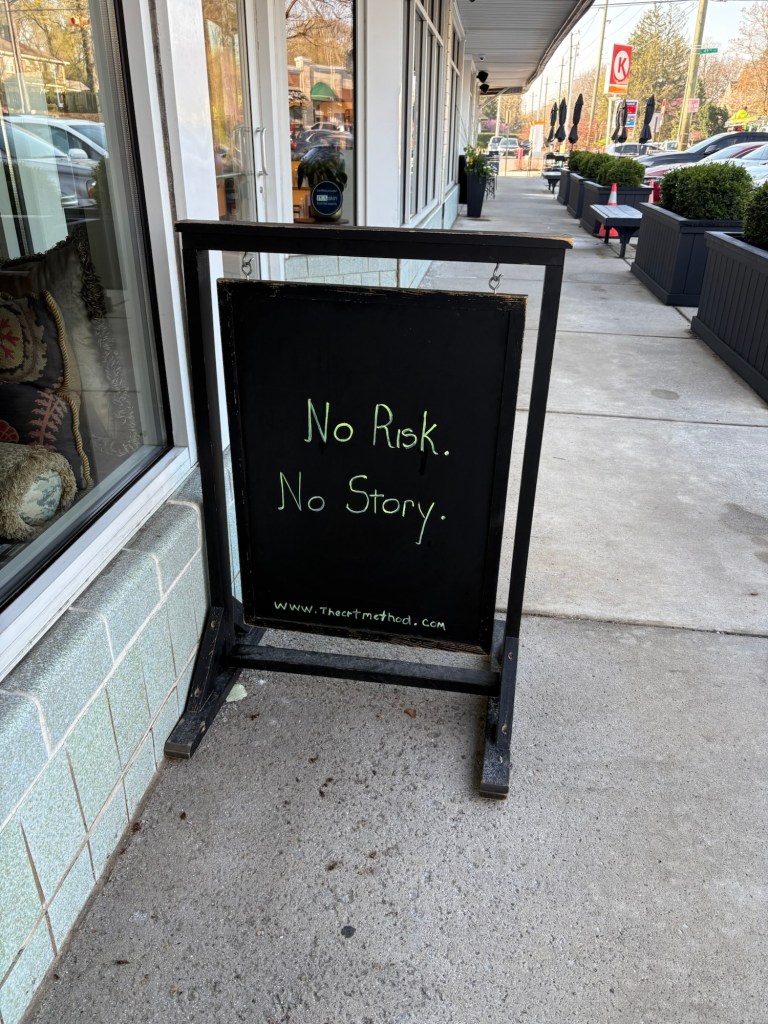
I enjoyed this side-walk art…… 49th and Penn in Meridian Kessler, Indianapolis
Finding the opportunity to seek forgiveness, participate in repair or restitution with people whom I have hurt may result in their expressing forgiveness. While hearing such comforting words warms me, self-forgiveness remains difficult.
Do you have similar battles?
I know this is a particular struggle because having known what is right, good, wholesome, I have not always done what is right and good and wholesome. I find this painful to admit and address. Knowing better was hardly helpful.
While it is no excuse, I am aware that I am not too different from many.
When I am feeling down it feels as if my failures speak louder than any successes. Despite the knowledge that “people are more than their actions” shame seeps and runs deep and makes me feel vulnerable and fragile. It can be a physical sensation.
Again, I must ask, do you ever feel this way?
When I am at my best, I can humble myself, accept my imperfections and that I am a forgiven person.
Admitting I am flawed is key to my freedom which leads me to self forgiveness at which point freedom fills my soul.
The capacity to FORGIVE is a divine gift. It can precipitate healing within people and among groups of people. The person who initiates acts of forgiveness is usually (but not always) the one who reveals greater strength. He or she may be the one carrying the deeper burden. It is the stronger person (usually) who is first to forgive, and both parties – the forgiver and the forgiven – benefit from the act if apologies are expressed and accepted. When I choose to forgive I seldom have anything to lose, and usually much to gain.
I know I harbor resentment when I am uncomfortable being around a particular person and would rather avoid him or her. I know I am holding onto hurt when I have little or nothing positive to say to or about someone and when I find it hard to think positive thoughts about someone. I will forgive as efficiently as I find it possible and can muster the strength from within to do so.
I will forgive when someone’s actions toward me (real or perceived) seem sealed into my consciousness and I can’t let them out of the prison within my head. I know it’s time for me to forgive when I feel haunted by someone whose acts against me will not let me go. Forgiveness links me with the divine, heals fragile families, calms hurting communities and restores hope within broken people – and – sets the forgiver free.
Our daily walk takes us through this forest — a 5 minute walk from our home
No matter how good or qualified your therapist — therapy will be of no help:
If you’re seeking help with your intimate relationship but you’re living with your mind made up, bags packed, and a heart full of blame and complaints.
It’s therapy, not arm-wrestling.
If you’re having an extramarital affair and you want to improve your relationship with your spouse so your divorce can be cordial.
It’s therapy, not help with deception and manipulation.
If you’re coming to change or influence a relationship you’re not directly a part of, for instance, you want to fix your son’s marriage or you want you husband to call his mom more often.
It’s therapy, not human chess.
If you’re committed to treating your adult sons and daughters as if they’re children and wonder why they resist visiting or phoning you.
It’s therapy, not guilt-tripping.
If you’re hoping for help to change the political views of people with whom you do not agree.
It’s therapy, not magic.
If you want the lazy to be hardworking, the harsh to be gentle, the stingy to be generous, and the unforgiving to find mercy.
Men and women who discover such radical transformation do so because they grow tired of their selfish, rigid, alienating and arrogant ways, and, in humility, find the courage for change.
It’s not therapy, it’s when desperation meets the Divine.
A man or woman who is a survivor of a difficult or traumatic childhood will often go to unusual extremes in several of life’s arenas.
“Make it perfect,” becomes the mantra.
The extremes are intense attempts at perfection to put right the past or stop it intruding on the present.
This may be particularly obvious when parenting.
The survivor of a difficult childhood whom you love will go to endless lengths to please you once he or she has broken through the trust barrier with you.
Once you are trusted it will be in ways he or she has never trusted before.
Be gentle as it could be very fragile.
When suspicious questions arise, answer as honestly as you know how you realize that it is not about your behavior, it’s about history repeating itself.
The man or woman whom you may love who is a survivor of a difficult childhood will often feel heavily let down if well made plans go awry. He or she may suddenly become completely disillusioned when discovering he or she was unable to create something perfect for you to experience together.
If you ever want a beautiful picture of mercy the Biblical account of the life of Joseph is the place to go.
His response to his desperate, begging brothers embodies the quality of mercy I have often received.
While in Genesis, you will encounter with Joseph moments of extraordinary grace and healing, on top of surely being bombarded with the impulse to burst out in songs from the musical that bears his name.
Following a rather violent and involuntary departure and after decades of separation from his family, Joseph abounds in kindness and mercy towards his brothers. This same band of brothers found young Joseph so threatening they discarded him into a well, as a kinder option to killing him, and then sold him to a traveling caravan.
As a result of their jealousy and violence Joseph spent years in isolation and torment.
When, decades later and faced with his brothers, Joseph would be justified if he chose to have nothing to do with them or exercised his extraordinary powers in the pharaoh’s domain to have them arrested and held accountable for their crimes.
But no, recognizing who they are, knowing his brothers have come in search of help, he discloses his identity.
“I am Joseph. Is my father still alive?”
His first question is about their father’s wellbeing.
I cannot imagine being cut-off from my extended family, all of whom live in distant countries.
I cannot imagine not knowing if one of my closest relatives is living or dead.
Joseph’s retribution quotient rests firmly at zero. When legitimately, there could be anger, Joseph expresses none. He fosters no desire for pay-back.
“Come closer,” he says and weeps with relief and gratitude for the opportunity for reconciliation.
“I will provide for you,” he tells them and there are hugs and kisses and weeping all round.
What a reunion!
Many families long for such a reunion.
Do you?
“Something got in the way,” I hear a woman say revealing she has not spoken to her sister in decades.
“I will never talk to that woman again. She got mom’s dining room table she knew I wanted.”
A table got in the way.
A dining room table was enough to sever a family tie?
“Ah, it is not about the table,” may be a legitimate retort.
I concede it may well not be about a table. Give me a few moments and I could suggest a variety of possible explanations for the schism a table may conveniently represent.
Family estrangements can be horribly painful but, even sadder, we grow accustomed to them. We live with them. It becomes how life is.
“Something got in the way,” would have been a gross understatement had Joseph chosen victimhood.
May we each do our parts in getting whatever got in the way, out of the way.
Joseph embodied mercy when he had the choice to extract vengeance.
Joseph chose humility, when he indeed could have demanded his brothers bow before him and beg for their lives.
Your body is more important than your brain therefore focus on your body, not your brain. Your body will get you further than your brain. Your body is bait. Use it well for a fine catch (riches, status – things you can’t get alone). Other people are more important than you. You are on Earth to serve, particularly all males.
Once a husband finds you, your greatest calling is to be a mother. If you have other ambitions you will compromise your mothering. Your only worthwhile ideas pertain to cooking, cleaning, and childcare; leave thinking about sciences, technology, and mathematics to males.
Once you are in love you will give up yourself for your husband and your children. This is what love is. You are a half. When you meet a man and marry you will become whole. If you suffer in silence and allow others to use you God will reward you.
Having addressed female audiences in the USA, Southern Africa, and in three Asian countries, I perceive these covert and overt messages to girls remain consistent. Perhaps saddest is that when girls find faith, they often expect God to be the ultimate male, issuing similar messages, demands, and expectations.
“Today is the 1st anniversary of discovering that my lady friend had been having an affair over the previous month with a fast-talking operator who is half my age. She told me it was over, a mere a flash in the pan for which she felt neither remorse nor regret.
“The revelation was devastating and reduced me to an emotional wreck. Over the next two months I was almost suicidal and had to seek professional help. I still loved her; I attempted to recover with the assistance of a therapist and researched depression and heartbreak. I lurched from one temporary separation to the next but was always so pleased to reconcile that it seemed the hurt was receding. That was until the next crisis surfaced.
“Then I read your column on forgiveness and experienced a wonderful epiphany. Suddenly I realized that I was punishing myself for actions for which I was not responsible. A huge cloud lifted and healing began. Today, a year later, I have absolutely no painful memories of the incident, feel rejuvenated and bear no resentments.
Covering for someone so outsiders do not notice or find out about his or her undesirable behavior (drinking, gambling, addictive habits).
Relaying lies to a workplace – calling in to say he or she is ill when he or she is unable to work because of the addiction.
Permitting, turning a blind-eye, cooperating, letting things go unnoticed to keep the peace or because it feel easier.
Enabling behaviors are often subtle way of disguising who it is in a family who is in need of help. The enabler often appears to be the strong or the healthy one. Control is the name of the game – and family life can feel like one.
Empowering is common in healthy families.
It can involve:
Getting out of each other’s way so people can learn from errors and get credit for their successes.
Allowing natural consequences to follow choices so people can learn just how powerful really are.
Trusting and believing in each other even when things do not go to plan or appear to be falling apart.
Empowered people require the company of other empowered people and all require a strong sense of self. Freedom to discover and to learn are the hallmark of the empowered.



 difficultrelationships.com