I devised a list of how to participate in the healing of men and women who have been hurt:
Be willing to listen, even if what is being said is what you’d prefer to not hear. Try not to re-engineer (re-frame, recast) what you have heard so it is more fitting with what you’d really like to hear.
Resist understandable attempts to short-circuit growth by trying to ease necessary pain, by offering false affirmations, and by accepting empty excuses for irresponsible behavior. Pain is a very good motivator for change. Resist the urge to remove it when it appears to be helpful.
Offer your presence, not your answers. “I am with you” is more helpful than “let me help you fix it.”
Welcome silence. There are ways to communicate that do not include words. Resist the understandable urge to chase healing and learning away with the incessant use of words and stories.
Avoid minimizing (“it’s not so bad!”) or rationalizing (“What else did you expect?”) or normalizing (“Anyone would have done that!”) the issues that resulted in pain. Do not rob necessary pain of its usefulness.
Promote “future thinking.” Ask questions focused on future wellness and success.
Try to avoid searching for the genesis (the cause) of what has led to pain. Where something comes from is not nearly as important living your way out of it.
As well-intentioned as we may be in desiring to avoid conflict and “keep the peace,” we create more problems we must face later by running or playing hide and seek. Then, when we do face matters, we’re not the people we once were.
Avoidance is a quick-change artist! It changes us in ways we are likely to regret.
We cannot solve or improve what we will not face. Denial gets us no place worthy of the journey or the unintended, unwanted destination. Until we gather the courage to look difficult situations directly in the eye and expedite what is necessary to face the difficulties, conflicts will stay as they are and they’re likely to deteriorate.
What we avoid shapes us in ways we may never notice. We modify our habits in order to sustain our denial and avoidance. We change our friendships in order to sustain our patterns. We go out of our way to keep the peace but the new path is one to further avoidance. Our defensive habits defend us in unhealthy and unhelpful ways and make us into people we’d rather not be.
Avoidance of necessary battles creates unintended distance from others — even those we truly love.
There is no worthwhile substitute for early honest approaches to family or business conflicts.
Avoidance makes the heart grow harder.
Ours.
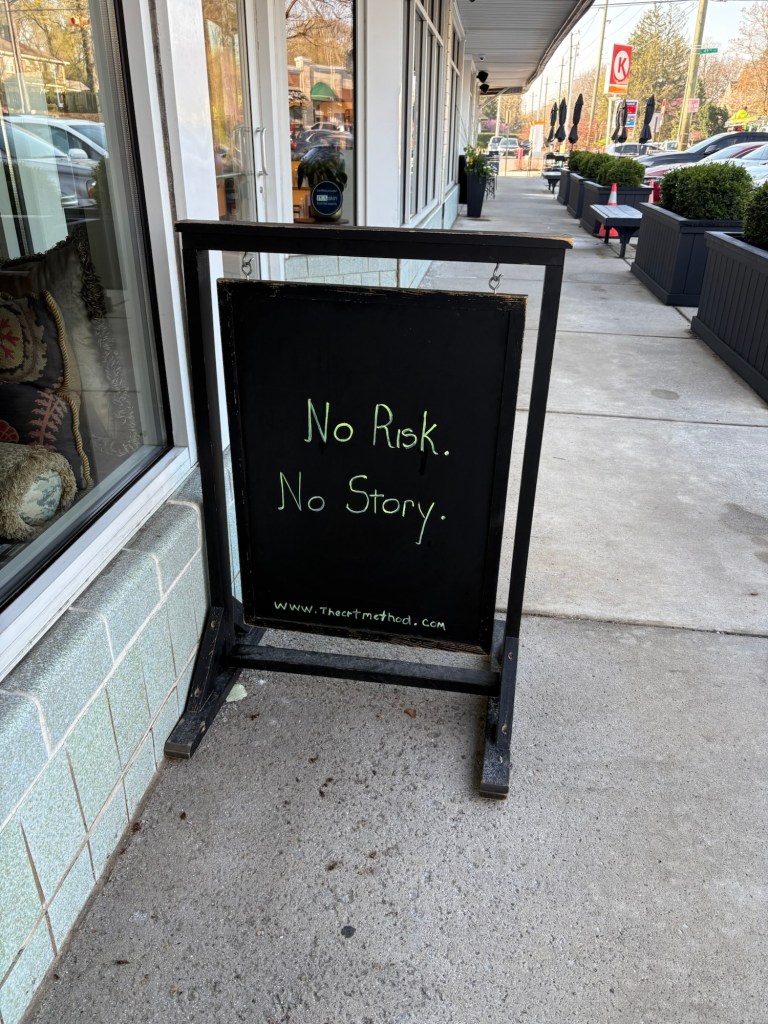
I enjoyed this side-walk art…… 49th and Penn in Meridian Kessler, Indianapolis
Within milliseconds the drawbridge – we each have one – may go down with a hearty welcome or remain up and sealed shut.
There may be Immediate comfort or discomfort, or levels of both.
Suspicions may be endorsed or deleted.
Information and misinformation transmission occurs at a speedy rate.
We read and misread and read and misread each other constantly – all within the backdrop of our unique experiences and training, our hurts, pains, goals, and desires – known and unknown.
The accent (if one party is not from “here”) is loaded with meaning. Clothes (anything unusual); laid-back or dominant stance; voice tone, volume, intonations; levels of energy or lack thereof, are cumulatively processed.
Triggers can be triggered. Stereotypes ignited. Warmth flows, or doesn’t.
The wave, the handshake, the hug, smile or frown, degrees of sincerity or insincerity are downloaded by the “who-are-you” antenna and the “can I trust you” antenna issued to all at birth to be processed with the morass of stored history, experience, memories, good and bad.
Every encounter is a miracle.
And, yes, with all that, we — you and I – are called to be neighbors and to love one another.
No matter how good or qualified your therapist — therapy will be of no help:
If you’re seeking help with your intimate relationship but you’re living with your mind made up, bags packed, and a heart full of blame and complaints.
It’s therapy, not arm-wrestling.
If you’re having an extramarital affair and you want to improve your relationship with your spouse so your divorce can be cordial.
It’s therapy, not help with deception and manipulation.
If you’re coming to change or influence a relationship you’re not directly a part of, for instance, you want to fix your son’s marriage or you want you husband to call his mom more often.
It’s therapy, not human chess.
If you’re committed to treating your adult sons and daughters as if they’re children and wonder why they resist visiting or phoning you.
It’s therapy, not guilt-tripping.
If you’re hoping for help to change the political views of people with whom you do not agree.
It’s therapy, not magic.
If you want the lazy to be hardworking, the harsh to be gentle, the stingy to be generous, and the unforgiving to find mercy.
Men and women who discover such radical transformation do so because they grow tired of their selfish, rigid, alienating and arrogant ways, and, in humility, find the courage for change.
It’s not therapy, it’s when desperation meets the Divine.
Your body is more important than your brain therefore focus on your body, not your brain. Your body will get you further than your brain. Your body is bait. Use it well for a fine catch (riches, status – things you can’t get alone). Other people are more important than you. You are on Earth to serve, particularly all males.
Once a husband finds you, your greatest calling is to be a mother. If you have other ambitions you will compromise your mothering. Your only worthwhile ideas pertain to cooking, cleaning, and childcare; leave thinking about sciences, technology, and mathematics to males.
Once you are in love you will give up yourself for your husband and your children. This is what love is. You are a half. When you meet a man and marry you will become whole. If you suffer in silence and allow others to use you God will reward you.
Having addressed female audiences in the USA, Southern Africa, and in three Asian countries, I perceive these covert and overt messages to girls remain consistent. Perhaps saddest is that when girls find faith, they often expect God to be the ultimate male, issuing similar messages, demands, and expectations.
What is the year teaching you? Please, reflect and let me know. Here are a few things I am learning afresh and re-learning:
Trust broken is hard to restore. My experience is that forgiveness can restore broken trust but the ability to trust again can take a long time to restore. This is especially so with close friendships and infidelity in marriage.
No one is more important than anyone else. To be intimidated by another is a waste of opportunity and energy. Yes, we all have different roles. We are afforded a variety of degrees of power and responsibility that come with our varying roles, but using that power to lord it over another is the surest indication that the power is in the wrong hands.
Some individuals are so significantly hurt that the real person has disappeared behind shame, regret, and pretense. The defense has become the identity. The vulnerable person inside died a very long time ago and, sadly, will probably never be known.
Ignored conflicts and family issues that are unaddressed will remain and usually grow. The issues may change shape, may go into hiding, may remain latent for decades – but they will surface and get necessary attention.
If you find yourself identifying with the chronic list I would strongly urge professional help. Please, if you use my list at all, use it for yourself, and not to identify others.
Two kinds of anxiety: chronic and situational
Chronic:
You worry and you don’t know why – it’s generic and floating; it’s not connected to anything specific.
You worry even when things are going well – there are times when you worry about having nothing to worry about.
You worry as a way of life – when people tell you they are not in a state of constant concern you think they are surely in denial.
You worry about everyone you love and regard the amount of worry as proportional to the depth of your love.
The rumbling feeling of anxiety feels like it is deep inside you and has lived in you for as long as you can remember – it’s as if you were born with it or it came from another life.
Situational:
You are facing an examination, a tough conversation, or an important interview. You know the tension will ease once you get started or once the trial is over. Your worry is attached to something real and when that is dealt with the worry will ease and then be gone.
It is helpful to think of every other driver as drunk, unpredictable, and crazy. This approach kept my father accident-free for more than 50 years (although it is unsure how many he caused). This attitude will keep you alert and will go a long way to securing your safety and the safety of others.
Never ride in a car with anyone who is under the influence of alcohol or any legal or illegal substance or substances even if this person is not the operator – and I don’t care if it is your favorite aunt. While I am on that subject, it’s not your job to transport drunk or drugged people.
Don’t drive any vehicle, not even a golf cart or ride a skateboard or bounce on a pogo stick, for goodness sake, if you have consumed anything that distorts, or potentially distorts, your judgment. If you have been drinking or even if you feel you have been out too late, call me, use a taxi or Uber.
I will NEVER refuse your call for help.
Don’t compromise your safety – even if it a very short ride in a very safe car in a very safe suburb. Cars are dangerous missile in the hands of sane, experienced drivers, and the danger quotient radically spikes in the shaky hands of anyone under the influence of anything – even anger.
Treat cars and the privilege of driving (it’s not a right) with great respect. If, from the minute you may legally drive and for at least the first five years, you never enter a car without humbly bowing for three to five minutes at the hood (bonnet), and then for three to five minutes at the trunk (boot) in quiet, humble reverence, with your hands folded in a typical stance of a person at prayer, you might develop the necessary awe cars and driving deserve.
Cars are like pulpits. They should be entered into in a spirit of humility and avoided by the proud, the angry, and blowhards. Driving is for getting from A to B. That is it. It’s not for the music, or texting, or eating, or watching movies. The journey is not the party Don’t make car ride into a party – there’s no quicker access to an ambulance.
When it comes to my sons, I remind myself of these things:
Their lives are larger at their ages than mine was at their ages. Of course, they’re starting late and the world is a very different place. Their platforms are more complex, and more dynamic than mine was and, I admit, I am somewhat limited in my ability to identify with it. This means I should not be taken aback when I am blinded to possibilities and experiences they see and want to embrace. Rejecting an idea or a possibility simply because I couldn’t envision it is a good way to widen a gap than is mine, and not theirs, to bridge.
While the world is a very different place than it was in my formative years, some things remain unchanged. Good manners, using please and thank you, looking people in the eye, standing up for adults, dealing honestly with money and time, working hard, and displaying empathy in the face of those who are suffering – are values that cannot be discarded just because the world is faster paced than it once was. One of my jobs as a parent is to encourage, even enforce some of these things if necessary.
I am enough for my sons and the only dad they will ever need.


 difficultrelationships.com