You will find the best in others ……. if you look for the best in others. I refer to the best in others as their gold. It’s generosity, kindness, wholesomeness, creativity, and friendliness. These qualities live within all others (no exceptions). Such gold is available to be found. It comes with the human package.
There’s only one condition.
You have to be willing to acknowledge that there is gold within you and be willing to find it within yourself first before you will be able to see it in others. It may be hiding behind the shame and guilt and honed skills of deception you have had to download for protection and survival.
I am aware that “comes with the human package” is quite a claim.
Some will doubt. They will tell stories of those whom they found to be no-good to the core.
The gold within some is easy to find – not too much digging required.
For others it can be deeply buried in shame, humiliation, guilt, deception and in a belief that cruelty or violence or deception are, or were, necessary for survival.
“No-good to the core” has its reasons, its history.
But, the gold is still there.
It cannot be eliminated.
Given time to be heard, time for trust to build, time to tell his or her story, I know that who some regard as the worst of humanity are often bearers of the purest of gold.
There is nothing like a good listener for feeding the soul.
A good listener determines there will be no distractions — no phones, text checking, no dings or app notifications or glances to see the time — and will offer complete and uninterrupted and undiluted attention to the speaker.
A good listener listens, says very very little except may offer occasional brief words of encouragement like “tell me more” or “go back to the beginning if you want” or “go into as much detail as you think will be helpful” or “could you tell me that again so it’s clearer for me.”
The good listener knows listening and any attempts at multitasking — even the most subtle — distract the speaker and obliterate listening. A good listener gets all the potential impediments to listening out of the way before sitting down to listen.
The good listener knows a listener’s inner-noise —- things the listener is refusing to hear or address from within — will emerge and sabotage attempts at hearing others and so addresses unresolved personal matters as much as possible so others may encounter a clear-headed listener.
The good listener does not formulate replies or develop counterpoints while listening and does not one-up the speaker with the listener’s own experiences whether they may appear to the listener to be helpful or not.
A good listener sees, hears, knows, acknowledges the speaker by listening — the most powerful and tangible expression of love.
I devised a list of how to participate in the healing of men and women who have been hurt:
Be willing to listen, even if what is being said is what you’d prefer to not hear. Try not to re-engineer (re-frame, recast) what you have heard so it is more fitting with what you’d really like to hear.
Resist understandable attempts to short-circuit growth by trying to ease necessary pain, by offering false affirmations, and by accepting empty excuses for irresponsible behavior. Pain is a very good motivator for change. Resist the urge to remove it when it appears to be helpful.
Offer your presence, not your answers. “I am with you” is more helpful than “let me help you fix it.”
Welcome silence. There are ways to communicate that do not include words. Resist the understandable urge to chase healing and learning away with the incessant use of words and stories.
Avoid minimizing (“it’s not so bad!”) or rationalizing (“What else did you expect?”) or normalizing (“Anyone would have done that!”) the issues that resulted in pain. Do not rob necessary pain of its usefulness.
Promote “future thinking.” Ask questions focused on future wellness and success.
Try to avoid searching for the genesis (the cause) of what has led to pain. Where something comes from is not nearly as important living your way out of it.
As well-intentioned as we may be in desiring to avoid conflict and “keep the peace,” we create more problems we must face later by running or playing hide and seek. Then, when we do face matters, we’re not the people we once were.
Avoidance is a quick-change artist! It changes us in ways we are likely to regret.
We cannot solve or improve what we will not face. Denial gets us no place worthy of the journey or the unintended, unwanted destination. Until we gather the courage to look difficult situations directly in the eye and expedite what is necessary to face the difficulties, conflicts will stay as they are and they’re likely to deteriorate.
What we avoid shapes us in ways we may never notice. We modify our habits in order to sustain our denial and avoidance. We change our friendships in order to sustain our patterns. We go out of our way to keep the peace but the new path is one to further avoidance. Our defensive habits defend us in unhealthy and unhelpful ways and make us into people we’d rather not be.
Avoidance of necessary battles creates unintended distance from others — even those we truly love.
There is no worthwhile substitute for early honest approaches to family or business conflicts.
Avoidance makes the heart grow harder.
Ours.
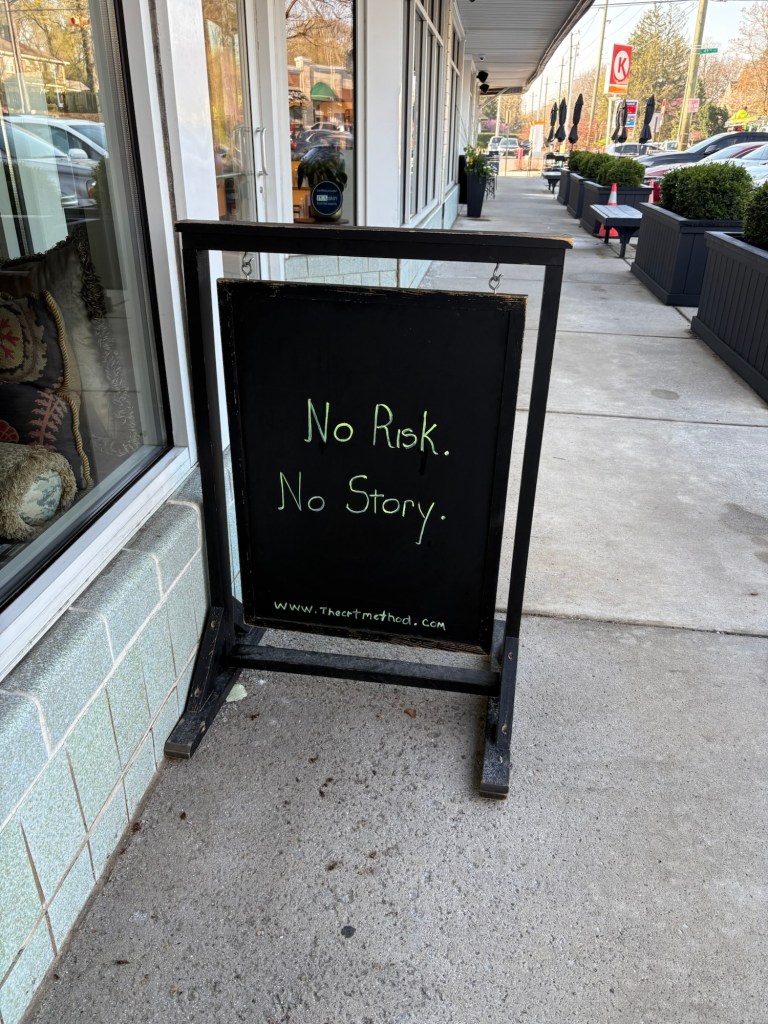
I enjoyed this side-walk art…… 49th and Penn in Meridian Kessler, Indianapolis
Definitions vary, but people usually want to be emotionally healthy, or moving in that direction.
How about some tangible goals displaying emotional wellness?
The emotionally well person is a self-starter who is inner-driven and internally-steered. She uses pre-established principles and boundaries to make decisions and is not usually externally steered by family, friends or fads.
The healthy person is no blind follower and nor is he “flying by the seat of his pants.” Even at his most spontaneous, he is living his pre-established principles and goals.
She loves her family but acts as a separate person when necessary and, when necessary, she is able to make unpopular decisions.
He sometimes chooses to spend time alone, time to think, plan, read, write and pray.
He is quick to forgive almost everything but learns to modify or manage trust. He understands that forgiving doesn’t necessarily mean forgetting although there are times and circumstances when it does.
Emotionally well people are able to “hold onto themselves” under pressure and do not lash out or blame others when things go awry.
Emotionally well people are comfortable with their status in life and thus able to impart calmness and comfort to those who appear to be on a constant treadmill in pursuit of wealth, success, or recognition.
“Living from within” can appear as arrogance to those who are tossed and turned by trends and fashions.
Your family – blood-, marriage, relatives-by-choice, adoption, and any other means people become family – is vastly more than a list of people on your group-chat or birthdays to try and remember or the ready-made crowd for weddings and funerals.
The hundreds of links (a family of 4 has 16 relationships) in your network – your family – and how you are linked (just right, over-connected, under-connected, loosely-affiliated, cut-off in anger, the “I’ll never talk to him/her-again” kind of connection) is of crucial importance.
How you are connected will either sustain and support and nourish you or drain and exhaust you. And, there is no escaping. Severe disconnections can wield a driving power even in a so-called non-relationship.
We are all “linked” and positioned in a variety of ways within the same extended family and so a family can nourish and support while, at the same time, it can rip to shreds and bleed someone dry.
I’d like to avoid this dramatic contrast but simply look around — listen to people’s family stories — you’ll see it is so.
We are each integral to the health (and un-health) of our family.
We are each a cell-within-the-whole.
The healthier we are, the more “just right” our connections, the more we will be nourishers and be nourished within the unique group of people we each call family.
The healthier I am will lead to a healthier “we” even if it results in hardship* along the way.
* attempts at greater health will be met with resistance from those around, especially those who’ve “benefited” from unhealthy habits and patterns.
Listening, no matter how skilled you are, cannot be faked.
You may be a skilled multitasker but even you can’t listen and, at the same time, do other things.
Even if you’re one of those people who can “spin a lot of plates at one time” or whatever the metaphor is, even you can’t do other things and listen and really hear the person talking to you.
Listening takes more than both ears. It takes both ears, both eyes, a closed mouth, and your whole focused body.
Even thinking about or wanting to check your phone, let alone the shifty reptile-like quick glances you give it and think no one notices, upsets your capacity to hear and it disturbs the speaker’s ease in talking to you.
Another thing that really upsets listening is your own unresolved stuff with other people, living or dead. As soon as any person “goes deep,” the millisecond he or she approaches anything close to something unresolved in your life, even if it’s from years ago, it’ll set you off inside, close your ears, or start you talking.
That’s how we ward off stuff, manage triggers, fight to keep things buried.
To listen is to love.
It’s often the only thing someone may want from you.
May this question help you to plan your day. I confess, it’s constantly in the back of my mind with almost all my daily interactions.
You’ve seen him demanding to see the boss, insisting on getting his way, banging fists on the counter. He becomes aggressive and threatening when things don’t go his way. You can be this person if you want. It all depends on what kind of person you want to be.
You’ve heard and seen her, raising her voice at a waiter in a fine restaurant because something wasn’t up to her standards. She plays dirty and attempts to humiliate helpers to land a free meal. You can be this way if you want. Everything depends on who you want to be.
You’ve seen him, kind and patient under stress, generous and openhearted, even when facing difficulties. You can be this way if you want. It’s always, and there are no exceptions, up to you.
You’ve seen her, helping the poor, serving the sick, making meals for neighbors, all-the-while undergoing her own stresses, suffering beneath her own burdens and loads. She serves while she herself deserves to be served. You can be this way if you want. Everything pivots on what kind of person you want to be.
My friend Michael — a finer human (than Michael) I’m yet to meet.
I have had the joy of being with you this past week: several of you shared meals with me and we met in ways I know I will remember. I hope you will, too. Thank you. Given the time I would have enjoyed such an opportunity with each of you. During your first session with me I told you I would give you my notes from each of my talks. If you read this letter today or in ten years it is all ok with me. People do what they are ready to do. Keep them. See how well they age. Remind yourself that I repeatedly said I am addressing the future you.
Day One I tried to tell you how unique and beautiful you are. This is not an older adult attempting to convince you of something adults generally want you to believe. As I said I really have never met – 50 countries and thousands of people later – anyone, anywhere who is not beautiful. Yes, I have met people who have done really ugly things and done a few myself, but, you (we) are beautiful. Get to know any human by listening, really listening, and I believe you will soon agree with me. We talked about leadership: I said Leadership is a Function, a role, not a position. If your motive in becoming a leader is to see your name at the top of a list or to be the boss, your distorted motive will be your constant hurdle. Leadership is about who and what you are and what you do within a community. It is not about status. If it is the status you seek, your drive for recognition will persistently contaminate your leadership. To lead others effectively it is necessary to know what you are good at and what you are not good at. Work at your strengths. Accommodate your weaknesses. Both are yours for the long-haul.
I encouraged you to consistently define yourself. If you don’t, someone will. Resist the natural anxious urge to define others. Become an expert in your own behavior. Resist the natural (anxious) urge to be an expert in the behavior of others, especially those who annoy you. Listen more than you speak. Make sure you are hearing, not waiting to talk. I closed saying Self-Leadership has by far the greatest impact on how effective you are as a leader. If you can’t lead yourself you can effectively lead nothing and no one.
Day Two I emphasized your (and my) uniqueness. I urged you to find within the depths of where your hearts, minds, spirits, souls meet (see it as a kind of Venn diagram) the beautiful “place” generally referred to as the SELF. YourSELF is beautiful, it’s as unique as your fingerprints, your voice, and your personality. It is shaped by your family history, your DNA, by enduring joyful and nurturing experiences. It is shaped also by trauma, by loss, grief and so much else. This SELF is resilient. The Self wants to be well. It self-repairs (given conducive conditions). It is not Selfish to find and love and know yourSelf. I would suggest it is selfish NOT to. People who avoid Self-Awareness because they consider it selfISH are usually people who put stress on leadership teams and on friendships and battle with boundary confusion – “I am I, you are you, we are we, Let’s not confuse the three” – Remember? It’s corny BUT if you live it, it will save you a LOT of pain and therapist bills!
Day Three I emphasized your God-given desire for Autonomy. It’s part of your humanity. To desire self-directedness (AUTONOMY – SPACE, ROOM TO MOVE, freedom to be yourself) comes with your birth package. When it is unfulfilled – or ignored – you will be discontent. You have a similar God-given desire for Intimacy. This is part of your humanity. We all want some closeness, to belong, to be part of. Accepting that these Dueling Desires live within you and recognizing they are present in all the people will make it easier for you to welcome both into their legitimate place within your life. You (and I) really grow up when you (we) meet these needs in yourself AND understand that others are similarly driven. When your best friend chooses to be alone (wants Autonomy) it is not a rejection of you (necessarily) if you, at the same time, want Intimacy. Remember, you cannot LOVE and CONTROL the same person.
This afternoon (Thursday) and Day Four, I left you with eight things I would tell my younger self:
Save, and never touch, one third of all the money you earn. Few people regret having saved from an early age. Few things upset adulthood as well as financial pressures.
Honor your family and extended family relationships above all other relationships. If you are a brother or a son, a niece or an aunt, be the best one you can be.
Learn to live without blaming others. While others are indeed imperfect, blaming others for anything will seldom get you to where you really want to go. There are exceptions which I made clear (I hope).
Forgive, truly forgive, but remember. To forgive and forget is often foolish and even impossible. Remembering is not the same as holding a grudge. There are exceptions which I made clear (I hope).
Find your VOICE and hold onto it. Finding your voice means figuring out what you want your life to say. Only a small portion of finding your voice has to do with actual words.
Every unfortunate or bad thing that happens to you will ultimately offer you a choice. Will it become SEED (for growth) or STONE (resentment or hardness)? Seed will be most helpful to you. The choice will always be yours.
Pursue (chase) education even over romance. Few people regret having a sound education.
Gain understanding about your power, the power that comes with being human. Treasure it; Protect it, Deploy it. Use it for its intended purpose only.
I have loved being with you. Thank you. I especially enjoyed the Talent Show and the party. I loved watching your amazing capacity to have fun and I particularly enjoyed seeing some of you who arrived earlier this week appearing shy and withdrawn having the time of your lives.
Rod
Dad, Uber Driver, International Speaker and Newspaper Columnist
There are a few ways I can tell when an unwell client is gathering strength and becoming well……
He begins to speak up. He resists “falling into line” and acquiescing to others when he’d previously kept his mouth shut and conformed to the expectations of others.
She starts to think things through. She turns consequences and ramifications over in her mind before agreeing with or accepting my suggestions. She trusts her own insights more than she trusts her therapist’s insights about her.
He develops a growing “bird’s eye view” of his life. He begins to see with greater and greater clarity how seemingly “small” decisions of repeated healthy choices rapidly usher in larger positive outcomes than can be anticipated.
She begins to enjoy the rewards of making difficult but healthy choices. She wakes up most days with growing anticipation despite her substantial challenges.
He sees and feels more and more courageous and confident about his own life even while appreciating the humility required of those who desire to live meaningful lives.
She expresses thanks and appreciation for her life despite its struggles and anticipates being an agent of hope to others with similar challenges.




 difficultrelationships.com