Archive for ‘Boundaries’

July 5, 2011

It’s usually a boundary issue…

by Rod Smith

Enduring (long-lasting) relationship difficulties can usually be traced to ill-defined boundaries.

Boundaries (fences, walls, lines on a road) surround us.

Some are unseen. People give couples “room” to be couples even though there is no visual demarcation.

Internal boundaries are “the lines I draw” inside me. These “unseen” boundaries are the reasons I don’t steal, hit annoying people, or say everything I think.

Boundaries support necessary separateness, space, definition, and therefore provide necessary clarity.

Separateness, space, clarity, are essential for individual growth and the wellness of any family or community.

Boundaries keep us apart and together by keeping us healthily apart and healthily together. People who are too close, and people who are too far apart, stunt or distort their potential.

Two imperfect illustrations:

Every time a vehicle is on the road a driver must obey (honor, acknowledge) many rules, and respect many boundaries or, of course, accidents occur, build up occurs, people are injured, and things are damaged.

Trees cannot grow to full height if planted too close to each other. If planted too far apart, their unified capacity to provide shade is limited.

Adults (except in very unusual circumstances) are responsible for establishing and maintaining their own boundaries. Boundary maintenance cannot be left to another no matter how much love or care or history is shared.

July 1, 2011

Achieving MUCH with YOUR life is a profound act of mothering

by Rod Smith

1. Enriched is the woman who does not lose herself to her marriage or motherhood. She has a strong spirit of independence while being a loving wife and mother.

2. Enriched is the woman who does not accommodate poor manners (being taken for granted or being victimized) from anyone (not husband, children, in-laws, siblings, or her parents).

3. Enriched is the woman who lives above manipulation, domination, and intimidation. Her relationships are pure and open; her boundaries are defined, secure, and strong.

4. Enriched is the woman who does not participate in unwanted sexual activity. She honors her body as her private temple and shares it, even in marriage, only by her own deliberate choice.

5. Enriched is the woman who has developed a strong, clear, identity. She regularly articulates who she is, what she wants, and what she will and will not do. She is unafraid of defining herself.

6. Enriched is the woman who knows that pursuing her dreams to be educated, to work, to accomplish much, to expect much from her life, are profound acts of partnership in marriage and profound acts of mothering. She knows that the woman who “takes up her life” does more for herself, her husband, and her children than the one who surrenders it.

June 29, 2011

There is help for addicts but the first step is recognition….

by Rod Smith

Addictions and addicts are swamped in denial.

The use of any substance or participation in any behavior is a problem (an addiction) for you if one of the following is true for you.

As a result of the use of a substance or engagement in a behavior:

  1. You’ve lost, or come close to losing, a significant relationship or a job.
  2. You’ve had a run in with the law.
  3. Your children are unsettled by your activities.
  4. You have physical cravings when you have been without it for a few minutes or a few days.
  5. You violate your values, or appear to have no values, to sustain your activity.
  6. You build your life around something people who love you wish you wouldn’t consume or do.
  7. Your life – finances, faith, and relationships – has become progressively unmanageable.
  8. You hide or you lie about your whereabouts and/or behavior.
  9. People who love you are put “on duty” and you expect them to lie for you.
  10. People, especially those you love, are embarrassed by your behavior.
  11. You hate a list like this list and hope certain people won’t see it.
  12. When confronted with this list you argue about definitions, display anger or rage, or write the writer off as an idiot.

Please, get help, AA, AL-ANON, and similar organizations are able to assist you. You do not have to live like this!

June 28, 2011

My wife had an affair and I am finding it hard to trust her……

by Rod Smith

The following theme comes to my attention at least several times a month: My wife had an affair. I am finding it hard to trust. Please help.

I can't MAKE you trust me

Trusting a spouse has nothing to do with your spouse. It has everything to do with you.

Each person determines his or her levels of trust with all other people – spouse included. If you hadn’t noticed, you trust people in different ways all the time.

I am not suggesting a wayward partner be fully trusted. This is exactly the point. Trust according to your levels of ability to trust, given the history and the circumstances you face.

“Prove I can trust you,” is unfair. If you are one given to suspicion nothing anyone can do will meet your standards. It is likely you will find holes given the most innocent of scenarios. This is the very nature of suspicion. It eats into everything, nothing ultimately satisfies.

A couple shipwrecked by an affair can survive. I have seen it many times. But the couple will face many challenges while the offended partner constantly seeks assurance or repeatedly brings up the past or plays the hurt puppy.

It takes two to tangle – affairs occur in a context.

It takes ONE to be unfaithful – don’t blame your partner for your actions.

It takes two to find reconciliation.

Trust can be fully restored, little by little over an extended period of time.

June 27, 2011

I hope your “partner” reads this and sees it as her impetus to bail……

by Rod Smith

“Women put everything on the MAN! Talking about they need to be in the right mood. They need romance. Don’t get me wrong, I try to look at her point of view about sex but they never put US in the mood. We’ve been together for a year and engaged since February and I already feel like I’m 50 or 60 years old! These types of problems are supposed to happen around that age! I’m only 24 and she’s 29! I can’t win!” (Edited of hard language)

Clean up your language. It might (emphasis on the “might”) make you more attractive all round. If you swear (cuss) while you are writing about your most intimate relationship, one can only imagine what you must be like face-to-face.

How a person treats outsiders (those whom you do not know and who will read your writing) is a powerful indicator of how a person treats insiders (those close to you).

If you shifted your focus from what you want to what you can contribute you might see some change.

Diminish your desire to control. (“I can’t win” — healthy relationships were never about winning and losing).

Become less demanding, needy, and a lot more loving, and you may grow up a lot and be ready for the kind of sex a partner wants.

You are totally off in your understanding of men in their 50’s and 60’s. You, it is clear to me, don’t have enough behind your eyes (life experience) to have good sex – and if you keep on with your current manner of operating, which I call being “penis propelled”, you might never have it.

I hope your partner reads your post and identifies you (which you sent anonymously –another indication of your immaturity) and regards it as an impetus to bail. If she stays, and you continue to be as demanding as you clearly are, she is in for one sad, sad ride.

June 26, 2011

Essential topics for talks with children……

by Rod Smith

Thulani, Nathanael, Max, and me

Important conversations do not need to be “serious” conversations. Thulani and I talked about my death. I had the distinct impression that although it is a tough concept for him to embrace, he’s rather have had the conversation that not have had it. I told him that he’d bring me most honor and joy through going forward (from my death) to live his own life as powerfully and meaningfully as possible.

Here are the broad topics I believe to be essential

Grief and death

Handled gently, death and grief can become a part of any parent-child conversation. Talking about death and dying does not need to be scary or even sad – and talking about it does not cause it.

Sex and intimacy

Helpful conversations about sex and intimacy do not need to be a “big talk” but an ongoing dialogue. Let your child learn about the joys and beauty of sex from you, the parent, not from a school or “program.”

Space and boundaries

Teach your child where he or she begins and ends – what is and is not his or her responsibility. Teach him or her to responsible to others and not for others.

Money and debt

Showing children how investments grow can become a powerful incentive for a child to save. Pointing out the folly of the misuse of credit cards and how debt can radically accumulate is a lesson every child ought to learn.

Planning a great future

It’s a cliché, but if you aim at nothing it is likely you will get it every time. It is a gift to any child to teach him or her to plan a powerful future.

June 25, 2011

Women, and jealous men…

by Rod Smith

Jealousy serves no useful purpose. Jealous men (It’s men in my experience) try and tell me it comes with love. Nonsense.

Ugliness is never a symptom of love.

Placated? Appeased? Entertained? Jealousy won’t dissipate. It will grow. And grow. Become increasingly demanding.

The sympathetic, those allowing jealousy to do its ugly work, will discover the virus to be insatiable. It will only becomes more restrictive and ridiculous.

“I stopped talking to men at work, I stopped dressing in pink, I stopped calling my sister, I stopped smiling – these behaviors of mine made him jealous,” she says, “now he doesn’t want me talking anyone, or wearing clothes he didn’t pick out for me, or talking to anyone in my entire family!”

Rings of pure love, doesn’t it?

It is common for a woman to believe she causes a man’s jealousy.

“I make him jealous,” she says.

“No you do not. You are not that powerful,” I say, “his jealousy predates you, and now you are the unlucky victim of the virus.”

Don’t mess (negotiate) with it. Stand up to it. Or it will get you every time. It will contaminate your every move, your every thought. (This is the nature of a virus.)

Address him with: “This is your issue, not mine. I love my life too much to allow your jealousy to manipulate or dominate me. If you want me, you have to accept that I will not allow your issues to have any power over me. It’s sad enough that your issues control you, I am certainly not going to let them control me. I’m interested to see what YOU will decide to do with YOUR problem.”

June 23, 2011

Take back your future…….

by Rod Smith

“A friend brought your column to my notice this morning. I cannot believe it! It’s like you were reading my mind! I’m trapped in my marriage of 27 years. My husband and I hardly communicate as he disagrees with everything I say. I have now chosen to communicate as little as possible in order for us not to get into an argument. I too walk on eggshells of fear of saying or doing the wrong thing. Everything around the home has to be done his way. My suggestions just fall by the wayside. He has not been able to contribute financially for years so maybe this is his way of retaining his ‘head of the family’ role. I think I’ve written to you ten years ago and nothing has changed since. Maybe I need to change. I’ve been unhappy for so long that I may never have a normal relationship again.”

Ten years is a small price to pay to learn that you are the one who might need to do some changing – many people never discover this.  If your husband is unable to manage his own happiness, why on earth would you think he can take care of yours?

Gather trusted women.

Carefully (slowly) hatch a plan.

Implement it.

Take back your future.

[If you want something better in the future than you have had in the past it won’t just happen to you. You must engage in the planning, you have to do something different in the present, if you want the future to look different from the present and the past.]

June 21, 2011

Love Poisons: Manipulation, Intimidation, Domination

by Rod Smith

When people have to use intimidation, manipulation or domination, the relationship is already spoiled or poisoned. It’s a power play of control. Redeeming such a relationship is possible with a wise plan, strongly re-defined boundaries, enduring commitment, and the possibility of a time of separation in order so a modified perspective might be gained.

Willingness and desire to be together, equality between people and complete mutuality are the hallmarks of healthy relationships.

Where any form of strong-arm tactics are used, the relationship has already taken a turn to become something harmful to both the parties.

Each of these relationship-poisons (manipulation, domination and intimidation) can be very subtle, coming in different shapes, sizes, and intensities.

Here are some of the evidences of manipulation, intimidation, and domination in a relationship:

1. The relationship is kept on an unequal footing that one person may keep power over another. In severely controlling relationships both parties may have forgotten there are choices at all.

2. One person tries to get what he or she wants without declaring what is wanted. In attempting to get what the one person wants, both persons are diminished.

3. One person does not see the other as totally free.

Confused boundaries4. One person tries to get what he or she wants through threats or withdrawal.

5. It is expected that every move, thought, and feeling will be reported at least from the less-dominant person to the other. If one person is unwilling to tell all, it is assumed there is something to hide.

6. One person is not free to make plans without consulting or getting permission from the other.

7. One person in the relationship continually evaluates and examines the commitment and love of the other.

8. The dominant person tells the other how they should feel and usually re-scripts any division or disagreement into the appearance of unity.

9. One person feels at liberty to speak for both people and then, is offended when the partner wants to express his or her own views.

10. Desire for self-expression or a distinct voice (by one) is considered betrayal or a lack of trust (by the other).

11. One person expects unilateral support for his or her opinions, choices and desires, declaring somewhat of an attitude which says: If you say you love me then you have to love everything about me, under all conditions, and all of the time.

12. Difference in opinion or having different interests is considered a lack of love, or a lack of respect and commitment.

Simple definitions and a metaphor which might be helpful in considering the three “cancers” of relationships:

Manipulation: playing chess with another person or with people. Maneuvering as if life were an attempt to checkmate others into loving us or doing what we want.Explosive
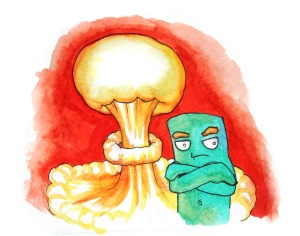
Domination: playing chess with another person or with people as in manipulation. The difference is the dominator has removed the opponent’s pieces without declaring so in the first place.

Intimidation: playing chess with another person or with people where winning and losing comes with either the threat of punishment or actual punishment.

Healthy Relationship: There is no element of either winning or losing; it is not a game. It is free of tactics, ploys, moves, and agendas.


June 20, 2011

There’s yelling, name calling, and pointing……

by Rod Smith

“I’m getting ready for church. He assesses what I’m wearing and suggests a dress he bought me. He wonders why I’m unhappy about it. We get into a fight. There’s yelling and name calling, and pointing. He advances into my personal space. He turns it into me being a victim based on my past. I’m very broken. He also threw out an ultimatum.” (Letter edited)

Destructive exchanges lead couples nowhere worth going. The “thinking brain” shuts down. The “fight, freeze, or flee brain” kicks in, assumes control, and wants ward off the perceived threat. Both people, in the heat of the moment, feel choices are limited and so things to escalate – they fight fire with fire and insult with insult until a domestic war ensues.

While difficult to do, walking away is the more helpful option.

If she’d said something like, “You choose your clothing. I’ll choose mine. I will not fight with you. You do not have permission to ruin my day,” and left for church without him, he’d have had the time and the space to face the unresolved issues that predate his marriage.

Why else would he want to determine what another adult wears?