What’s in your tank? When I see the way some behave I have to ask the question.
Then I find the question coming right back at me when I react to others in ways that are hurtful, even harmful.
What are you running on? Is it regret, remorse, feeling of inferiority and rejection.
Is this why you lash out at others, most of whom you don’t even know?
None of these brewing emotions will get you (or me) very far even if regret and remorse and inferiority seem earned and appropriate. Live like this for any length of time and this toxic mix will return to you from all sides.
Perhaps life has filled your tank with anger, arrogance, grievances and blame.
Running on this mixed up mix may give you a feeling of empowerment but you will never find any semblance of happiness with all that living within you. Such attitudes and emotions will alienate you from others, even those whom you love.
This concoction will burn you and others if you live long enough without imploding or exploding.
May we (you and I) do whatever it takes to fill our tanks with humility and kindness.
Such attitudes and emotions will take us places worth going.
With humility and kindness filling our tanks we will build solid and trustworthy friendships.
I think my disdain for the sheer evil was discerned early on in my military basics when a breath-reeking dirty-mouthed two-striper screamed into my face from such proximity that I could smell and see his back teeth.
Mixing Afrikaans and English he proclaimed with anger that by the time he was finished and done, “finished and klaar,” with me, me specifically, I would be a real soldier, an “ordentlike soldaat.”
He said I would be able to march, not walk, march, in those shiny boots right over my mother’s dead body and feel nothing, nothing at all.
I gathered my thoughts.
He waited.
He expected the routine.
He waited for me to jump to attention and scream, “Ja, Bombardier. Bombardier is always correct, Bombardier,” in Afrikaans.
This response was expected, an individual response when addressed as an individual, or blurted in unison if addressed as a group. There were times it reminded me or 7-year-olds singing their times tables for a teacher.
“Do you know that you are stupid, and you are for nothing good?” would be said to all of us.
“Ja, Bombardier. You are correct, Bombardier. Bombardier is always correct, Bombardier,” we had to reply but in Afrikaans.
Agreement was essential no matter what insults were hurled.
This particular insult, that we were for nothing good, I found amusing. The “for nothing good” is a direct translation from Afrikaans and the bombardier would have had no idea how stupid he sounded in his desire to parade comfort in both official languages.
This time was different.
This was no routine insult.
He was screaming at me about my Mother, a woman he did not know, a woman about whom he knew nothing.
He was addressing me, a man he did not know.
A man about whom he knew nothing.
A man he had spent no time trying to know.
He was shouting so all could hear and be impressed by his evil aspirations with words tailored for me.
I waited.
I did not jump to attention and scream “Ja, Bombardier. Bombardier is always correct, Bombardier.”
I did come to attention and yelled, “Bombardier!”
Then, rather quietly, having now gained his full attention, I told the depraved man, in my faulty Afrikaans, as faulty as his English, that despite all of his efforts, I would indeed never, not ever, not in a thousand years, would I be that soldier.
I talked quietly and I was clear.
The bombardier appeared taken aback that I would dare reply with an unanticipated response.
He backed off.
In his retreat he did not send me or the whole squad running to the fence or make all of us do 30 push-ups. He moved away, stepping backwards, losing eye contact for brief seconds as his eyes darted seeking back-up from fellow bombardiers.
I did not drop my gaze.
I gave him all the eye-contact he ever could want.
Somehow, waiting to reply had knocked him off balance, stopped him in his tracks.
His peers made no moves of support.
He was alone in this and he knew it.
Perhaps it made him think of his mother but I will never know.
A violation had occurred and I refused to cooperate with pure evil.
He kept his distance.
He limited his involvement with our particular squad and seemed to forever regard me with suspicion mixed with a dose of fear and healthy respect.
That’s all I wanted; a lot of respect for my Mother and a little respect for me.
And, I wanted not to be that soldier.
Not ever.
So, I told him.
I wanted him to know I would never be that soldier.
As well-intentioned as we may be in desiring to avoid conflict and “keep the peace,” we create more problems we must face later by running or playing hide and seek. Then, when we do face matters, we’re not the people we once were.
Avoidance is a quick-change artist! It changes us in ways we are likely to regret.
We cannot solve or improve what we will not face. Denial gets us no place worthy of the journey or the unintended, unwanted destination. Until we gather the courage to look difficult situations directly in the eye and expedite what is necessary to face the difficulties, conflicts will stay as they are and they’re likely to deteriorate.
What we avoid shapes us in ways we may never notice. We modify our habits in order to sustain our denial and avoidance. We change our friendships in order to sustain our patterns. We go out of our way to keep the peace but the new path is one to further avoidance. Our defensive habits defend us in unhealthy and unhelpful ways and make us into people we’d rather not be.
Avoidance of necessary battles creates unintended distance from others — even those we truly love.
There is no worthwhile substitute for early honest approaches to family or business conflicts.
Avoidance makes the heart grow harder.
Ours.
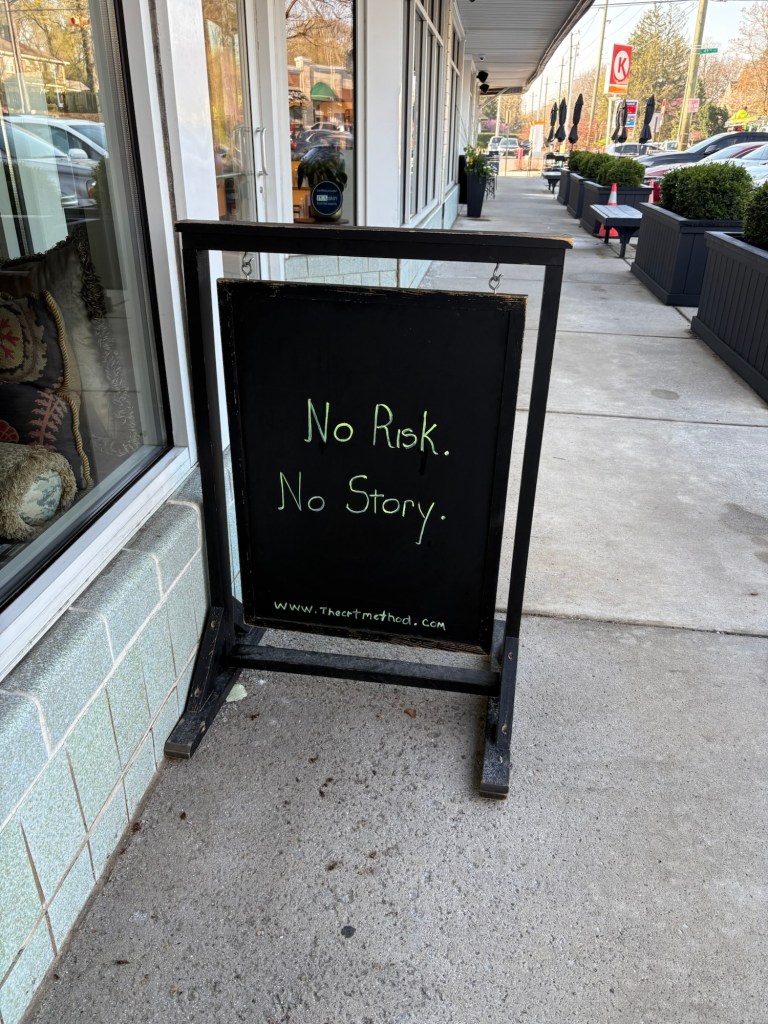
I enjoyed this side-walk art…… 49th and Penn in Meridian Kessler, Indianapolis
I EMPOWER others and myself when I get out of their way and anticipate that they will speak for themselves. I am empowered when I understand and apply the critical distinction between being responsible TO others but NOT and responsible FOR other adults. I empower others when I allow choices and consequences of choices to run their course. I am empowered when I learn to distinguish between helpful pain, necessary, useful anxiety, what to embrace and what to ignore. I am empowered when I work at healthy, necessary separation, even when in love, and even when having strong soul-ties.
I ENABLE others if I lie to cover, run interference, or protect others, in hopes of keeping people employed, protected, or “close.” I am an enabler if I feel overburdened with mis-placed responsibility or rewarded with mis-placed responsibility for anyone. I am enabling others when I feel like I am living more than ONE life. I am enabling when someone’s choices – both good and bad – feel like my responsibility. I am enabling when I am unable to see myself as a separate being from another, and regard the connection as “oneness” or love, a soul-tie, making the enabling crucial, necessary, and somehow inescapable.
Your family – blood-, marriage, relatives-by-choice, adoption, and any other means people become family – is vastly more than a list of people on your group-chat or birthdays to try and remember or the ready-made crowd for weddings and funerals.
The hundreds of links (a family of 4 has 16 relationships) in your network – your family – and how you are linked (just right, over-connected, under-connected, loosely-affiliated, cut-off in anger, the “I’ll never talk to him/her-again” kind of connection) is of crucial importance.
How you are connected will either sustain and support and nourish you or drain and exhaust you. And, there is no escaping. Severe disconnections can wield a driving power even in a so-called non-relationship.
We are all “linked” and positioned in a variety of ways within the same extended family and so a family can nourish and support while, at the same time, it can rip to shreds and bleed someone dry.
I’d like to avoid this dramatic contrast but simply look around — listen to people’s family stories — you’ll see it is so.
We are each integral to the health (and un-health) of our family.
We are each a cell-within-the-whole.
The healthier we are, the more “just right” our connections, the more we will be nourishers and be nourished within the unique group of people we each call family.
The healthier I am will lead to a healthier “we” even if it results in hardship* along the way.
* attempts at greater health will be met with resistance from those around, especially those who’ve “benefited” from unhealthy habits and patterns.
No matter how good or qualified your therapist — therapy will be of no help:
If you’re seeking help with your intimate relationship but you’re living with your mind made up, bags packed, and a heart full of blame and complaints.
It’s therapy, not arm-wrestling.
If you’re having an extramarital affair and you want to improve your relationship with your spouse so your divorce can be cordial.
It’s therapy, not help with deception and manipulation.
If you’re coming to change or influence a relationship you’re not directly a part of, for instance, you want to fix your son’s marriage or you want you husband to call his mom more often.
It’s therapy, not human chess.
If you’re committed to treating your adult sons and daughters as if they’re children and wonder why they resist visiting or phoning you.
It’s therapy, not guilt-tripping.
If you’re hoping for help to change the political views of people with whom you do not agree.
It’s therapy, not magic.
If you want the lazy to be hardworking, the harsh to be gentle, the stingy to be generous, and the unforgiving to find mercy.
Men and women who discover such radical transformation do so because they grow tired of their selfish, rigid, alienating and arrogant ways, and, in humility, find the courage for change.
It’s not therapy, it’s when desperation meets the Divine.
If you fall in love (or are friends) with a man or a woman who reveals having had a very difficult childhood there are a few things of which you may want to be aware.
Keep in mind that I am only one voice in a vastly explored arena. It is usually a good idea to get lots of insights from several sources.
Sad thing is that if you have already fallen in love you probably won’t be looking for help.
If you are, it’s because you’ve already begun to see how tough it is to love tough-historied people. (I rather like my euphemism).
“Troubled” or “unsettled” are pejorative terms.
Avoid them.
People from tough backgrounds can be very exciting, motivated and “world-changing” people.
If you are going to be partners you have to learn and understand what kind of music is playing in their heads and hearts and how they dance to it or turn it up or turn it down or turn it off (if they ever can).
They will often be way ahead of most people in terms of being street wise. They have had to be. They have been watching, negotiating, recruiting, debating and have had to have an eye for undercurrents for so long such behaviors are a way of life for them.
They will usually be cunningly intelligent but also possess zero desire to bring harm to you or others.
More about this sometime….
Artist: Trevor Beach – google him or find him on Facebook and buy his art. The above and another hangs in my office. I enjoy the idea that an artist named Beach seems only to paint Ocean Scenes.
The problem with difficult childhoods in troubled families (pick your conflicts or addictions or stressors or health concerns – or a combination of several) is that children with difficult childhoods have had to dress for self-protection, and, as a lifestyle, have often had to prepare themselves for enduring domestic tensions or wars and regarded it as normal. This is how everyone lives isn’t it?
Once the child becomes an adult its difficult to shed engrained protection measures and essentials and throw off a guarded and conflictual lifestyle even if it’s no longer needed.
Carefree happy children may become carefree happy adults but it’s unlikely a stressed and anxious child will enter realms of stressfree bliss and trusting vulnerability on coming of age.
Adult survivors of difficult childhoods hear things like, “You’re so difficult to get to know,” and “You’re so difficult to get close to,” and “Why does everything have to be a fight?” and proceed with the hard work of adult life that mirrors the hard work of childhood wondering what on earth people are talking about.
************
Unrelated to column: got some new art in our home today: Cameroon artist Patrick Yogo Oumar (see Instagram if interested).
Covering for someone so outsiders do not notice or find out about his or her undesirable behavior (drinking, gambling, addictive habits).
Relaying lies to a workplace – calling in to say he or she is ill when he or she is unable to work because of the addiction.
Permitting, turning a blind-eye, cooperating, letting things go unnoticed to keep the peace or because it feel easier.
Enabling behaviors are often subtle way of disguising who it is in a family who is in need of help. The enabler often appears to be the strong or the healthy one. Control is the name of the game – and family life can feel like one.
Empowering is common in healthy families.
It can involve:
Getting out of each other’s way so people can learn from errors and get credit for their successes.
Allowing natural consequences to follow choices so people can learn just how powerful really are.
Trusting and believing in each other even when things do not go to plan or appear to be falling apart.
Empowered people require the company of other empowered people and all require a strong sense of self. Freedom to discover and to learn are the hallmark of the empowered.
You’ve heard about an adrenalin rush. I’ve seen ego rush. I see it in in groups, teams, and in classrooms. I detect it rumbling in me. Perhaps it’s natural and part of survival.
Symptoms of an ego rush occurring:
Authentic conversation – the give and take and the sharing and building on ideas of others – seems impossible. It’s verbal arm-wrestling or nothing.
Perceived insults, rebuffs, refusals, or dismissals are stored. They lurk in awareness, crouched for attack when the timing is right.
What a person knows must be known and he or she will nudge and provoke until you share his or her belief in his or her superiority.
The ego will win by winning or it will win by losing but humility and backing down are not options.
Actual loss, perceived as humiliation, is temporary – a matter of perception. The “loser” will circle around and get even.
Everything spins around hierarchy and real engagement, the wrangling, is delayed until the hierarchy is figured out.
Conversations are calculated and are a means to advance an undisclosed agenda.
The presence of authentic humility escapes or confuses those caught up in the ego rush as much as witnessing or trying to engage in a conversation using a totally foreign language.





 difficultrelationships.com