There is nothing like a good listener for feeding the soul.
A good listener determines there will be no distractions — no phones, text checking, no dings or app notifications or glances to see the time — and will offer complete and uninterrupted and undiluted attention to the speaker.
A good listener listens, says very very little except may offer occasional brief words of encouragement like “tell me more” or “go back to the beginning if you want” or “go into as much detail as you think will be helpful” or “could you tell me that again so it’s clearer for me.”
The good listener knows listening and any attempts at multitasking — even the most subtle — distract the speaker and obliterate listening. A good listener gets all the potential impediments to listening out of the way before sitting down to listen.
The good listener knows a listener’s inner-noise —- things the listener is refusing to hear or address from within — will emerge and sabotage attempts at hearing others and so addresses unresolved personal matters as much as possible so others may encounter a clear-headed listener.
The good listener does not formulate replies or develop counterpoints while listening and does not one-up the speaker with the listener’s own experiences whether they may appear to the listener to be helpful or not.
A good listener sees, hears, knows, acknowledges the speaker by listening — the most powerful and tangible expression of love.
I devised a list of how to participate in the healing of men and women who have been hurt:
Be willing to listen, even if what is being said is what you’d prefer to not hear. Try not to re-engineer (re-frame, recast) what you have heard so it is more fitting with what you’d really like to hear.
Resist understandable attempts to short-circuit growth by trying to ease necessary pain, by offering false affirmations, and by accepting empty excuses for irresponsible behavior. Pain is a very good motivator for change. Resist the urge to remove it when it appears to be helpful.
Offer your presence, not your answers. “I am with you” is more helpful than “let me help you fix it.”
Welcome silence. There are ways to communicate that do not include words. Resist the understandable urge to chase healing and learning away with the incessant use of words and stories.
Avoid minimizing (“it’s not so bad!”) or rationalizing (“What else did you expect?”) or normalizing (“Anyone would have done that!”) the issues that resulted in pain. Do not rob necessary pain of its usefulness.
Promote “future thinking.” Ask questions focused on future wellness and success.
Try to avoid searching for the genesis (the cause) of what has led to pain. Where something comes from is not nearly as important living your way out of it.
Most USA schools are back in full swing…… at least around here they are:
Hats off……
Hats off to teachers and coaches who love the world and its peoples and whose zeal for both results in empoweing students of all ages.
Hats off to teachers and coaches who love their subjects and sports and whose passion for their work opens vast vistas of opportunities for their students.
Hats off to teachers and coaches who are as tough as nails over matters of integrity but are easy sells when it comes to listening and attempting to understand students and their home-lives, peer, and social struggles.
Hats off to teachers and coaches who know their students well enough to be able to anticipate and address problems before unnecessary escalation.
Hats off to school administrators who have the courage to support teachers and coaches in the face of often difficult parents and who have the courage to listen to all parties before they act.
Hats off to school administrators who aspire to serve rather than be served, who understand the power of humility, and who see their essential role as empowering coaches and teachers and students to get the very best from each other.
Hats off to parents of students who seek to respect and learn from their children’s school teachers and coaches and administrators rather than demand rights or seek to chastise or correct.
Hats off to Librarians, Musicians, Counselors, School Security Teams….. and all who work daily to keep our students motivated, kind, and safe.
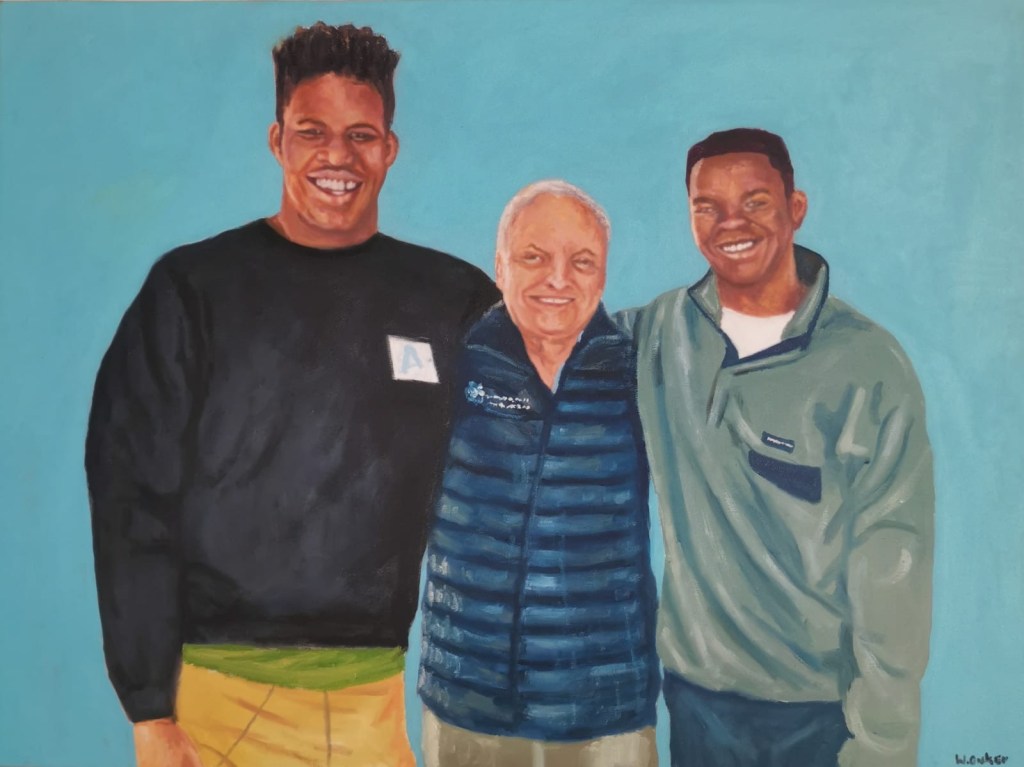
Andrea Neal, Jay Sherrill and so many others who regarded Thulani and Nate as their own.
“Now what would Jesus do?” asked the woman glancing at her WWJD bracelet.
“Grape nuts,” replied the companion, as if he’d served Jesus breakfast that morning. I slipped away pondering how the will and the ways of the greatest political, religious and social reformer of all time got reduced to a formula for grocery shopping.
What Would Jesus Do is a great question to ask, but wearing it on a wrist somehow suggests that the answer is easily accessible. It suggests that if you and I will simply stop and think a little, having eyed the bracelet, we’ll get the answer. Then, as we act on our newfound knowledge, predicaments will be resolved, we will have better lives, and conditions in the world will improve all around for everybody.
Quite the contrary: Answering the question and doing what Jesus would do in any situation is neither easily established nor executed. Finding the answer itself would take a lot of work, like tunneling back though a couple of thousand years, researching culture, geography and weather conditions and the varying political and religious climates. Then we’d have to identify, and then decipher, metaphor, understand and interpret tone and intent, humor, and immerse ourselves in at least a few ancient languages. Besides all this, we’d need a working knowledge of the subcultures and the prejudices that existed within those subcultures. Then, with all this done, we might be able to decide what Jesus might think, might say, might do, given a few, but not all, situations we face.
The next challenge, once we’ve established the answer, would be to have the courage to do what Jesus would do. WWJD is not about “doing the right thing.” Jesus did not always do the “right” thing. If that were so, no cross would have awaited him. Doing the “right thing” would have endeared him to those who mattered and would not have required him to buck Rome and the Temple authority.
Essentially Jesus laid a platform for his followers to live differently, in ways that set both the religious establishment and Rome against Jesus and those who followed him – embracing Samaritans, making a Samaritan the hero of a parable, illustrates this. That alone was enough to put a target on his back. It doesn’t take too deep an analysis of the Gospels to see that he despised pretentiousness and empty religious “performance” and was particularly vocal wherever he found religious zeal devoid of inner transformation. Jesus despised abusive systems and was a particular critic of those who ripped others off. So now, where will you bank, shop, invest, give, worship? How will you vote? How will our practices change were we to take WWJD seriously?
I do not think Jesus cares what cereal you buy, what dress or suit you wear or how your hair is or is not cut or if you wear a hat to church or not. But. I do believe he cares about what kind of people you and I are and whether we love mercy, humility, truth and justice. I believe he cares that we challenge systems where these qualities are absent. I do think Jesus cares about what motivates you and me. I do think he cares about how we treat the poor, the homeless, the disenfranchised. When we (you and I) elevate the rich and show contempt for the poor we get his goat.
It is apparently forgotten that Jesus was hardly a nice guy. Today he’d be a threat to our political order and might not be able to find a church he’d attend, let alone one that would permit him to preach! Consequently, doing what Jesus would do could significantly reduce our popularity rating.
The real question, by the way, is not “What Would Jesus Do” but rather what will you, what will I do, in response to what he has done?
It’s not grape nuts or cheerios, but love, mercy, humility and justice that may bring us, yes, you and me, all a little closer to reflecting who and what Jesus was and is. But be careful, you might shed the WWJD bracelet and exchange it for a cross – and it won’t be hanging around your neck.
————
* When published in The Indianapolis Star, this column certainly got me some fans – and enemies. The morning it appeared my email was as hot! I was called brilliant, I was called stupid. One reader said that finally he’d read something by an intelligent Christian about a really stupid gimmick. Another said he’d be praying for my salvation even though he was convinced I was a lost cause.
———-
Unrelated image…. Meditating a moment in an Havana Art School
I saw Santa at the Children’s Museum with a feather of a child pleading her case. They were locked in discussion, a confessional of sorts, as she entered into detail of her every Christmas wish. Hands, eyes, and all of her face enticed Santa closer lest he miss a detail living so clearly in her head.
“Oh, you want, oh, I see it. Why yes, of course. Perfectly,” Santa said, his voice tapering off into her ear, “I will see what I can do about that.”
Then she nestled into his side, her shoulders comfortably enveloped by his plush red suit as if to declare her mission accomplished. He was a perfect depiction of everything I imagined him to be and the sight easily immersed me in the voices and music of my own Christmases past.
Santa came all year round to our home. I’d look through the window in April or mid-August and Santa would be strolling up the driveway on his return from visits to every home on the street. He’d be wearing dad’s shoes and one of his ties underneath the tatty red coat, but I knew better than to expose his identity. I wanted to believe in Santa and he in turn needed me to believe. Such faith had rewards. I knew better than to dash my own hopes. I wasn’t ready to lose my trust in Santa for anyone and certainly not by my own hand.
He couldn’t resist visits to the whole neighborhood and would drop in from time to time and inspire children toward good behavior, perfect obedience at school, and remind them to count their blessings one by one. At every appearance in our home we’d sing “The Little Boy that Santa Clause Forgot” and we’d all have to cry. He insisted on it.
The lines “he didn’t have a daddy” and “went home to play with last year’s broken toys” really got us going.
It was clear he sang to all the children of the world who’d had to skip childhood and who had known poverty; children who’s fathers had gone to war or whose fathers or mothers had fled their families.
Donning the suit, surprising the children, was our Santa’s way of making the world right.
His visits created intrigue in the neighborhood, and to every child he repeated the promise that this Christmas, no child on this street would be forgotten. As far as I could tell none ever was.
The last Christmas we had together was in August of 1994. We were riding in a car and in the curves of Bluff Road when spontaneously he began to sing, “Christmas comes but once a year.”
The car became a holy place as I heard once more of the boy who “wrote a note to Santa for some soldiers and a drum and it broke his little heart to find Santa hadn’t come.”
The tears we both shed required no encouragement for we both somehow knew this would be the last time he’d sing this nostalgic hymn.
Now this old song is top of my list of Christmas songs.
The melody emerges randomly in my awareness, most particularly when faced with children who are in need. I have had to silence it at all times of the year.
It was the little girl’s confidence, Santa’s grace, and the loving parents looking from the side that caught my attention last week. She touched his flowing beard and told him her every Christmas dream and I found myself listing my own requests with childlike zeal.
It gave me renewed hope that you and I, the real Santas of the world, could deliver a more hopeful tomorrow for “those little girls and boys that Santa Claus forgot.”
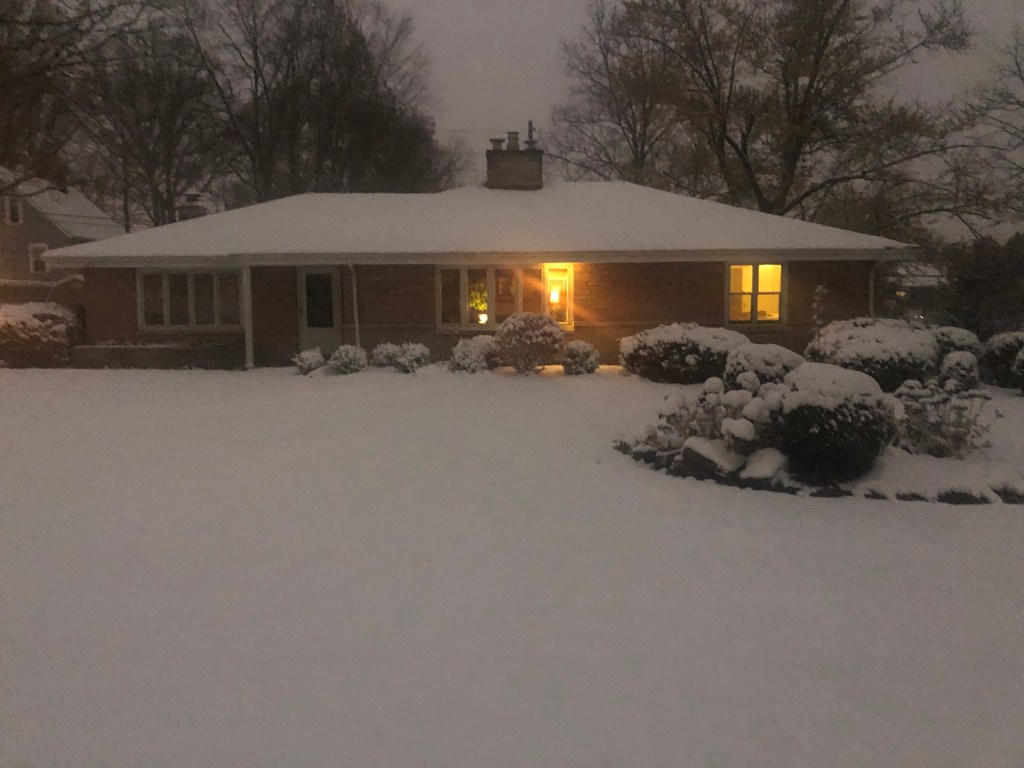
(First published, December 9, 2000, Indianapolis Star) ———— Our home this evening….
Definitions vary, but people usually want to be emotionally healthy, or moving in that direction.
How about some tangible goals displaying emotional wellness?
The emotionally well person is a self-starter who is inner-driven and internally-steered. She uses pre-established principles and boundaries to make decisions and is not usually externally steered by family, friends or fads.
The healthy person is no blind follower and nor is he “flying by the seat of his pants.” Even at his most spontaneous, he is living his pre-established principles and goals.
She loves her family but acts as a separate person when necessary and, when necessary, she is able to make unpopular decisions.
He sometimes chooses to spend time alone, time to think, plan, read, write and pray.
He is quick to forgive almost everything but learns to modify or manage trust. He understands that forgiving doesn’t necessarily mean forgetting although there are times and circumstances when it does.
Emotionally well people are able to “hold onto themselves” under pressure and do not lash out or blame others when things go awry.
Emotionally well people are comfortable with their status in life and thus able to impart calmness and comfort to those who appear to be on a constant treadmill in pursuit of wealth, success, or recognition.
“Living from within” can appear as arrogance to those who are tossed and turned by trends and fashions.
In a world of chaos and discord may you and I be part of the solution and not part of the problem. May we not fuel fruitless discussions but rather attempt to be agents of calm and sound reason.
In a world of selfishness and greed may you and I find it in ourselves to be self-aware and generous. May we assist when possible and necessary but may our help be carefully considered so that it is authentic, helpful and empowering help.
In a world of indifference and frequent contempt may you and I be engaged with others and accepting of others. May we learn the art of seeing, validating, and hearing people and loving those whom we may have formerly regarded with indifference had we noticed them at all.
In a world where many people are demanding and entitled, may you and I learn when to give way, to accommodate, to compromise, to yield, and when to stand firm. May we learn the art of repeated healthy responses to unhealthy expectations.
In a world of sarcasm, hurt and rejection may you and I represent hope. May we be people of healing and listening and grace. May you and I learn how to be safe people in an unsafe world.
The soul – enigmatic, yet so incredibly powerful – is what brings to life, and is the essence of life, feuling and energizing an inner-being. We may refer to a young person, even a toddler, as an old soul and we know the toddler is, as many toddlers are, or appears to be a deep thinker. We may say a spritely person of advanced age is a young soul and we ready ourselves for an elderly person with a spring in her step or a youthful inside. Soul is often packaged with a prefix: broken-, angry-, critical-, abandoned-, creative- and all reflect on an inner-condition.
The Soul is the Person housed in flesh and bones; pulsating immortal vitality ferried, decade upon decade, within the mortal corpus, while not limited to it or by it.
May I illustrate? As I write my soul is reaching out to your soul. Hopefully our souls are connecting right now as you read. I have no idea where you are but I assure you, my soul is firmly here with me while simultaneously seeking to reach you and be received and embraced by you.
I hope it does, and is.
It has happened before.
I know it occurred through the thousands of newspaper columns I have had the joy of writing and hearing in return from many readers.
The soul is the spark of light within that lights up the eyes – eyes which will cease to ignite (yours and mine) once the soul is freed from the body, a body that, for whatever reasons, can no longer house or contain it. On this side of life we have named this moment of release, rather unfortunately, death. Perhaps, rather, it’s a new beginning, a refreshing adventure of deeper love and deeper companionship than any of us has ever before known, and it’s not death at all.
That’s my belief.
Installed, divinely imputed and imparted, at the milli-moment of conception, itself also learning, the soul begins immediately, within the womb, to impart strength and resilience into the made-from-dust flesh-and-bone outer form. Soul-power sweeps into the body, bringing with it a life-time’s worth of the capacity for love, a life-time’s worth of the desire for survival, a life-time’s worth of joy in human connection. It imparts to the physical being, an enduring and innate urge for worship, and a compelling desire to impact the larger environment and leave behind a beautiful and substantial legacy.
You and I are not limited to our physical bodies and I do not mean some outer-body experience, well, not exactly. It is much much more than about my soul reaching out to yours.
When we write, paint, sculpt, love and rear (raise) our children, adore our grandchildren, and enjoy great-grandchildren; when we arrange flowers, build skyscrapers, plant vegetables, light birthday candles for 3-year-olds, leave fortunes to find cancer’s cure, we are gathering the best of our pasts and throwing our souls into the future.
Generations yet unborn will know our departed souls:
They will know who we are from the stories told by those whom we have loved.
They will know who we are from what we have written.
They will see what we have painted, sculpted.
Our handiwork and heartfelt work, our generous love and nurturing gentleness will live on, revealing the power of our souls long after the fuel of our inner-being has escaped our aging, dust-to-dust, ashes-to-ashes bodies, the whereabouts of our remains marked with a stone or a plaque, and our souls have returned to the Place from whence they came.
So? Write it (whatever it is). Record it (whatever it is). Say it in poetry, with colorful paints on paper or on canvas. Write a book, gather photographs, place them in an album. Dance it (whatever it is). Sing it. Declare it, while you can.
You’re seeking a soul-mate in a great-great-grandson yet unborn.
When he is old enough to understand what you have created for him – your name signed at the end of a love letter or your family name on a high-rise research hospital – he will appreciate it and you will be generational soul-mates.
You may have noticed a certain keenness and sharpness within your soul, a sharpness and keenness that may far outpace the keenness and strength of your body, even your intellect, mind, memory. Perhaps your soul is more aware than you may think and knows it is teetering on inevitable escape, in a year, or three, or more. This is why this is as good a time as any to dance, to sing, to declare, and to do so while you can, however you can, ……. when you can.
Your soul is intricately invested in beauty and in your life’s legacy.
Reach for the diary, the photograph album, the compendium of letters your grandparents or great uncle or favorite aunt left to you and allow those precious souls – now adventuring or resting paradise – to speak to you anew across generations, and then, via you, let them, too, continue to live in the generations yet to come.
We are holding hands, not across a mere oceans, not across mere time zones, but with the generations, past and future, and so, let’s Do Like David did – DLDD – and let everything that has breath (life, soul, energy) Praise the Lord (Psalm 150:6).
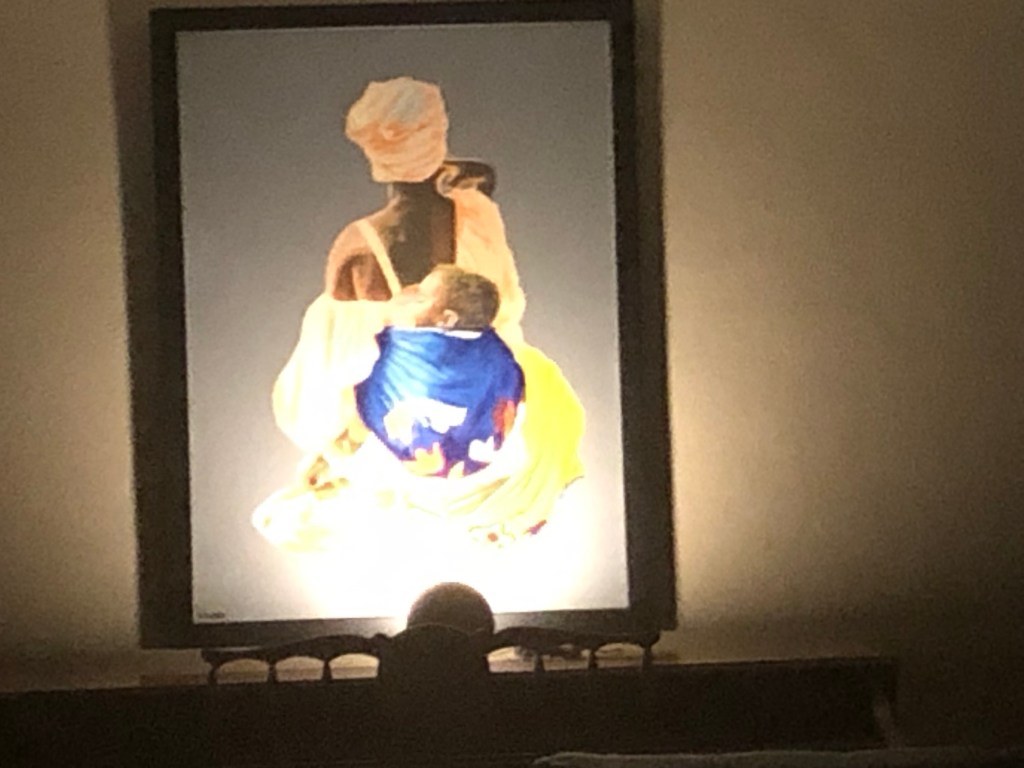
One of my favorite paintings — I keep it illuminated 24/7/365 to remind me ever of the women who made me a dad — and sent my soul soaring.
“What parenting advice could you offer my wife and me,” said the delighted dad, “my son is 16 months young.”
Above all, love your wife with joy, freedom and courage. This will reduce and deflect loads of the anxiety that naturally tries to derail all childhoods.
Lavish your baby, then young child, then pre-teen and teenager with affirmation and affection. No matter what you and your wife face, when you come home from work, or he returns after time away, or when he wakes in the morning or in the middle of the night — baby or teenager — be glad to see him, and, say so. Verbally express the joys your son brings you, to each other, and to him.
Teach him to talk Joy.
Regard the ages 5, 8, 12, 14 and 16 as transition ages. At these times discuss with him your parental plans (your mutually agreed upon plans you’ve made as parents) to do less and less for him, while expecting more and more from him. Yes, even at 5 — point out that he can make his own, age-appropriate decisions. Include him in planning and establishing his growing independence. Plan your parenting so that by his eighteenth year your parenting roles are accomplished and he has all it takes to be an interdependent young adult.
Hold in high regard the beautiful idea that you parent (the verb) for his sake and not yours.
Our new painting will go up in my home-office this week….. from Friday this week, both of my adult sons are launched and living independently of me. Oh the joy; oh the niggling pain. #graceupongrace
I want to LISTEN as if I am studying fine, complex, beautiful art, a masterpiece, rather than as if I’m engaged in a hard game of competitive verbal tennis.
I want to listen as one who has much to learn rather than hide behind a secretly held belief that I’m the one with much to teach.
I know arrogance neither hears nor listens well, or accurately, but hears what it wants to hear. Arrogance reshapes what’s said into what the listener wants to hear or wishes was said.
I know that if I think I’ve “heard it all before” then I’m not listening.
Listening, really listening, can open new worlds for those who speak and those who listen and lead both down a path of brave discoveries. It’s a risk both parties must take if their communion is to improve.
I know the loving listener listens to what is said, listens to what is unsaid, and does so without rearranging either.
The authentic listener is capable of leaving the world of another admired and untouched – no matter how beautiful or how troubled that world may be.




 difficultrelationships.com