Loneliness is multifaceted, comes in various strengths, flavors and shades, pastel and primary.
Not all forms are negative, require therapy or can be “fixed” by having someone pop in.
Your (my) unique blend is best embraced.
Denying or rejecting it, over time, will cost you. Identified and embraced they (the many forms of loneliness) proffer opportunities for learning, opportunities for grace, for reflection. They provide a springboard for diving inward, for self-assessment. Do it well and you will be able to say with Psalmist David, who more than glimpsed within himself and was able to proclaim that he was “fearfully and wonderfully made.”
Rejected or denied, it will surface as thick-skinned crassness, emotional plaque, relational arthritis.
Unaddressed loneliness will transform into stones of self-righteousness even the hardened pharisees could not bring themselves to hurl once they self-assessed (dove inward) and saw themselves reflected in the eyes of the adulterous woman of John 8.
Loneliness, in some forms, comes in time to all of our lives, acknowledged or not. Some live with it for years, and years, and years, turns them (us) into cynics and comedians and adult class-clowns, and mean politicians, devoid of empathy. It will turn you (and me) into that person whom you sense you can never really get to know.
Not all forms of loneliness are painful. Some are stunningly beautiful.
Everything pivots on how we deal with our unique blend of loneliness or permit it to deal with us.
My beautiful home is empty of my sons. Each has moved into adulthood and has a significant relationship and a career and a full life of his own. Both men earn their way, love their partner – one being a wife. Each son is becoming more and more proficient and involved in his career. I rejoice that they are men of substance, people of character. I rejoice in their accomplishments. I celebrate their absence. I rejoice in their fullness of life (and even their expected struggles) they’re enjoying beyond this house, this address, this zip-code. The now-vacant domestic territories which were theirs in our shared home leave me room for the quiet joy of mission accomplished. Their absence, the alone-ness I feel, thrills me. I love it when they visit. I love it when they stay overnight, I love it when they call as they do usually several times a week. But, I’m really glad they don’t live here anymore and I know they are, too.
There is the loneliness of effective leadership.
Give yourself a few minutes and your mind will flood with the men and women whose leadership cost them everything, shaped the world as we know it. Their stands, opinions, decisions, also rewarded them with lives of isolation and pain as they made decisions popular and unpopular. They knew it came with the role and did it anyway. Great leadership (of nations, little-league soccer, city hall, the school board, your HOA) will give authentic leaders lasting tastes of life’s beauty and brutality, the inseparable rewards and “punishments” (sometimes even death) of sound and moral and courageous leadership.
There’s loneliness that comes from being in a crowd.
Most of us experience this and accommodate it when we do. It’s hard to sense we belong in some circles, because…… well….. we don’t. Nobody fits everywhere. (Beware if you do.) Where you don’t (fit) aloofness may travel in all directions, toward you and from you. These times are usually short-lived. Most of us accept and understand this kind loneliness can usually politely escape it if necessary.
Perhaps the hardest of all forms of loneliness lodge within the wake of significant loss.
Where there once was somebody, somebody whom we loved, somebody with whom we shared life, someone with whom we shared decades, who’s gone. Then, there is the loneliness that comes from indifference: the I-don’t-care-if-you-live-or-die loneliness, the severest cut of all.
You will find the best in others ……. if you look for the best in others. I refer to the best in others as their gold. It’s generosity, kindness, wholesomeness, creativity, and friendliness. These qualities live within all others (no exceptions). Such gold is available to be found. It comes with the human package.
There’s only one condition.
You have to be willing to acknowledge that there is gold within you and be willing to find it within yourself first before you will be able to see it in others. It may be hiding behind the shame and guilt and honed skills of deception you have had to download for protection and survival.
I am aware that “comes with the human package” is quite a claim.
Some will doubt. They will tell stories of those whom they found to be no-good to the core.
The gold within some is easy to find – not too much digging required.
For others it can be deeply buried in shame, humiliation, guilt, deception and in a belief that cruelty or violence or deception are, or were, necessary for survival.
“No-good to the core” has its reasons, its history.
But, the gold is still there.
It cannot be eliminated.
Given time to be heard, time for trust to build, time to tell his or her story, I know that who some regard as the worst of humanity are often bearers of the purest of gold.
The Mercury (this begins my 25th year of Monday to Friday Mercury columns)……..
It is a die-hard custom for columnist to “reflect” on the past year. Here are broad principles I have found to be true. I hope, readers in Southern Africa and elsewhere, that you will share yours with me:
Life is simultaneously beautiful and brutal. It is wiser to embrace both as fully as is humanly possible. Attempting to reject life’s inevitable brutality seems to delay deep appreciation and awareness of its beauty.
Generosity, kindness, openness to all others are more powerful than any politician or army.
My enemies unknowingly serve me, make me think, make me honor my life with greater effort and dedication. Thank you. I owe you. I long to repay you with grace, respect, and honor.
If I think my sons and their friends cannot teach me anything I soon discover I indeed have a lot to learn.
The most difficult people, the most demanding clients, the most trying customers, are those who offer me the most powerful opportunities to grow, learn, and exercise love and grace.
People do what they want to do. No finely designed intervention or battery of therapeutic skills can stop a person doing what he or she really wants to do.
The minute I blame anyone for anything, I regress. The minute I take responsibility for myself, I grow.
Learn the ART of living fully in your own head, and only, in your own head. Think for yourself. Try not to interfere when others think for themselves even when they express thoughts you’d never think. It’s allowed. MINDing yourown business, avoiding crossovers, is a crucial and necessary art in the empowering business. Like everything, it begins at home. Your spouse, adult sons and daughters, your parents, all the adults you know have unique brains capable of their own thinking. You may find this harder than it sounds if you are accustomed to living in multiple heads other than your own, and in yourown.
Why is this important? It’s fundamental to trust, growth, respect, equality, mutuality and all those good things. I’d suggest it would be highly disrespectful of me to assume I am better at doing your thinking than you are at doing yourthinking. If I focus my mind on my business and trust you will do the same, the meeting of our minds has the potential to enhance both of us. Conversely, if every time we talk or spend time together you cross over in my head it is likely much of my energy will be spent, not in thinking and exploring with you, but in attempts to safeguard my head-territory.
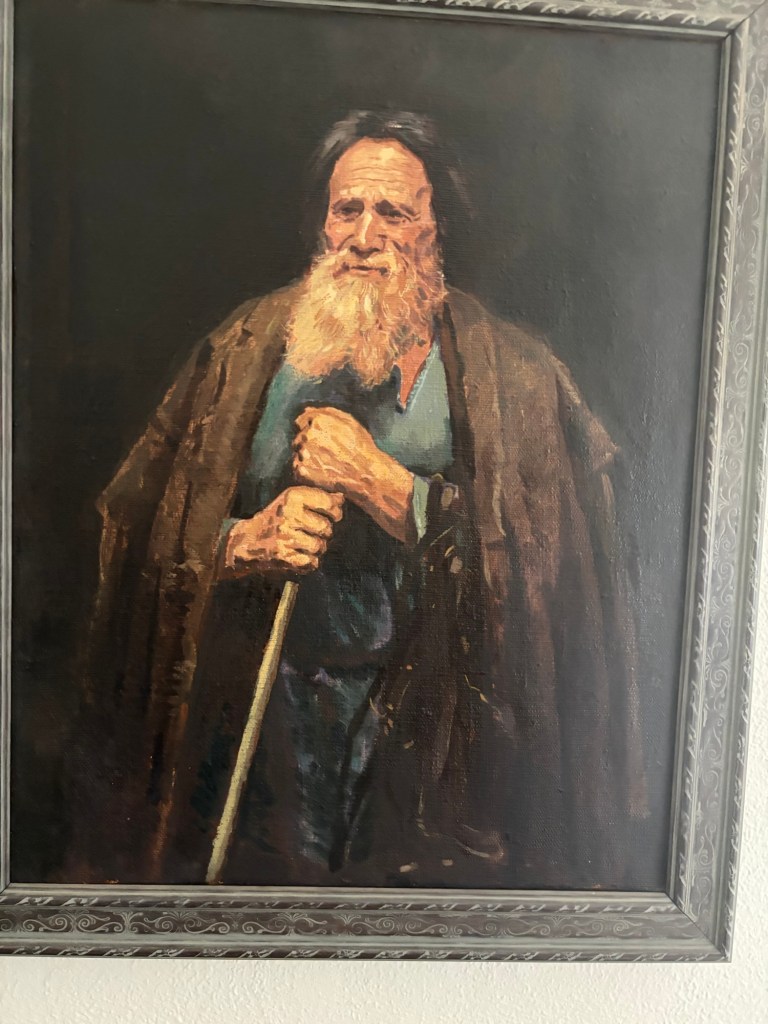
One of my very favorite pieces of art. It’s from Gorky Park, Moscow. Street artist — 1992.
Allow yourself to experience your emotions – even the extremes. Don’t cover or hide from your grief. If you are feeling joy, express it. Avoid constructing a wall or barrier between you and your emotions. The day may come when you cannot see over the barrier, let alone climb the wall.
Take time to hear as many “sides” to every story. Don’t rush to judgment. There are usually 7, 8, even 10 sides to every story. Hear them all. Things are often not as they appear. Listeners take all the time needed to hear things out.
As far as you’re capable, go back and make right where you have failed. Often, this may be impossible. Make a list of your regrets, determine never to move in those directions again. Learn, recover, learn recover.
Even if it’s not in your usual habit, try to talk more to people you care about about the things you care about. Don’t rehash hobby horses. Let people into unexpressed parts of your thinking.
Notice your indifference. This is where you’ve been unmoved, unaffected, by things that ought to move everybody, ought to affect everybody. Allow the world about you, near and afar, to have its impact on you.
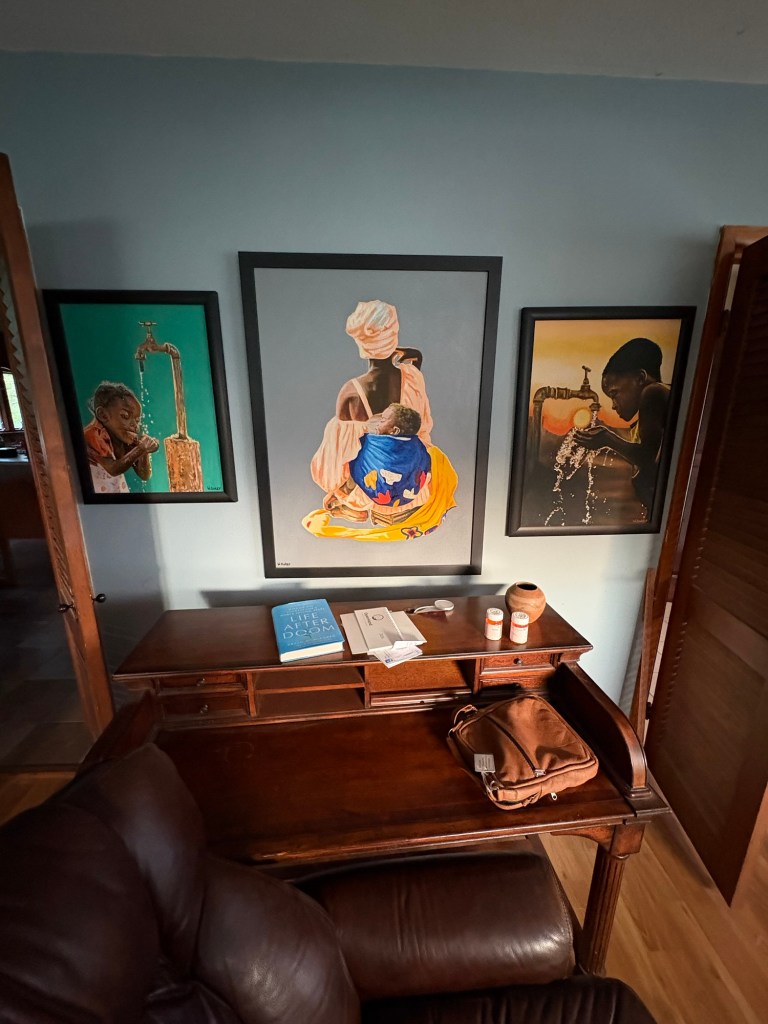
One corner of my home office……. you’re welcome here.
There is nothing like a good listener for feeding the soul.
A good listener determines there will be no distractions — no phones, text checking, no dings or app notifications or glances to see the time — and will offer complete and uninterrupted and undiluted attention to the speaker.
A good listener listens, says very very little except may offer occasional brief words of encouragement like “tell me more” or “go back to the beginning if you want” or “go into as much detail as you think will be helpful” or “could you tell me that again so it’s clearer for me.”
The good listener knows listening and any attempts at multitasking — even the most subtle — distract the speaker and obliterate listening. A good listener gets all the potential impediments to listening out of the way before sitting down to listen.
The good listener knows a listener’s inner-noise —- things the listener is refusing to hear or address from within — will emerge and sabotage attempts at hearing others and so addresses unresolved personal matters as much as possible so others may encounter a clear-headed listener.
The good listener does not formulate replies or develop counterpoints while listening and does not one-up the speaker with the listener’s own experiences whether they may appear to the listener to be helpful or not.
A good listener sees, hears, knows, acknowledges the speaker by listening — the most powerful and tangible expression of love.
I devised a list of how to participate in the healing of men and women who have been hurt:
Be willing to listen, even if what is being said is what you’d prefer to not hear. Try not to re-engineer (re-frame, recast) what you have heard so it is more fitting with what you’d really like to hear.
Resist understandable attempts to short-circuit growth by trying to ease necessary pain, by offering false affirmations, and by accepting empty excuses for irresponsible behavior. Pain is a very good motivator for change. Resist the urge to remove it when it appears to be helpful.
Offer your presence, not your answers. “I am with you” is more helpful than “let me help you fix it.”
Welcome silence. There are ways to communicate that do not include words. Resist the understandable urge to chase healing and learning away with the incessant use of words and stories.
Avoid minimizing (“it’s not so bad!”) or rationalizing (“What else did you expect?”) or normalizing (“Anyone would have done that!”) the issues that resulted in pain. Do not rob necessary pain of its usefulness.
Promote “future thinking.” Ask questions focused on future wellness and success.
Try to avoid searching for the genesis (the cause) of what has led to pain. Where something comes from is not nearly as important living your way out of it.
Most USA schools are back in full swing…… at least around here they are:
Hats off……
Hats off to teachers and coaches who love the world and its peoples and whose zeal for both results in empoweing students of all ages.
Hats off to teachers and coaches who love their subjects and sports and whose passion for their work opens vast vistas of opportunities for their students.
Hats off to teachers and coaches who are as tough as nails over matters of integrity but are easy sells when it comes to listening and attempting to understand students and their home-lives, peer, and social struggles.
Hats off to teachers and coaches who know their students well enough to be able to anticipate and address problems before unnecessary escalation.
Hats off to school administrators who have the courage to support teachers and coaches in the face of often difficult parents and who have the courage to listen to all parties before they act.
Hats off to school administrators who aspire to serve rather than be served, who understand the power of humility, and who see their essential role as empowering coaches and teachers and students to get the very best from each other.
Hats off to parents of students who seek to respect and learn from their children’s school teachers and coaches and administrators rather than demand rights or seek to chastise or correct.
Hats off to Librarians, Musicians, Counselors, School Security Teams….. and all who work daily to keep our students motivated, kind, and safe.
Andrea Neal, Jay Sherrill and so many others who regarded Thulani and Nate as their own.
Israelite-Nathanael gets an invitation to meet Nazarene-Jesus and responds rather snarkily:
Can anything good come out of Nazareth?
This exchange, recorded early in the Gospel of John, intrigues me and, as a result, I’ve always loved the person and name Nathanael.
He questioned, appeared playful and unintimidated.
On meeting, Jesus greets Nathanael by name, interprets his name, tells Nathanael He had seen him before Nathanael was aware of being seen by Jesus.
In modern parlance Jesus saw through the Israelite, welcomed everything about him, called him into a life-changing journey and Nathanael readily responded
Nothing takes the Son of Man by surprise: Jesus saw Nathanael coming and New Testament Nate more than met his match.
Jesus saw my Indianapolis-born son coming, too.
I didn’t. I had to decide blind.
Privacy laws permitted limited information – African American Male, Date of Birth, Full Term – was all I could know.
Pondering names for my son, whom I was yet to meet, the no guile or nothing false in Jesus’ description of Israelite-Nathanael wrapped it up for me.
Enroute from the courthouse to the hospital, custody papers in hand, with a stop at the K-Mart on Lafayette Road to pick up a few baby-essentials, I named a baby and formed a living link with a favorite character from the New Testament.
“Thula, Thula” I’d sing, following the maid around the house as she sang the prayerful lullabye. I could be on her back, tied with a blanket, listening to the Thula Thula song. The song was about a child urged not cry because the father will soon return from work on the gold mine. The song soothed and reached deeply into me, especially while tied to a maid’s back. There was not safer realm. Theres was no place warmer or more comfortable.
At 10 or 11 years old I learned from teenage boys and men named Thulani who came regularly into our dad’s tea-room the name means peace and stillness, to be quiet and comforted.
Temba means hope.
It is the name my adult Zulu friends called me once I reached adulthood and tried to unlearn so many things of childhood.
Although no one said it or taught it, I learned not to reveal excessive interest in the lives of the young men who came daily to the shop but rather to proffer indifference. I knew I was not to walk to the street corner too often in the evenings where they played lively music on guitars, hand made from wood attached to emptied cooking oil containers. No-one had to tell me of the barriers that came with my whiteness. I knew I was not to enjoy watching the young men dance and smoke the loose cigarettes – purchased from me at the tea-room, 2 cents each for unfiltered Lexingtons and 3 cents for filters – and laugh and rough-house bare foot on white suburban corners. The kitchen-boys’ or garden boys’ uniforms, white coarse red or blue trim v-neck shirts marked them legitimate workers in white suburbs even until late at night or at least until dad’s shop closed at 9.
They’d drift off to a concrete block room at the farthest corner of the yard of the property where they worked. The young men washed their master’s car and weeded the master’s yard, helped The Girl in the kitchen. I learned, although no one taught it or said it, to hide my interest. I wanted to join in and enjoy the lively music and playful antics and raucous laughter and the loud conversations which I could not understand.
But, I learned, although no one said it, to turn my desire to belong into a supervisory stance or glare which carried censure of the noise made by African young men in our white neighborhood where they were fortunate we allowed such antics.
Thulani and Temba were embedded into me by women who were our maids and who most certainly but unknowingly provided complete comfort, peace, solace for the living load tightly strapped to her body, riding her back and, everything I ever wanted for my infant son was provided unintentionally for me some 40-something years earlier when they sang his name.
“Choose something easier. Something American,” said a friend, “no one will remember it.”






 difficultrelationships.com