February 25, 2010
by Rod Smith
“My son (16) has from very young displayed the most unvelievable stubbornness on some issues. We have come to understand it as being inflexible explosive behaviour that it is incredibly difficult to work with. Usually there is a pattern and there are times when one is able to reason and resolve, other times there is no warning and the explosion or meltdown occurs. It is usually because he has not been able to get his own way despite our explanations. He indulges in defiant behaviour such as in this last instance, staying his bedroom for 25 hours and sleeping most of the time. Upon arising my attempts to talk to him are met with a blank. How does one handle someone who resorts to defiant behaviour when he doesn’t get his own way? I believe it is time for him to find alternate, more mature ways of dealing with issues – or am I expecting too much from a 16 yr old?” (Edited)
While I could say “take him by suprise” or “change the rules” I am going to resist suggesting the solution is easily found. He sounds depressed perhaps relating to some broader matters. I am hereby asking readers to express their opinions and experience before I tackle your question again in a few days.
Yesterday’s column clearly hit a hot button. Here are two of may responses…
“I was amazed at the description of the stubborn 16 year old. It could have been a description of a family member of mine who has been diagnosed as depressed. For a long time we all thought it was purely a self-centred nature or a short fuse. Based on learning the hard way my advice to the parent would be to stand up to his behaviour. If an explosion occurs walk out of the room. Do not try to reason or explain. Being depressed does not give anyone the right to abuse others. The depressed individual is quick to see a pattern forming: ‘If I have a tantrum everyone will do as I wish, out of fear, or just to keep the peace.’ If you fall into this trap you are setting yourself up for much misery and are not doing your depressed family member any favours by playing to their brattish behaviour.”
“My first impression was that the boy suffered from a lack of discipline. However, the problem appears to have existed from a very young age and appears to be a more deeply rooted problem. If I was in the shoes of the parents I would consult a psychologist/psychiatrist as Bi-polar comes to mind.”
One reader’s view regarding the defiant 16-year-old….
“The story of the stubborn, defiant 16-year old makes me smile. The mother has waited 16 years too long to start disciplining her son. One of my daughters had this same strong will, it was not an iron will, it was stainless steel! Her first few years made life very difficult for us, until I started reading books about the strong willed child. When she was old enough to begin understanding that her tantrums were not acceptable we began teaching her. Whenever we told her to stop whatever was unacceptable, and when I counted to 10 and she did not stop I would give her a smack with my wooden spoon on ‘the seat of learning’. After about 6 weeks the truth sank in, and I only had to warn her: the wooden spoon treatment became now very rare. She grew up into a delightful woman. The Bible tells us to spare the rod and spoil the child. Unfortunately this has now become forbidden in many countries.”

Rod Smith, MSMFT
your experience ends happily. I’d welcome a comment from your daughter whom you say is a “delightful woman” – and hear her comments on your discipline.
I fear she might be too afraid to tell her truth.
Posted in Adolescence, Differentiation, Difficult Relationships, Family, Parenting/Children, Teenagers, Triangles, Triggers, Victims, Violence, Voice |
Leave a Comment »
February 20, 2010
by Rod Smith
“I have a daughter (5) and I have been with my partner for over a year. My daughter stays with her grandparents during the week to help me with gas. My partner does not work and I pay all the bills. He gets angry with me because he believes that I do not hold my daughter accountable. I don’t hit my child but I do talk to her so she has an Rod Smith, MSMFT
This will go nowhere worth going for you until you love yourself more than you love your daughter and you love your daughter more than you love him. I’d suggest you devise an immediate escape plan. Your daughter, not this manipulator, is your responsibility.

Jean Hatton
‘held accountable’ is a good idea, but not concerning him. I would ask you to consider that you have brought this man into your home and by so doing, have put yourself and your daughter’s well being at risk. It sounds like he has done nothing but add stress and guilt to your life as he makes demands on you to keep him happy. Loving your daughter is your priority. Be accountable for the decision that you made to bring this angry controlling man into your lives — and choose the healthy way out.
Posted in Attraction, Betrayal, Boundaries, Children, Communication, Differentiation, Difficult Relationships, High maintenance relationships, Manipulation, Marriage, Parenting/Children, Re-marriage, Triangles, Triggers, Trust, Victims, Violence, Voice |
2 Comments »
October 26, 2009
by Rod Smith
“My son (12) and my daughter (14) don’t like their stepmother but when they play their cards right for her she buys them stuff. I don’t like to see my children manipulating to get things from her. Should I step in and say something? We are not really on good terms with each other.”
Let then be...
that the challenges I will place before you are most difficult to achieve – but I repeat: parenting is for grown ups; successful co-parenting is for saints. So…
Do all you can to get on good terms with the other woman who is co-parenting your children. I am not suggesting you become bosom pals but “cordial adults” would be a helpful arrangement for all concerned.
Avoid stepping into the mix with your children and their stepmother. All three have a lot to teach each other. Approaches from you will hinder the process. While no parent wants to see his or her children develop manipulative habits, this is a matter for you to directly address with your children. Your children will manipulate if it works, and will not, if it doesn’t. Take care of how they treat you, and allow their stepmother to discover her own unique relationship with her stepchildren.
Posted in Adolescence, Anger, Attraction, Blended families, Boundaries, Children, Communication, Differentiation, Difficult Relationships, Divorce, Education, Faith, Family, High maintenance relationships, Listening, Manipulation, Parenting/Children, Single parenting, Spousal abuse, Step parenting, Stepfather, Stepmother, Teenagers, Triggers, Trust, Victims, Voice |
Leave a Comment »
October 22, 2009
by Rod Smith
I am convinced that no matter how rough a person’s past is, or how traumatized the present might be, or how bleak or absent possibilities might seem, there is always hope for a more fulfilling future. Today I shall be an agent of hope.
I am convinced that no one is thoroughly bad (there is something redeemable in the “worst” of humanity) and no one is thoroughly good (everyone must combat his or her own “dark” side). Today I will offer guarded trust to all whom I meet.
I am convinced that while in the depths of the bleakest of circumstances, loneliness, and pain, some people attempt to display a brave front. Today I will be an agent of kindness to those who have to hide their deep pain.
I am convinced that my own happiness and fulfillment will be incomplete while it is at the expense of my integrity, while it requires someone else to lose, while it is contingent on darkness or deceit. I will live honestly and without manipulation.
I am convinced that conflict is a necessary part of fulfillment and integral to love. Today I will readily engage in helpful conflict that I may learn to love others more deeply than I have done before.
Posted in Boundaries, Communication, Difficult Relationships, Domination, Faith, Family, Forgiveness, High maintenance relationships, Leadership, Manipulation, Parenting/Children, Past relationships, Reactivity, Recovery, Single parenting, Space, Triggers, Trust, Victims, Violence, Voice, Womanhood |
1 Comment »
July 15, 2009
by Rod Smith

It all connected...
experienced with their children, who then, during the conversation, will openly confess they have no time for a mother or father-in-law, their own parent, or are out of sorts with an adult sibling. When I gently point out that these conflicts are possibly connected, fueling each other, I am met with disbelief.
“You’re saying that my fights with my son over his homework (or irresponsibility, or drinking) is connected to the fact that my father-in-law is an impossible man whom I have refused to talk to for the past five years?”
Indeed.
“You’re saying that my ridiculously controlling mother who walks in here like a movie director telling us all where to stand and what to say is connected to my 12-year-old daughter mouthing off to me however she likes.”
Indeed.
When the adult takes the challenge of embracing the “impossible” father-in-law, or standing up to the “controlling” mother, the adult is taking personal responsibility for his or her pivotal relationships. A parent who takes full responsibility for himself or herself when it comes to relating to members of their preceding generation, will see less anxious, less reactive, less rebellious behavior in the generation that follows. Yes. It is all indeed connected.
Posted in Anger, Anxiety, Betrayal, Boundaries, Communication, Differentiation, Difficult Relationships, High maintenance relationships, Leadership, Responsive people, Single parenting, Step parenting, Stepfather, Stepmother, Therapeutic Process, Triangles, Triggers, Trust, Victims, Violence, Voice |
Leave a Comment »
July 9, 2009
by Rod Smith
“My husband is steadily gaining weight. He is obese (30kg over-weight) and we’re in our thirties. I’ve tried changing to a healthy eating routine and he loses interest. I’ve bought trainers to encourage him to begin walking with me. I have told him directly he needs to lose weight and he does nothing. It angers me that I make the effort to stay in shape by eating healthily and exercising regularly for various reasons, one of which is so that he can be proud of me in public. I am turned off in the bedroom and avoid intimacy whenever. I’m bothered that I’m looking at other men because I do love my husband. How do I get him to realize that this is a serious issue for me without hurting his feelings?”
KATHRYN: Pushing him to lose weight is producing the opposite results. No amount of energy spent on your part will ever be enough. The weight is symptomatic of a deeper issue, perhaps feelings of inadequacy. Thoughts about other men points to intimacy problems in your marriage that have nothing to do with sex. Plan a date for the two of you and look beneath the layers of subcutaneous tissue where you will indeed find your husband again. Energy spent in this way will not be wasted and perhaps he will begin discovering who he is and see you again in the process.
ROD: 1. Get his weight off your shoulders by telling him your complete truth. Your emotional health is more important than his feelings. Incredibly, he is free to dig his grave with his teeth or to find appropriate help.
2. Never have sex you don’t want.
3. Realize that while you perceive yourself as responsible for his health you will ruin your own. While it’s your issue it will never be his. The best help you can be is by NOT helping.
4. Get out of his sinking boat by taking your hands off his diet, exercise, and image. Remember the more your work the more he won’t. Sorry, this is not because your husband is in some manner peculiar, it is the nature of dependency.
JEAN: If you are frustrated that your husbandhas gained weight since your marriage, there must be frustration on his part too. Advice we listen to; but it’s pain we obey. Your husband will need to realize himself that he doesn’t want to be overweight because recovery for him will be hard work. Addiction in a relationship can subtly draw in the partner who tries to ‘fix’ the other. When he or she can’t, he or she can become controlling, angry, and resentful. Find ways to encourage your husband but look after your own needs. Seek help about wanting someone else.
Posted in Anger, Attraction, Betrayal, Boundaries, High maintenance relationships, Love, Marriage, Recovery, Triangles, Triggers, Trust, Victims, Violence, Voice |
2 Comments »
June 24, 2009
by Rod Smith
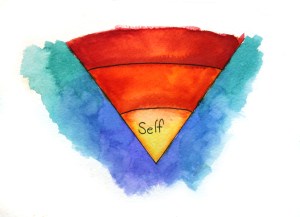
The deepest recess, where soul, spirit, body, intellect collide and connect and have their enduring party
(I prefer “higher” or “lower” functioning family) is a family’s inability to protect the emerging self (the sense of self, soul, spirit, inner being, heart) of persons in the family.
Characteristics of the self:
1. It is beautiful (created by God as the unique expression of who you are to the world). Even the “worst” person has, hidden beneath it all, a beautiful self.
2. It is relational (naturally wants to relate and engage). Every act – think about it – is an act of relationship.
3. It is sexual (naturally wants to procreate, build and nurture something larger than its-self). Nothing can be done to escape our gender; it is inextricably woven deeply within and finds expression in everything we do.
4. It naturally desires to engage in worship (naturally wants to ascribe greatness). This explains why BMWs, children, houses are “worshiped.”
5. It is enduring (it doesn’t change much in a lifetime). Parents say things like, “From the day he could walk he’s been a determined person.”
6. It is regenerative (naturally seeks to mend and heal). Like the body is always in a state of regeneration, so is the self.
7. It is resilient (can tolerate and survive enormous pain and suffering). Humans have endured untold horror when it has been inflicted upon them.
8. It is creative (naturally thinks outside its-self) and resourceful. It is the powerhouse (engine room) within every person.
9. It can be fed, trained, encouraged (one person can take better care of a self than another) and can grow.
10. Unfortunately, it can be starved, neglected (can wilt away without nurturing) and can give up the fight.
11. It is the place from within which people are able to want, to express desire; it is the center of desire within us.
Take Up Your Life
Although the self within us all usually has a huge repertoire of protection mechanisms, when and if it is damaged, it is usually slow in healing. While the self is difficult to damage, considering its incredible resilience, it can be damaged. A damaged self displays the impacts of hurt and trauma most vividly in relational difficulties, in matters of closeness and intimacy. The effects of damage and trauma to a self can apparently leave a person quite unaffected regarding distant or impersonal encounters. It is in intimacy, in close friendships, that the damage most vividly reveals its presence. When in relationship, a person with a damaged self will find himself unable to “be him-self.”
Posted in Attraction, Communication, Difficult Relationships, Triangles, Triggers, Voice |
Leave a Comment »
November 29, 2007
by Rod Smith
It is in us to love. It’s human. We have the capacity for it. Even hurt and rejected people can love. Once a person accepts that love has more than romantic connotations, as powerful and valid as these of course are, he or she will be able to see its broader power.
Love is unleashed through simple, but not easy, human acts of seeking the highest good both for oneself and for others. Acts of offering unearned forgiveness, of reaching out to the estranged, of welcoming a stranger, of letting go of all prejudice, of rejecting dishonesty – all begin within the individual human heart.
When a person intentionally facilitates others toward finding and enjoying and exercising the full range of their humanity, he or she will know and see and experience the powerhouse love is.
Even people with reason to reject others, having themselves been rejected or treated inhumanely, have it in them to love, if they dare to muster the courage for it. It comes quite naturally to the courageous person, and when it is unleashed, the purposes and the meaning of life surge into the heart of all who have the courage to hear and respond to its powerful call.
If you want a bound edition of all 400+ columns GO TO: www.ToughPlace.Blogspot.com and follow the directions on the right of the page…….
Posted in Anger, Anxiety, Attraction, Betrayal, Boundaries, Children, Communication, Differentiation, Difficult Relationships, Faith, Family, Grace, High maintenance relationships, Listening, Long distance relationships, Love, Marriage, Meditation, Past relationships, Re-marriage, Recovery, Sexual abuse, Sexual compatibility, Therapeutic Process, Triggers, Trust, Victims, Voice, Womanhood, Young Love |
4 Comments »
November 13, 2007
by Rod Smith
The power and sacredness of sex …
Morality, religious beliefs, and family values and expectations aside, which, by the way I believe is impossible to do, don’t have sex with a person whom you do not know, and are not committed to in every area of your life, for the long haul.
To say “it (sex) is just a physical thing” is naïve, shortsighted, and misguided.
Sexual behavior is powerfully connected to the essence of who and what each of us is, and to regard it lightly or with flippancy, dismisses the powerful, creative, and beautiful place sex occupies in the engine room of each our lives, whether married or single.
To regard sexual acts as purely (only) physical is absurd.
Sexuality, and its expression through physical acts, potentially combines your whole heart, mind, your spirit (or inner being) and your body – in a sacred act of shared love, resulting in mutual replenishment, mutual recharging, and the willing refocus, as a couple on all that is mutually and individually important.
It is impossible to get the best out of sex (or put your best into sex) with a stranger, or with someone you hardly know, and with whom you have no long-term shared responsibilities and commitments.
Posted in Affairs, Attraction, Betrayal, Boundaries, Communication, Difficult Relationships, Divorce, Domination, Forgiveness, Friendship, High maintenance relationships, Listening, Living together, Long distance relationships, Triggers, Trust, Victims, Violence, Voice |
1 Comment »
November 8, 2007
by Rod Smith
“I have been going out with ‘Jill’ for several years. We do not live together. Every now again, when she has problems, she does not want to be around people, including me. I find this very difficult. I don’t think she understands how to love or be loved. I have tried to get her to understand that I want to help her but she will not listen. She says she wants to be left alone to go where nobody can find her.”
Jack, avoid interpreting Jill’s desire to be alone, or escape, to be about her capacity to give or receive love. These desires, however triggered, most certainly pre-date your relationship. Love Jill enough to grant her the fulfillment of her desires that you have difficulty understanding.
Love – by letting alone. You, Jack, love by being present, and through absence. Both can be acts of love. Some people simply need (no, I am going to say ALL healthy people) or desire some alone time. It allows for the natural stresses accompanying even the most loving of relationships to dissipate.
And, when she goes away to be alone, resist your powerful, understandable urge to go looking for her. Trust Jill, Jack, to get what she needs. This is a very important component of your love for Jill.
Posted in Anger, Attraction, Blended families, Boundaries, Children, Differentiation, Difficult Relationships, Therapeutic Process, Triggers, Trust |
5 Comments »


 difficultrelationships.com