I am convinced that there are always reasons to HOPE.
No matter how dire, or conflicted the circumstance, no matter how bleak the prognosis, while there is life, and even beyond it, there remain reasons to be hopeful.
I’ve seen hope in action.
I’ve seen painful family scenarios, the most estranged of siblings, the most obstinate of personalities, turn, then find previously unimagined degrees of humility, and move in healthier directions.
But, of course, evil abounds. It tries to rob people of hope. Sadly, we all know men and women who are capable of inflicting much hurt and destruction.
Nonetheless, I will continue to believe that good far outweighs evil.
Goodness, kindness, benevolence, empathy, are latent in every man, woman, and child, and such qualities exercised by individuals, squelch humanity’s sometimes crazed desire to spread hate and destruction.
While I am well aware my ideas will be considered absurd in some circles, heresy in others, I’d suggest that when a lonely woman reaches again for alcohol, or a depraved man engages in illicit behavior, or an adult or teenager self-destructs, these behaviors are desperate acts of prayer, desperate attempts at sanity, desperate attempts to relieve pain and restore hope.
I will be an agent of hope to those who feel hopeless, abandoned, or aimless. Having seen my own life change, and an occasion, my own difficulties diminish, I know others can successfully face fearful, problematic situations, and emerge with increased hope. I will live a hopeful life and spread hope wherever I go.
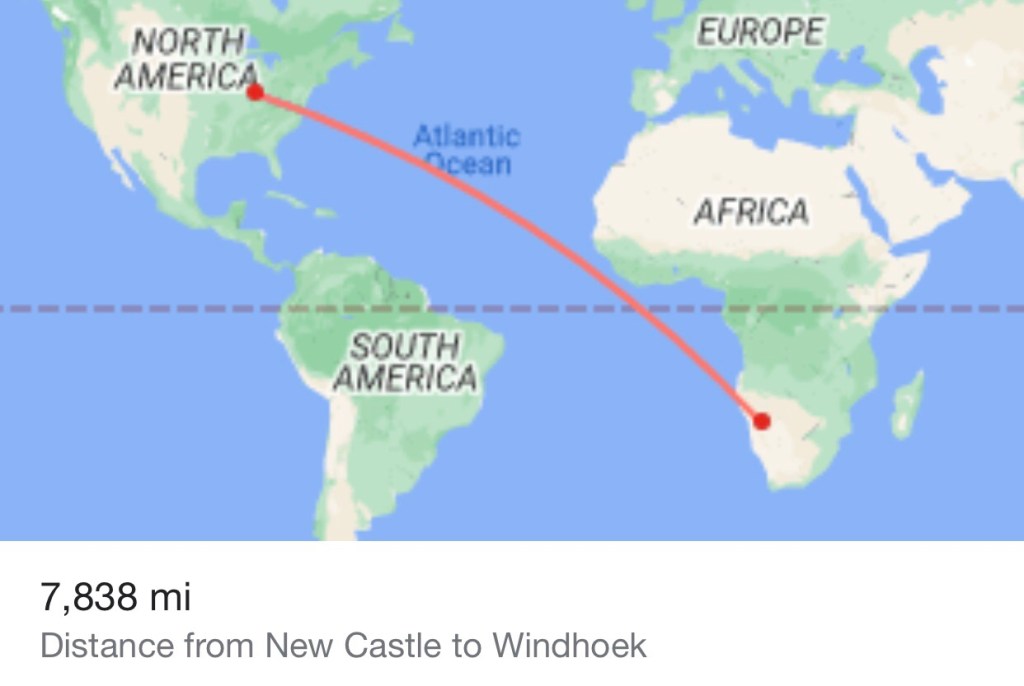
Today I’m headed, not to Windhoek, but to Cape Town #graceupongrace
Within milliseconds the drawbridge – we each have one – may go down with a hearty welcome or remain up and sealed shut.
There may be Immediate comfort or discomfort, or levels of both.
Suspicions may be endorsed or deleted.
Information and misinformation transmission occurs at a speedy rate.
We read and misread and read and misread each other constantly – all within the backdrop of our unique experiences and training, our hurts, pains, goals, and desires – known and unknown.
The accent (if one party is not from “here”) is loaded with meaning. Clothes (anything unusual); laid-back or dominant stance; voice tone, volume, intonations; levels of energy or lack thereof, are cumulatively processed.
Triggers can be triggered. Stereotypes ignited. Warmth flows, or doesn’t.
The wave, the handshake, the hug, smile or frown, degrees of sincerity or insincerity are downloaded by the “who-are-you” antenna and the “can I trust you” antenna issued to all at birth to be processed with the morass of stored history, experience, memories, good and bad.
Every encounter is a miracle.
And, yes, with all that, we — you and I – are called to be neighbors and to love one another.
The “outside world” can be a dangerous place for children.
Another exceedingly dangerous environment for children can also be their own homes. While medicine cabinets, cleaning materials and unlocked swimming pool gates are a legitimate threat to the child-safety, the unguarded mouth of an angry adult can inflict grievous harm to a child.
A vigilant parent might install childproof locks yet leave a totally exposed web of anger in every room of the house. Unresolved anger in a parent, expressed through unpredictable displays of frustration and annoyance or rage, can quite effectively sabotage a childhood and even pass a baton of anxiety and rage to unborn generations. It is in their own homes that children might be at most in danger. At home they learn about trust, and exercise the most trust. It is at home they will learn, or fail to learn, by watching and experiencing, almost everything they will ever know about love.
It is at home they will make the most mistakes and receive the most affirmation and correction. It is at home that children will learn about fear and hurt and rejection and empathy and love and acceptance.
Children are constantly seeing, feeling, learning, trying, sometimes succeeding, sometimes failing, watching, waiting and taking it all in.
Monitoring diets is a crucial aspect of childhood health. Another “diet” is the calm, security, predictability and warmth healthy parents can provide.
If you have the opportunity to see “The King of Broken Things” run at it.
It’s doing what’s good and right to the best of your awareness, as limited as your awareness may be, for the greatest number of people possible in your immediate circle of influence, including those whom you don’t know and even those who may have rejected you or may even hate you.
It’s gathering your strength and harvesting your latent patience and shopping at your store of inner kindness when others test you your many daily contexts, and then being strong and patient and kind even if it feels like you’re surrounded by people who don’t appear to think very much, and, if they do, their thinking appears limited to considering only what pertains to themselves alone.
It’s paying for someone’s groceries or petrol (gas) or electricity, but it’s also stopping to consider why it is that you are able to and trying to understand what circumstances have placed the recipients of your generosity in such vulnerable, often humiliating situations, that they need your help and thinking these things through without resorting to low-hanging stereotypes like “I’ve worked hard and ‘they’ have not.”
It’s seeing people’s faces, acknowledging their unique stories, accepting that all people want to be seen, heard and included, even if their day-to-day behavior suggests volumes of evidence to the contrary.
When receiving texts — except texts of a purely perfunctory nature — do you read between, behind the lines?
We offer affirming eye contact during face-to-face conversations.
Timing, tone, cadence, clarify meaning in voice calls.
Are we listening to texts?
You may engage with the person who responds to texts as if anxiously awaiting, even aching for human contact. Prior knowledge may inform your understanding of your quick-to-reply friend.
I find it helpful, early in any text exchange, to declare my level of availability. I am unlikely to ignore a verbal approach and I try to acknowledge texts.
Apparent indifference can be cruel.
Respond in kind: words for words, sentences for sentences, emojis for emojis. One who composes a paragraph deserves a like-response. A thumbs up emoji or hand clapping butterflies may come off as dismissive when a friend just spilled his guts.
Grammar rules and sound spelling seem widely ignored with texting. While pedantic perfectionism may reek pretentiousness, effort reveals respect.
Avoid alarm —- can’t wait to tell you something terribly important to you and your future when we meet next month — is hardly fair.
Read between and behind the lines.
Friends might be telling you something of crucial importance (to them) and selected you to be their audience.
Arrived in the USA late last evening from Malaysia.
What kind of week will you have? What kind of person will you be this week? Ask these questions and most will say they don’t know or reveal a Que Sera, Sera (Whatever Will Be, Will Be) attitude.
It is possible to plan.
Here’s my five-point plan for this week:
I will do something every day that is an act of self-care and self-love. It is impossible to love others without also loving myself.
I will occupy the driver’s seat of my life. Abdication of this adult role to others – except under extreme circumstances – is the definition of selfishness.
Within the framework of my predetermined values and boundaries and my callings, I will be a highly cooperative person, a team-player, an encourager.
I will listen without waiting to speak knowing that every person has a voice worth hearing and something to teach me.
I will commit at least one specific act of unexpected generosity, one that costs me time and/or treasure, each day. This is to train my seeing, thinking and responding to others so that generosity becomes an ingrained way of life for me.
I’d love to see what you are planning for your week. Email me your 5 or 3 or 7 point plan.
Your family – blood-, marriage, relatives-by-choice, adoption, and any other means people become family – is vastly more than a list of people on your group-chat or birthdays to try and remember or the ready-made crowd for weddings and funerals.
The hundreds of links (a family of 4 has 16 relationships) in your network – your family – and how you are linked (just right, over-connected, under-connected, loosely-affiliated, cut-off in anger, the “I’ll never talk to him/her-again” kind of connection) is of crucial importance.
How you are connected will either sustain and support and nourish you or drain and exhaust you. And, there is no escaping. Severe disconnections can wield a driving power even in a so-called non-relationship.
We are all “linked” and positioned in a variety of ways within the same extended family and so a family can nourish and support while, at the same time, it can rip to shreds and bleed someone dry.
I’d like to avoid this dramatic contrast but simply look around — listen to people’s family stories — you’ll see it is so.
We are each integral to the health (and un-health) of our family.
We are each a cell-within-the-whole.
The healthier we are, the more “just right” our connections, the more we will be nourishers and be nourished within the unique group of people we each call family.
The healthier I am will lead to a healthier “we” even if it results in hardship* along the way.
* attempts at greater health will be met with resistance from those around, especially those who’ve “benefited” from unhealthy habits and patterns.
There is a difference between peacekeeping and peacemaking.
In a troubled emotional environment peacekeeping saps energy and can be a never-ending task.
Peacemaking lays groundwork for authentic peace to prevail.
Peacekeepers work hard to keep the tensions from rising and work at pretending that nothing is amiss.
Peacekeepers avoid conflict. Their reward is the semblance of tranquility, the demise of integrity and escalation of anxiety.
Peacemakers invite necessary conflict knowing there is no other pathway toward understanding between warring people and groups.
Peacekeepers can endure fake “peace” leading to feelings of being called or anointed while they tiptoe through minefields they pretend don’t exist.
Peacekeepers apparently “enjoy” feelings of martyrdom. How else would they rationalize the accompanying stress of trying to hide or tame the proverbial elephant in the room?
Peacekeepers often see their role as “spiritual” and “humble” because they endure without “saying anything.”
Peacemakers value authentic peace more than its distorted parody. The peace that exists between people who possess the courage to endure conflict, for the sake of lasting peace, is like pure gold when compared with its counterfeit cousin.
Move with courage toward lasting peace.
Assume your legitimate role as a peacemaker rather than avoid conflict in order to keep a semblance of peace that is not worth having.
Listen to your conversations, yes, eavesdrop on yourself.
I try to do this and I am often embarrassed how regularly I’m on auto-play. I hear the same stuff – the same stories and one-liners – coming out of me over and over again.
It is as if I am bored with myself and those who are part of the “conversation.”
I don’t like this about me and I don’t particularly like it when I’m caught in someone else’s well-worn loop.
Sometimes I hear traces of contempt and sarcasm in my conversations.
I am very careful about avoiding swearing and blasphemy, yet there are times I am apparently okay with using words as clubs and bullying others with snarky sarcasm. These verbal habits are surely at least as toxic as possessing a foul mouth.
The gift of thoughtful conversations, where people listen without waiting to talk and people hear what is really being said is something to which I deeply aspire despite what sometimes comes out of my mouth.
By the way, I am heading to Duban during much of February.
I would be delighted to speak at your school, church, business, or club – and I promise to watch my mouth.
Drop me an email if you are interested.
Let’s see what time permits.
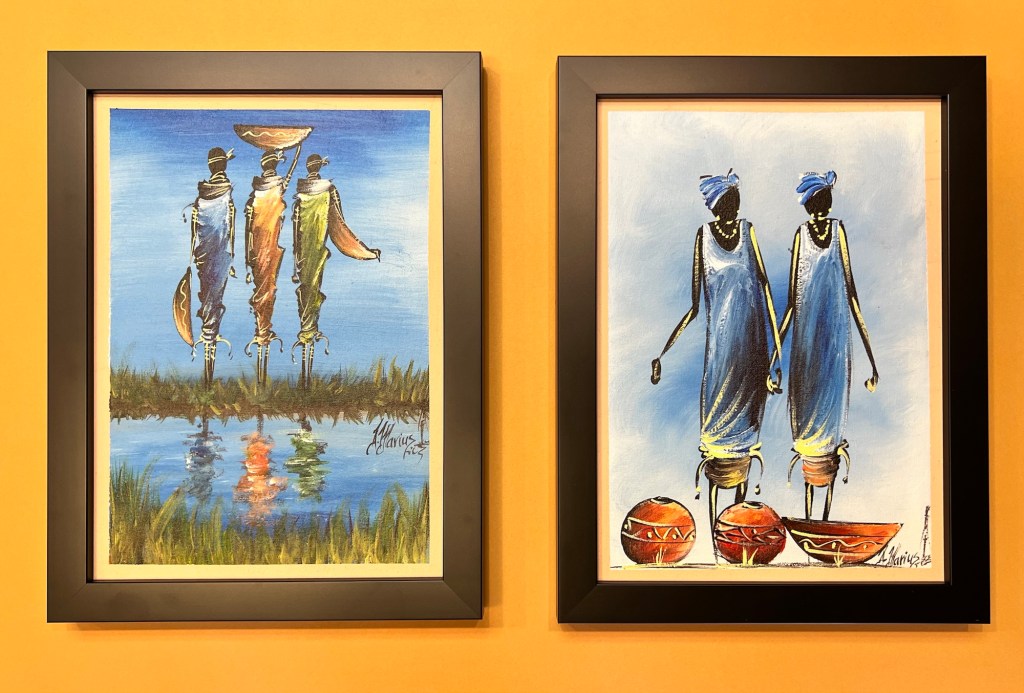
Two new pieces in our home — picked up in Lome, Togo and framed locally.
Take time, lots of it, yes, weeks, perhaps even months, to think deeply about your life and to write about it.
Great art deserves careful consideration and meticulous planning. Such contemplations will not require, in the meantime, you to stop functioning. Humans are vastly capable and can think and plan and ponder their unique works of art while engaged in day-to-day life as it is.
“Am I going where I want to go and doing the things I really want to do with the people who are most important to me?” is the backdrop question.
Articulating goals, even if they are unsure, generic, will bring you an added confidence as you pursue your ArtLife.
Identify which people are really important to you.
Evaluate what activities are really important to you.
Assess your direction.
Some people will tell you that this is a selfish way to live and, sadly, some will indeed plan selfish lives and reap the disappointment such planning will bring.
A life seen as art, planned as art, results in fulfilled, generous and thoughtful people.
Haphazard living, pointless, random existing, dependent on others for a sense of meaning and purpose, is a selfish life if I ever saw one.





 difficultrelationships.com