Your “spirituality” is not measured by how much you (or I) read the Holy Scriptures, sing hymns, pray, clap your hands, run around a sanctuary with a purple flag, dance to contemporary religious music or reject those who do.
It’s not determined by how much you visit your place of worship or how much money you donate to its causes.
It’s not affirmed by your title (if you have one) or the ornate design of your robe (if you wear one) or the position you hold in the hierarchy of your faith tradition (if you’re part of one).
But, it is affirmed by your willingness to take responsibility for your life, your choices, and the good use of your skills and talents.
A biopsy of the validity and integrity of our faith and spirituality is revealed in how we treat people, especially loved-ones and strangers; how we love our enemies, offer hospitality, respect, regard, love those who reject our beliefs.
Do you clean up after yourself? Are you wisely generous to a fault? Do you love those who are different from you, whose lives might be in direct conflict with what you believe? Do you love others by listening?
If you take full responsibility for yourself, become extraordinarily generous with what you have, embrace diversity, and love others by listening, you will fast-forward your “spiritual” growth. Actually, you will put it on supercharge.
It’s not your title, the reach of your authority, or the crowds who respect and adore you. Rather, it’s how you respect and love and respond to those who don’t.
I think my disdain for the sheer evil was discerned early on in my military basics when a breath-reeking dirty-mouthed two-striper screamed into my face from such proximity that I could smell and see his back teeth.
Mixing Afrikaans and English he proclaimed with anger that by the time he was finished and done, “finished and klaar,” with me, me specifically, I would be a real soldier, an “ordentlike soldaat.”
He said I would be able to march, not walk, march, in those shiny boots right over my mother’s dead body and feel nothing, nothing at all.
I gathered my thoughts.
He waited.
He expected the routine.
He waited for me to jump to attention and scream, “Ja, Bombardier. Bombardier is always correct, Bombardier,” in Afrikaans.
This response was expected, an individual response when addressed as an individual, or blurted in unison if addressed as a group. There were times it reminded me or 7-year-olds singing their times tables for a teacher.
“Do you know that you are stupid, and you are for nothing good?” would be said to all of us.
“Ja, Bombardier. You are correct, Bombardier. Bombardier is always correct, Bombardier,” we had to reply but in Afrikaans.
Agreement was essential no matter what insults were hurled.
This particular insult, that we were for nothing good, I found amusing. The “for nothing good” is a direct translation from Afrikaans and the bombardier would have had no idea how stupid he sounded in his desire to parade comfort in both official languages.
This time was different.
This was no routine insult.
He was screaming at me about my Mother, a woman he did not know, a woman about whom he knew nothing.
He was addressing me, a man he did not know.
A man about whom he knew nothing.
A man he had spent no time trying to know.
He was shouting so all could hear and be impressed by his evil aspirations with words tailored for me.
I waited.
I did not jump to attention and scream “Ja, Bombardier. Bombardier is always correct, Bombardier.”
I did come to attention and yelled, “Bombardier!”
Then, rather quietly, having now gained his full attention, I told the depraved man, in my faulty Afrikaans, as faulty as his English, that despite all of his efforts, I would indeed never, not ever, not in a thousand years, would I be that soldier.
I talked quietly and I was clear.
The bombardier appeared taken aback that I would dare reply with an unanticipated response.
He backed off.
In his retreat he did not send me or the whole squad running to the fence or make all of us do 30 push-ups. He moved away, stepping backwards, losing eye contact for brief seconds as his eyes darted seeking back-up from fellow bombardiers.
I did not drop my gaze.
I gave him all the eye-contact he ever could want.
Somehow, waiting to reply had knocked him off balance, stopped him in his tracks.
His peers made no moves of support.
He was alone in this and he knew it.
Perhaps it made him think of his mother but I will never know.
A violation had occurred and I refused to cooperate with pure evil.
He kept his distance.
He limited his involvement with our particular squad and seemed to forever regard me with suspicion mixed with a dose of fear and healthy respect.
That’s all I wanted; a lot of respect for my Mother and a little respect for me.
And, I wanted not to be that soldier.
Not ever.
So, I told him.
I wanted him to know I would never be that soldier.
There is nothing like a good listener for feeding the soul.
A good listener determines there will be no distractions — no phones, text checking, no dings or app notifications or glances to see the time — and will offer complete and uninterrupted and undiluted attention to the speaker.
A good listener listens, says very very little except may offer occasional brief words of encouragement like “tell me more” or “go back to the beginning if you want” or “go into as much detail as you think will be helpful” or “could you tell me that again so it’s clearer for me.”
The good listener knows listening and any attempts at multitasking — even the most subtle — distract the speaker and obliterate listening. A good listener gets all the potential impediments to listening out of the way before sitting down to listen.
The good listener knows a listener’s inner-noise —- things the listener is refusing to hear or address from within — will emerge and sabotage attempts at hearing others and so addresses unresolved personal matters as much as possible so others may encounter a clear-headed listener.
The good listener does not formulate replies or develop counterpoints while listening and does not one-up the speaker with the listener’s own experiences whether they may appear to the listener to be helpful or not.
A good listener sees, hears, knows, acknowledges the speaker by listening — the most powerful and tangible expression of love.
I devised a list of how to participate in the healing of men and women who have been hurt:
Be willing to listen, even if what is being said is what you’d prefer to not hear. Try not to re-engineer (re-frame, recast) what you have heard so it is more fitting with what you’d really like to hear.
Resist understandable attempts to short-circuit growth by trying to ease necessary pain, by offering false affirmations, and by accepting empty excuses for irresponsible behavior. Pain is a very good motivator for change. Resist the urge to remove it when it appears to be helpful.
Offer your presence, not your answers. “I am with you” is more helpful than “let me help you fix it.”
Welcome silence. There are ways to communicate that do not include words. Resist the understandable urge to chase healing and learning away with the incessant use of words and stories.
Avoid minimizing (“it’s not so bad!”) or rationalizing (“What else did you expect?”) or normalizing (“Anyone would have done that!”) the issues that resulted in pain. Do not rob necessary pain of its usefulness.
Promote “future thinking.” Ask questions focused on future wellness and success.
Try to avoid searching for the genesis (the cause) of what has led to pain. Where something comes from is not nearly as important living your way out of it.
Most USA schools are back in full swing…… at least around here they are:
Hats off……
Hats off to teachers and coaches who love the world and its peoples and whose zeal for both results in empoweing students of all ages.
Hats off to teachers and coaches who love their subjects and sports and whose passion for their work opens vast vistas of opportunities for their students.
Hats off to teachers and coaches who are as tough as nails over matters of integrity but are easy sells when it comes to listening and attempting to understand students and their home-lives, peer, and social struggles.
Hats off to teachers and coaches who know their students well enough to be able to anticipate and address problems before unnecessary escalation.
Hats off to school administrators who have the courage to support teachers and coaches in the face of often difficult parents and who have the courage to listen to all parties before they act.
Hats off to school administrators who aspire to serve rather than be served, who understand the power of humility, and who see their essential role as empowering coaches and teachers and students to get the very best from each other.
Hats off to parents of students who seek to respect and learn from their children’s school teachers and coaches and administrators rather than demand rights or seek to chastise or correct.
Hats off to Librarians, Musicians, Counselors, School Security Teams….. and all who work daily to keep our students motivated, kind, and safe.
Andrea Neal, Jay Sherrill and so many others who regarded Thulani and Nate as their own.
Dad owned the tearoom near the top of Blackburn Road next to the Dutch Reformed Church up the road from Park Hill Soccer Club.
You may or not have known him by name but you may have been a woman in need of milk for her baby. He would have given it to you “under the counter” as if defying the boss which, of course, was himself. When you tried to pay he may have whispered “take the milk, my dear. No baby should go without food. Keep your money for something else the baby needs.”
Or, you may have wandered into the shop and said you had no place to stay for a while and he may have said “we have plenty of room here” and given you a bed for a week, a month, even longer.
Perhaps you knew him because you faced addiction to alcohol and he was your Alcoholics Anonymous sponsor and he said “just for today” to you and told you he’d decided he’d no longer drink “just for today” until his pledge spanned decades of sobriety.
Did you know my dad?
You may not have known him by name but perhaps you went to his tearoom where he served bread, milk, kindness and good humor and wrapped the goods with the feeling that you were known, you belonged, you were important.
As well-intentioned as we may be in desiring to avoid conflict and “keep the peace,” we create more problems we must face later by running or playing hide and seek. Then, when we do face matters, we’re not the people we once were.
Avoidance is a quick-change artist! It changes us in ways we are likely to regret.
We cannot solve or improve what we will not face. Denial gets us no place worthy of the journey or the unintended, unwanted destination. Until we gather the courage to look difficult situations directly in the eye and expedite what is necessary to face the difficulties, conflicts will stay as they are and they’re likely to deteriorate.
What we avoid shapes us in ways we may never notice. We modify our habits in order to sustain our denial and avoidance. We change our friendships in order to sustain our patterns. We go out of our way to keep the peace but the new path is one to further avoidance. Our defensive habits defend us in unhealthy and unhelpful ways and make us into people we’d rather not be.
Avoidance of necessary battles creates unintended distance from others — even those we truly love.
There is no worthwhile substitute for early honest approaches to family or business conflicts.
Avoidance makes the heart grow harder.
Ours.
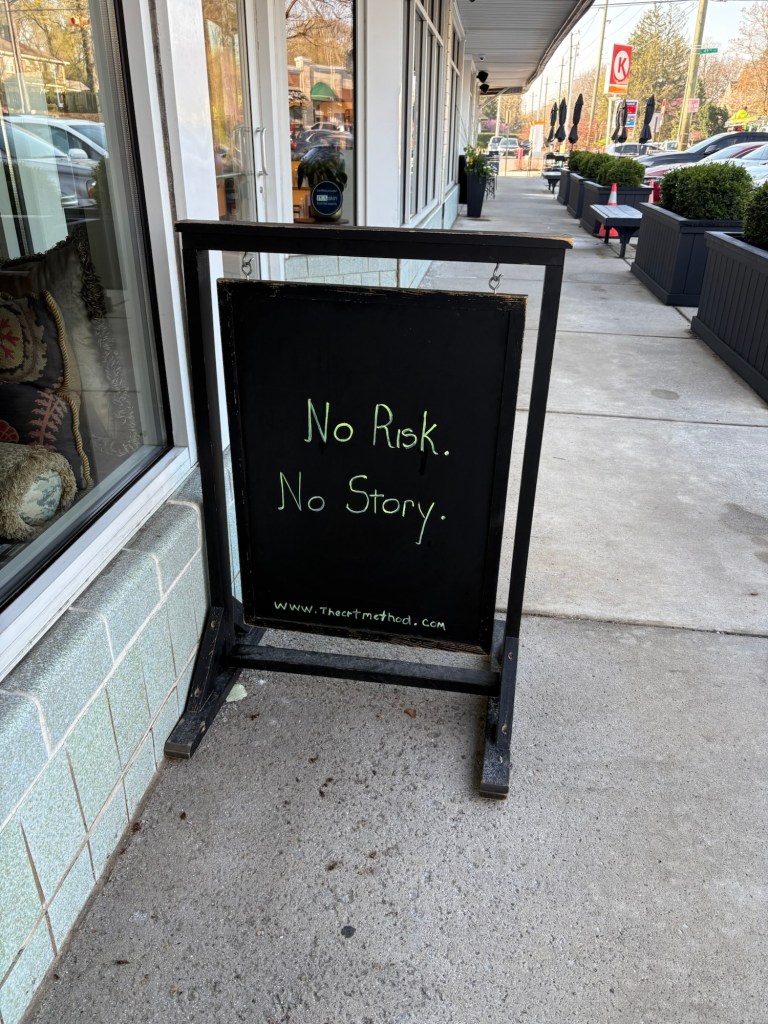
I enjoyed this side-walk art…… 49th and Penn in Meridian Kessler, Indianapolis
I shall strive to speak and teach as one who has indeed much to learn.
In every classroom we are all learners.
I shall strive to listen to people in the class (and out of it) as if I were listening to the mountains.
Mountains reveal their real beauty to the dedicated observer, beauty that’s easily missed by those who offer casual hurried glances or who are themselves caught up in how they look or are dressed or what the student may think of them.
Can there be a greater privilege than jetting to Penang to teach Family Systems?
Real leaders, authentic leaders, as opposed to those who are in it for the illusion of power, love of money or the mirage of status will face multiple paradoxes and do so constantly.
Yes – daily.
It comes with the role – the “role” and not position. Leading is what leaders do.
It’s a function.
I have known “leaders” whose names are boldly declared on a suite’s entry – or the headmaster’s office, or the pastor’s study – but the leader is an under-appreciated someone somewhere whose name is upon nothing, and definitely not on a fat cheque.
Leaders lead, but must also follow.
It’s an art.
Leaders go first, but must also hold back, and know when to go last.
It’s a dance.
Leaders know that leaders are servers, first.
Leaders try to understand those whom they lead, yet cannot let their desire to understand, desire for empathy, derail decisions that are best for the whole, the calling, the gravitas, the goodness of the organization they lead.
Real leaders are aware that if they cannot lead themselves, monitor themselves, hold-onto themselves, they can lead anyone anywhere worth going.
Leaders are self-aware, self-assured, not selfish or self-less.
It’s an inner-tango, often the limbo, seldom a waltz.
And, here’s the kicker – it’s a solitary dance no matter what the music.
Not everything is proceeding as you’d prefer. You notice you are starting to avoid and resent some members of your team and some people in your organization. You’d rather not pick a fight so you’re managing your day (week, month) around who you do not want to encounter. You notice, on occasion, there’s a dictatorial edge lurking just under your calm exterior and you hope it is not going to take you by surprise.
Find a leadership coach.
You find yourself taking sides on issues and recruiting those who are on yours. While you know that surrounding yourself with YES men and women is probably not good for your organization it feels good. You know that the people who hold counter opinions are good for you and for you and for your organization, you’d like them to ease off a little.
Please, find a leadership coach.
Your family is getting in your way and there are times you want to stay at work rather than go home. At the very same time, when you are home, you want to work from home to avoid some of the underlying conflicts you have to address at work. Nowhere feels completely comfortable right now.
Please, for everyone’s sake, find a leadership coach.







 difficultrelationships.com