Introduction to Bowen Theory and to the week ahead.
Exercise: PSALM 23
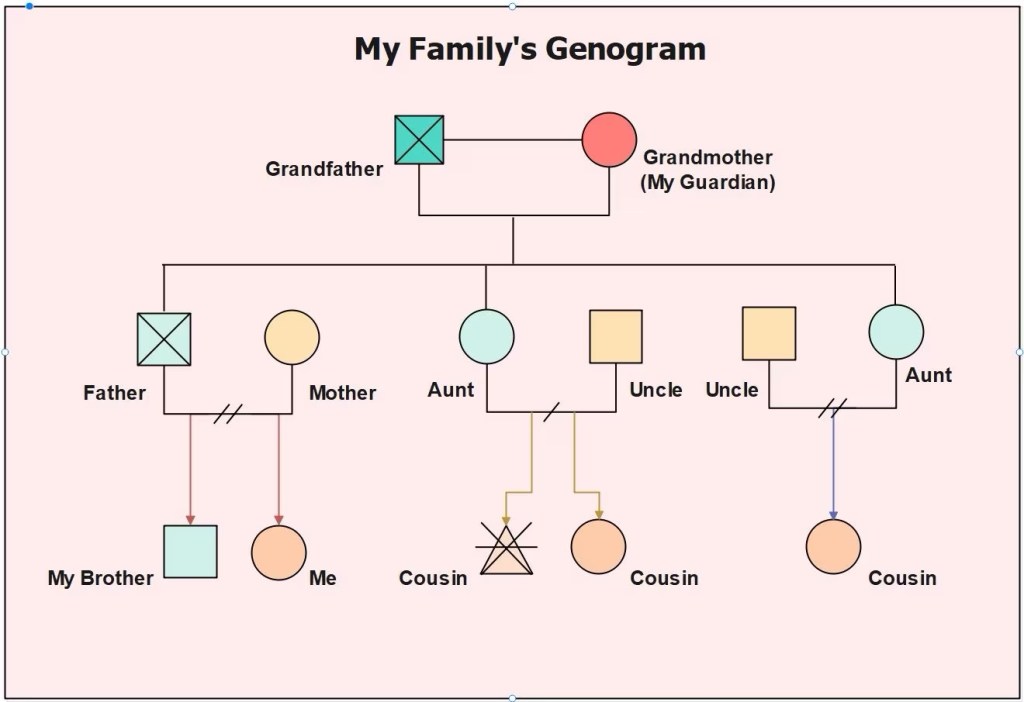
Genograms.
This is a drawing of any client’s family relationships covering at least three generations. It is always a “drawing in progress and process” as people and families are constantly evolving (chabing, growing).
The genogram is a predictive tool (it is not determinative) revealing what’s likely to occur within a family (where and when there is no intervention) by seeing what’s set in motion by preceding and passed on from generations.
My hope is that each student and staff member will complete his or her Genogram.
All family members are deeply connected to all other family members. The manner in which people are connected either nourishes or drains individuals and the entire network – and, of course – many relationships do both and at the same time.
Size (power, perceived importance, lack of boundaries) matters in all relationships – family or not.
What is desired and the goal for all of our relationships? Respect, Mutuality, Equality.
It is my pleasure and joy to near Geneva in Switzerland this week where I will teach Family Systems theory and practice. Over our five days together I hope to:
Cover the history and the development of The Genogram. This is a drawing of any client’s family relationships covering at least three generations. The genogram is a predictive tool revealing what’s likely to occur within a family by seeing what’s set in motion by preceding generations. Each student will complete his or her Genogram.
Demonstrate how all family members are deeply connected to all other family members and how the connections either nourish or drain individuals and the entire network.
Demonstrate how assuming personal responsibility for one’s life lessens the power of the negative (unwanted) themes driving our lives. Assuming an active healthy and engaged stance about our lives increases the likelihood of a healthier future if the past has offered tough and debilitating challenges.
While every class is unique and the material is designed for each group, my focus is always to encourage deep engagement from every person. As insights are shared the way opens for the group process to be at least as powerful as the content.
Join me as I continue my journey toward being a low-maintenance person:
Take care of yourself as best as you are able. If possible, pay your own way. Live in your own head, but more important, get out of the heads of others. Others want — or don’t — want to do their own thinking.
Offer information as needed and only to those who need it. Listen to yourself. Filter content. Negative talk about others reveals nothing about others but everything about you.
Delete “you should, – ought, – must,” from your vocabulary even if you do think you know better or are more experienced.
Take others at their word unless you have solid reasons not to. Believe people when they tell you who they are. People constantly communicate who they are but if you are already convinced you already know you will miss what they are telling you and only hear and see what fits with your already-made-up-notions. Observe without prejudice.
Chase no one for anything.
Resist the urge to convince others of what you think, believe, support, and desire to defend and know it is impossible to persuade the already convinced.
People are always communicating. There is no such thing as “no communication.” This is a cop-out catchphrase used when a person prefers to avoid or deny what is being communicated.
I shall reply more fully soon. I’m at a wedding in the midlands and quite busy with family.
I will be in a position for a better reply soon.
May I publish your letter on my website. If yes, do you want your name, or any other details withheld?
Rod Smith
————
May 7, 2024
Dear Rod
I am pleased that my sharing with you of the changes in my destiny, have been a joy for you, Rod!
I can compare this message to a sermon – one is never sure whether the seed has fallen on rich soil or fallow ground/rocks.
You have my permission to publish my letter on your website – with no withholding of any of the content, nor any changes needed.
I notice that the family wedding in the Midlands, is followed by a busy programme being imminent!
Regards,
Gary
—————-
May 3, 2024
Dear Rod
Earlier this week I read your response to the fund-raising decision on behalf of Dale College, by the new incoming Northwood headmaster, Dr Garth Shaw.
Your comment mirrored the many pearls of wisdom which I have read since your first contributions (2001) to the column in the Mercury.
After 38 years in the banking world, and aged 58 years, I was not happy to ride out another huge change with a Barclays, UK, takeover looming over Absa Bank.
It was amazing how a colleague anonymously dropped off your article dated 4/4/2001.
Question: I’m tired of the “rat race” yet too poor to retire. Any suggestions?
Answer: If all you have is money, indeed you are poor.
Your message was very clear to me!
As one of the leaders in the province, I was aware of the enormity of the early retirement, by 5 years, a decision which I needed to embrace.
That was a turning point in my life, and career – and I have you and your message to thank, as I approach my 80th birthday this weekend.
Early in 2002 I retired, and I was well looked after by my employer.
My wife and I spent the next 10 months converting our family home at 71 Old Mill Way, Durban North, into what was ultimately a large 4-star bed and breakfast – Cornerstone! It was biblically named, and over the next 13 years we hosted 13 Heartbeat Healing ministry weekends, on behalf of St Martin’s church, in Chelsea Drive.
It was time to move on, and late in 2016 we sold the house and business, and moved to Doone Retirement Village in Manors, Pinetown.
Suffice to say we are very active in numerous activities and ministries – “Here I am, send me” is our witness.
Both of our grandsons are at Northwood, They will enjoy and benefit from the quality leadership of Dr Shaw, from the beginning of the 3rd term.
Thank you for your words of truth and wisdom, which changed my life path for the better!
Behold — look closely, observe, see, acknowledge, identify — your Mother.
We all have or had one.
No matter what your memory, treasured for its overwhelming sense of love and acceptance and unconditional positive regard, or the sad antithesis of all that is good and associated with good mothers and mothering: behold your mother.
Consider your mother as you would fine and treasured art, a masterpiece and, then, give thanks.
Remember the good times.
Recall the hard times, recall the challenges you gave to your mother and the challenges your mother brought to you.
The woman you called mother brought to the unique relationship with you, experiences and heartbreaks and history of which you, as a child would know nothing.
Yet, you’d know and experience and benefit, and even suffer the impact of it all, all she is, or was.
Behold, living or dead, known or unknown, behold, appreciate your mother.
There is something wildly healthy about doing so be your mother saint or villain, victor or victim, well or unwell.
—
Emotional Wellness and Living An Authentic Life will be my topics at The Westville Bowling Club on May 9, 2024. Please email Shirley@ShirleyWilliams.co.za for details in the event you’d like to attend.
——-
Sunday, May 12, 2024 I shall have the privilege of delivering the Mothers Day sermon at the two morning services (7:30 and 9:15am) at Musgrave Methodist Church on the Berea.
———
Saturday 11th from 9-12 with Terry Angelos at ST. Michael’s in Umhlanga…..
It’s doing what’s good and right to the best of your awareness, as limited as your awareness may be, for the greatest number of people possible in your immediate circle of influence, including those whom you don’t know and even those who may have rejected you or may even hate you.
It’s gathering your strength and harvesting your latent patience and shopping at your store of inner kindness when others test you your many daily contexts, and then being strong and patient and kind even if it feels like you’re surrounded by people who don’t appear to think very much, and, if they do, their thinking appears limited to considering only what pertains to themselves alone.
It’s paying for someone’s groceries or petrol (gas) or electricity, but it’s also stopping to consider why it is that you are able to and trying to understand what circumstances have placed the recipients of your generosity in such vulnerable, often humiliating situations, that they need your help and thinking these things through without resorting to low-hanging stereotypes like “I’ve worked hard and ‘they’ have not.”
It’s seeing people’s faces, acknowledging their unique stories, accepting that all people want to be seen, heard and included, even if their day-to-day behavior suggests volumes of evidence to the contrary.
Leadership will always be strongest, most effective when the leader sees and regards herself or himself as a servant to those in her or his care.
This is not for effect or for greater impact, it is simply how authentic leadership works.
If you are the leader then you will be a servant who seeks to serve those whom she or he leads. You will do so with all your heart, mind, soul and you will love those in your care. You will love them to such a degree that they will end up even unknowingly tapping into the very best of who they are because that’s how people behave when they are loved.
If you think of yourself as elevated, deserving of being served by others, afforded status by your role, you are not a leader no matter what you think you are. What you are is one who is capitalizing on those whom you are really called to serve.
Your leadership function must benefit others, not you.
When you are the true leader there is nothing you will not do within the bounds of law and the boundaries of sound ethics to enhance the lives of those whom you lead.
It’s enjoying face-to-face conversations, really listening to each other, responding, asking relevant, respectful questions. It’s encouraging people to talk about things they find interesting, important.
It’s sharing, refusing to dominate or set the agenda for every conversation.
Meals with friends, unhurried times, occasions when talk leads to laughter and may also lead to tears simply (and profoundly) because shared history is being re-lived.
Pain – revisited.
It’s simple meals that transform into events because hearts are healed even though a shared meal was the only intention.
It’s welcoming others, people known and unknown. It’s genuine openness, radical hospitality. It’s wild generosity. It’s sincere interest expressed.
It’s the simple things.
And, no cell-phones are required or necessary.
————
Two personal matters:
I will be in KZN from May 5 to May 15, 2024. Best selling author Terry Angelos (WHITE TRASH) and I will host a public seminar. During my visit I will, at your invitation, meet with groups, schools, churches, businesses, and individuals. Please contact Shirley@ShirleyWilliams.co.za to find out more about the Angelos/Smith event or schedule events with me.
This column appeared first in The Mercury on March 20, 2001 and has been published every weekday for 23 years. Thank you for your readership.
What kind of week will you have? What kind of person will you be this week? Ask these questions and most will say they don’t know or reveal a Que Sera, Sera (Whatever Will Be, Will Be) attitude.
It is possible to plan.
Here’s my five-point plan for this week:
I will do something every day that is an act of self-care and self-love. It is impossible to love others without also loving myself.
I will occupy the driver’s seat of my life. Abdication of this adult role to others – except under extreme circumstances – is the definition of selfishness.
Within the framework of my predetermined values and boundaries and my callings, I will be a highly cooperative person, a team-player, an encourager.
I will listen without waiting to speak knowing that every person has a voice worth hearing and something to teach me.
I will commit at least one specific act of unexpected generosity, one that costs me time and/or treasure, each day. This is to train my seeing, thinking and responding to others so that generosity becomes an ingrained way of life for me.
I’d love to see what you are planning for your week. Email me your 5 or 3 or 7 point plan.
Your family – blood-, marriage, relatives-by-choice, adoption, and any other means people become family – is vastly more than a list of people on your group-chat or birthdays to try and remember or the ready-made crowd for weddings and funerals.
The hundreds of links (a family of 4 has 16 relationships) in your network – your family – and how you are linked (just right, over-connected, under-connected, loosely-affiliated, cut-off in anger, the “I’ll never talk to him/her-again” kind of connection) is of crucial importance.
How you are connected will either sustain and support and nourish you or drain and exhaust you. And, there is no escaping. Severe disconnections can wield a driving power even in a so-called non-relationship.
We are all “linked” and positioned in a variety of ways within the same extended family and so a family can nourish and support while, at the same time, it can rip to shreds and bleed someone dry.
I’d like to avoid this dramatic contrast but simply look around — listen to people’s family stories — you’ll see it is so.
We are each integral to the health (and un-health) of our family.
We are each a cell-within-the-whole.
The healthier we are, the more “just right” our connections, the more we will be nourishers and be nourished within the unique group of people we each call family.
The healthier I am will lead to a healthier “we” even if it results in hardship* along the way.
* attempts at greater health will be met with resistance from those around, especially those who’ve “benefited” from unhealthy habits and patterns.


 difficultrelationships.com