Learn the ART of living fully in your own head, and only, in your own head. Think for yourself. Try not to interfere when others think for themselves even when they express thoughts you’d never think. It’s allowed. MINDing yourown business, avoiding crossovers, is a crucial and necessary art in the empowering business. Like everything, it begins at home. Your spouse, adult sons and daughters, your parents, all the adults you know have unique brains capable of their own thinking. You may find this harder than it sounds if you are accustomed to living in multiple heads other than your own, and in yourown.
Why is this important? It’s fundamental to trust, growth, respect, equality, mutuality and all those good things. I’d suggest it would be highly disrespectful of me to assume I am better at doing your thinking than you are at doing yourthinking. If I focus my mind on my business and trust you will do the same, the meeting of our minds has the potential to enhance both of us. Conversely, if every time we talk or spend time together you cross over in my head it is likely much of my energy will be spent, not in thinking and exploring with you, but in attempts to safeguard my head-territory.
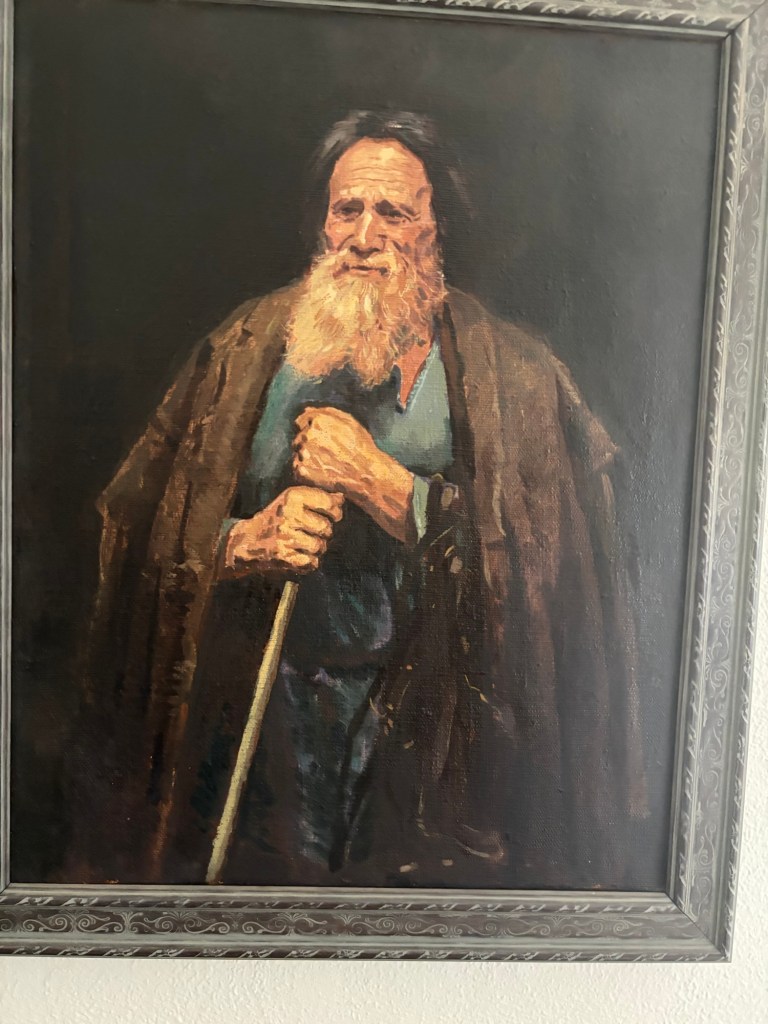
One of my very favorite pieces of art. It’s from Gorky Park, Moscow. Street artist — 1992.
Cameras can transform not-so-friendly people into Mr and Mrs Charming.
You may have noticed cameras and social media often dictate attitudes and behaviors.
Don’t be fooled.
Little reveals integrity and the lack of it more than how so-called powerful people treat all other people. Position and reach and power mean nothing if they lack authenticity and it’s all for the camera.
If he (no matter who he is) looks down on others, shows his power by withholding legitimate tips or generosity to prove a point, you have met an untrustworthy type. If she expresses that she’s surrounded by incompetent idiots and says things like, “If you want something done properly do it yourself,” beware.
Do not trust the “only for camera” smiles or niceness. If everything shifts in the above scenarios when a camera appears, beware.
A kind and generous person is kind and generous when there are no cameras, when there is no applause. A person who can relax and enjoy himself or herself over a meal with people with whom they have little or nothing in common without racing for the camera to publish their goodness and humility for the world to see, is a person of depth and of trustworthy integrity.
Allow yourself to experience your emotions – even the extremes. Don’t cover or hide from your grief. If you are feeling joy, express it. Avoid constructing a wall or barrier between you and your emotions. The day may come when you cannot see over the barrier, let alone climb the wall.
Take time to hear as many “sides” to every story. Don’t rush to judgment. There are usually 7, 8, even 10 sides to every story. Hear them all. Things are often not as they appear. Listeners take all the time needed to hear things out.
As far as you’re capable, go back and make right where you have failed. Often, this may be impossible. Make a list of your regrets, determine never to move in those directions again. Learn, recover, learn recover.
Even if it’s not in your usual habit, try to talk more to people you care about about the things you care about. Don’t rehash hobby horses. Let people into unexpressed parts of your thinking.
Notice your indifference. This is where you’ve been unmoved, unaffected, by things that ought to move everybody, ought to affect everybody. Allow the world about you, near and afar, to have its impact on you.
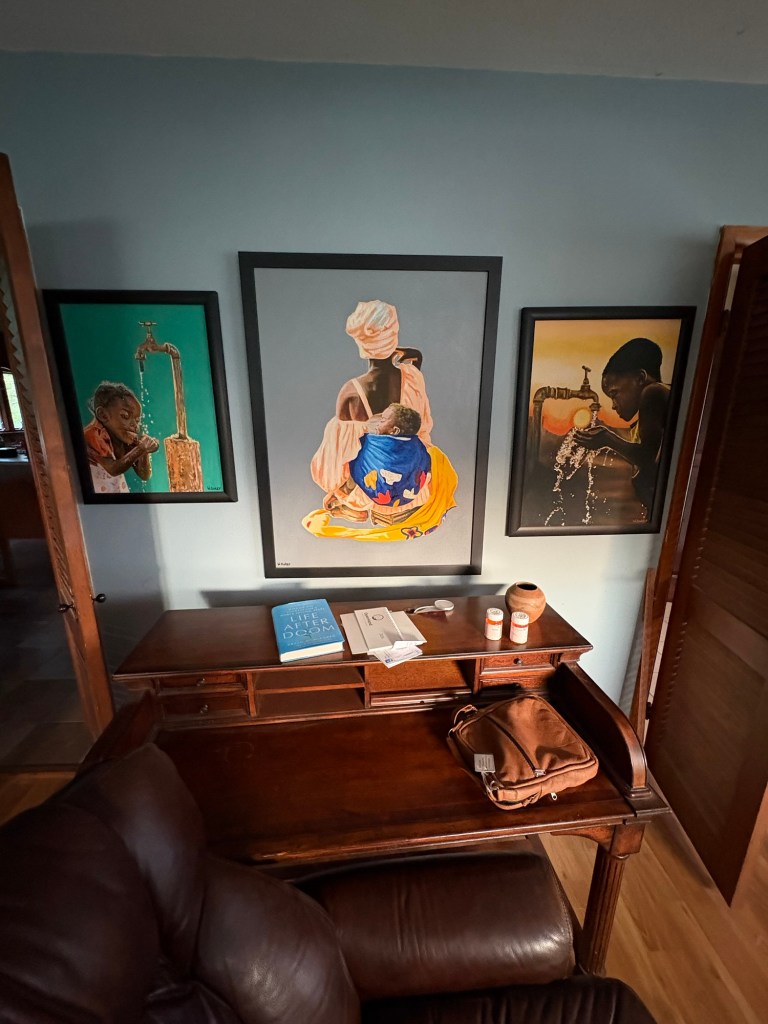
One corner of my home office……. you’re welcome here.
I know competition is tough, really tough, but I think I win the International Best Sister Award. My Australian brother would win a parallel brother award but today I’m celebrating my South African sister, Durban’s own Jennifer Arthur.
As I’ve previously written Jen is the original Facebook. She remembers everyone she’s ever met, be it for 7 minutes on a train or plane somewhere in the world, and somehow gets them a birthday message. She keeps contact with people for years despite the brevity of a first encounter. There’s always a way to stay in touch and Jen finds it.
Jen’s adored by her 9 grandchildren and 1 great grandchild and by my adult sons. I’ve heard children, seen their longing, as they request she be their grandmother. My sister is widely known as Granny Goose.
This week, in fact 3 days ago, my sister landed in the USA for my son’s wedding, a journey booked without awareness that I’d be in need of assistance following my joust with salmonella. My kitchen is organized, my house has beautiful new touches, and recuperation feels 100 times easier.
Even Duke my Lab has switched allegiances and is under her feet as much as possible.
You may earn more than I do and live in a nicer house – but our loneliness is probably the same. When it rips us apart it doesn’t really matter who has the most cash or the nicest home. Loneliness doesn’t care where we live or about our financial status. Invite me in – perhaps we can be friends and ease our common pain.
You may be more educated than I am and you may have graduated from a respected university – but I know that if you regard anyone, anywhere with contempt, your education has given you little worth knowing. I may not be very bright by your standards but I do know that truly educated people never use it as a weapon. Talk to me – I might be able to teach you a thing or two.
You may be more travelled than I am and can talk about places I have not heard of or could afford to visit in my wildest dreams – but if travel has made you contemptuous of your homeland and its peoples then travel has not done its finer work in you. Citizens of the world find beauty and wonder everywhere. Come to my house – my culture is as interesting as any you will find on any distant shore.
Your “spirituality” is not measured by how much you (or I) read the Holy Scriptures, sing hymns, pray, clap your hands, run around a sanctuary with a purple flag, dance to contemporary religious music or reject those who do.
It’s not determined by how much you visit your place of worship or how much money you donate to its causes.
It’s not affirmed by your title (if you have one) or the ornate design of your robe (if you wear one) or the position you hold in the hierarchy of your faith tradition (if you’re part of one).
But, it is affirmed by your willingness to take responsibility for your life, your choices, and the good use of your skills and talents.
A biopsy of the validity and integrity of our faith and spirituality is revealed in how we treat people, especially loved-ones and strangers; how we love our enemies, offer hospitality, respect, regard, love those who reject our beliefs.
Do you clean up after yourself? Are you wisely generous to a fault? Do you love those who are different from you, whose lives might be in direct conflict with what you believe? Do you love others by listening?
If you take full responsibility for yourself, become extraordinarily generous with what you have, embrace diversity, and love others by listening, you will fast-forward your “spiritual” growth. Actually, you will put it on supercharge.
It’s not your title, the reach of your authority, or the crowds who respect and adore you. Rather, it’s how you respect and love and respond to those who don’t.
I think my disdain for the sheer evil was discerned early on in my military basics when a breath-reeking dirty-mouthed two-striper screamed into my face from such proximity that I could smell and see his back teeth.
Mixing Afrikaans and English he proclaimed with anger that by the time he was finished and done, “finished and klaar,” with me, me specifically, I would be a real soldier, an “ordentlike soldaat.”
He said I would be able to march, not walk, march, in those shiny boots right over my mother’s dead body and feel nothing, nothing at all.
I gathered my thoughts.
He waited.
He expected the routine.
He waited for me to jump to attention and scream, “Ja, Bombardier. Bombardier is always correct, Bombardier,” in Afrikaans.
This response was expected, an individual response when addressed as an individual, or blurted in unison if addressed as a group. There were times it reminded me or 7-year-olds singing their times tables for a teacher.
“Do you know that you are stupid, and you are for nothing good?” would be said to all of us.
“Ja, Bombardier. You are correct, Bombardier. Bombardier is always correct, Bombardier,” we had to reply but in Afrikaans.
Agreement was essential no matter what insults were hurled.
This particular insult, that we were for nothing good, I found amusing. The “for nothing good” is a direct translation from Afrikaans and the bombardier would have had no idea how stupid he sounded in his desire to parade comfort in both official languages.
This time was different.
This was no routine insult.
He was screaming at me about my Mother, a woman he did not know, a woman about whom he knew nothing.
He was addressing me, a man he did not know.
A man about whom he knew nothing.
A man he had spent no time trying to know.
He was shouting so all could hear and be impressed by his evil aspirations with words tailored for me.
I waited.
I did not jump to attention and scream “Ja, Bombardier. Bombardier is always correct, Bombardier.”
I did come to attention and yelled, “Bombardier!”
Then, rather quietly, having now gained his full attention, I told the depraved man, in my faulty Afrikaans, as faulty as his English, that despite all of his efforts, I would indeed never, not ever, not in a thousand years, would I be that soldier.
I talked quietly and I was clear.
The bombardier appeared taken aback that I would dare reply with an unanticipated response.
He backed off.
In his retreat he did not send me or the whole squad running to the fence or make all of us do 30 push-ups. He moved away, stepping backwards, losing eye contact for brief seconds as his eyes darted seeking back-up from fellow bombardiers.
I did not drop my gaze.
I gave him all the eye-contact he ever could want.
Somehow, waiting to reply had knocked him off balance, stopped him in his tracks.
His peers made no moves of support.
He was alone in this and he knew it.
Perhaps it made him think of his mother but I will never know.
A violation had occurred and I refused to cooperate with pure evil.
He kept his distance.
He limited his involvement with our particular squad and seemed to forever regard me with suspicion mixed with a dose of fear and healthy respect.
That’s all I wanted; a lot of respect for my Mother and a little respect for me.
And, I wanted not to be that soldier.
Not ever.
So, I told him.
I wanted him to know I would never be that soldier.
When people discover I was “in the army” they usually express disbelief.
I’m perfectly fine with it.
If a war-story is told or I am asked directly about military service in the SADF my default reply is that I was a terrible soldier.
It is true.
I was.
Even visualizing myself as a soldier is a stretch.
But, I was one, really.
I was conscripted into the South African Defense Force like all white South African boys my age.
There is a lot more to my year in the army which I usually reduce to “terrible soldier” but I do avoid when-I-was-in-the-army stories.
I will not pretend it was a good season for me.
Real war stories told by real soldiers and sailors who fought in brutal wars can be tiresome and there is already enough that is tiresome, told, and retold, and exaggerated, without my adding my two bits.
On the occasion I seek reminding about the horrors of war and the evils of which we humans are capable, I open Wilfred Owen’s 1920 poem, Dulce et Decorum est and I’m satisfied.
Fully.
Owen warns against the glorification war and I never came close to one.
Like Owen, I too have seen human evil, thankfully not to the degree he recounts, but I do know it requires no uniform.
I’d rather leave war stories to war heroes and those who are able to hold an audience.
My dad was a war hero.
For him it was frighteningly close.
Extraordinarily personal.
How much closer, more personal can it be than knowing your two best friends (my brother has their names) were killed in an upper-deck explosion while you scrambled off the side of a kamikaze-wounded destroyer into the Indian Ocean in the hopes of finding safety as your ship disappeared from beneath you within 8 minutes?
Able Seaman 67799 EWG Smith was 19 years and 4 months old when he took to the water searching for life and safety.
There is nothing like a good listener for feeding the soul.
A good listener determines there will be no distractions — no phones, text checking, no dings or app notifications or glances to see the time — and will offer complete and uninterrupted and undiluted attention to the speaker.
A good listener listens, says very very little except may offer occasional brief words of encouragement like “tell me more” or “go back to the beginning if you want” or “go into as much detail as you think will be helpful” or “could you tell me that again so it’s clearer for me.”
The good listener knows listening and any attempts at multitasking — even the most subtle — distract the speaker and obliterate listening. A good listener gets all the potential impediments to listening out of the way before sitting down to listen.
The good listener knows a listener’s inner-noise —- things the listener is refusing to hear or address from within — will emerge and sabotage attempts at hearing others and so addresses unresolved personal matters as much as possible so others may encounter a clear-headed listener.
The good listener does not formulate replies or develop counterpoints while listening and does not one-up the speaker with the listener’s own experiences whether they may appear to the listener to be helpful or not.
A good listener sees, hears, knows, acknowledges the speaker by listening — the most powerful and tangible expression of love.
I devised a list of how to participate in the healing of men and women who have been hurt:
Be willing to listen, even if what is being said is what you’d prefer to not hear. Try not to re-engineer (re-frame, recast) what you have heard so it is more fitting with what you’d really like to hear.
Resist understandable attempts to short-circuit growth by trying to ease necessary pain, by offering false affirmations, and by accepting empty excuses for irresponsible behavior. Pain is a very good motivator for change. Resist the urge to remove it when it appears to be helpful.
Offer your presence, not your answers. “I am with you” is more helpful than “let me help you fix it.”
Welcome silence. There are ways to communicate that do not include words. Resist the understandable urge to chase healing and learning away with the incessant use of words and stories.
Avoid minimizing (“it’s not so bad!”) or rationalizing (“What else did you expect?”) or normalizing (“Anyone would have done that!”) the issues that resulted in pain. Do not rob necessary pain of its usefulness.
Promote “future thinking.” Ask questions focused on future wellness and success.
Try to avoid searching for the genesis (the cause) of what has led to pain. Where something comes from is not nearly as important living your way out of it.









 difficultrelationships.com