The Mercury (this begins my 25th year of Monday to Friday Mercury columns)……..
It is a die-hard custom for columnist to “reflect” on the past year. Here are broad principles I have found to be true. I hope, readers in Southern Africa and elsewhere, that you will share yours with me:
Life is simultaneously beautiful and brutal. It is wiser to embrace both as fully as is humanly possible. Attempting to reject life’s inevitable brutality seems to delay deep appreciation and awareness of its beauty.
Generosity, kindness, openness to all others are more powerful than any politician or army.
My enemies unknowingly serve me, make me think, make me honor my life with greater effort and dedication. Thank you. I owe you. I long to repay you with grace, respect, and honor.
If I think my sons and their friends cannot teach me anything I soon discover I indeed have a lot to learn.
The most difficult people, the most demanding clients, the most trying customers, are those who offer me the most powerful opportunities to grow, learn, and exercise love and grace.
People do what they want to do. No finely designed intervention or battery of therapeutic skills can stop a person doing what he or she really wants to do.
The minute I blame anyone for anything, I regress. The minute I take responsibility for myself, I grow.
The annual cavort down the track to get back to the “real meaning” of Christmas, as if we ever fully knew it, fascinates me.
Then, after fascination, I shudder.
The ramifications of “Getting Jesus Into Christmas” if ever achieved, cause me to shudder.
Then I relax with the knowledge it’s beyond us (definitely me, and probably you).
We are too far gone. Off the mark.
I admit there may be rare exceptions but we’ve gotten so sidetracked with the divine-Reveal, we (you and me), seem to forget that Jesus was a baby for as long as we were.
Then, He grew up.
Fully grown Jesus is quite demanding, a straight-shooter. Uncompromising.
And, He’s exorbitantly full of patience and compassion while personifying, justice, mercy, and humility. Jesus rejects pretension, prejudice, all that comes with both. He does not take kindly to pride, arrogance.
You and I will never get Jesus into Christmas while we hold the (perhaps) secret belief in our own superiority, or remain ready to stone others, any others.
His cup overflows with goodness and mercy but don’t get on the wrong side of Him.
Jesus requires we love those whom we think we’re justified to reject.
He loves those whom we (falsely) believe He rejects and expects us to love (not tolerate, or accommodate, but love) which begins at least with a willingness to engage “them,” whomever “them” is.
Your (our) rejection of – insert groups, nations. Individuals, subgroups, “illegals” – will never lead you or me to greater health or deeper spirituality or deeper knowledge of Him.
It’s impossible to grow closer to Him while rejecting anyone or any group He loves.
Rejection, indifference, scorn, at any one is to reject, scorn, be indifferent also to Him……
No matter how many ways you try to bring Jesus into Christmas you (I do too) lock yourself out while you harbor resentments or rejection for anyone, no matter how righteous or justified you may believe yourself to be.
The real meaning of Christmas is, dare I say, rather frightening.
What’s in your tank? When I see the way some behave I have to ask the question.
Then I find the question coming right back at me when I react to others in ways that are hurtful, even harmful.
What are you running on? Is it regret, remorse, feeling of inferiority and rejection.
Is this why you lash out at others, most of whom you don’t even know?
None of these brewing emotions will get you (or me) very far even if regret and remorse and inferiority seem earned and appropriate. Live like this for any length of time and this toxic mix will return to you from all sides.
Perhaps life has filled your tank with anger, arrogance, grievances and blame.
Running on this mixed up mix may give you a feeling of empowerment but you will never find any semblance of happiness with all that living within you. Such attitudes and emotions will alienate you from others, even those whom you love.
This concoction will burn you and others if you live long enough without imploding or exploding.
May we (you and I) do whatever it takes to fill our tanks with humility and kindness.
Such attitudes and emotions will take us places worth going.
With humility and kindness filling our tanks we will build solid and trustworthy friendships.
Everyday, everytime, under all circumstances, no exceptions, you (and I) get to decide what you (and I) will bring to every, yes, every, interaction.
Yes, this one, right here, right now at Wimpy, the bank, with my sons, with your daughter, at this busy traffic intersection.
We have a question we are answering with our behavior 24/7/365: Will you (and I) be agents of love and forgiveness and long-suffering, or will you (and I) settle for the usual combative or irritable or unloving behaviors that seem to come so naturally and easily to so many?
In the heat of the moment – the bad traffic, the wait at the bank, the poor service in the restaurant when you are hungry, whatever – does not make you (or me) unloving or unkind, it reveals who we are.
Challenging circumstances expose, they do not cause.
They reveal.
Love and loving responses take planning, require decisions long before decisions have to be made or require or evoke a response.
Love and forgiveness can only come from you (and me) if love and forgiveness are living within you (and me) already.
What’s within you (and me), will come pouring out, no matter what the circumstances.
You will know your young matriculating adult sons and daughters have transitioned into adulthood when:
Your efforts as parents are acknowledged, appreciated, articulated and somewhat or approximately understood. They are aware of the commitments you made to facilitate their arrival at this juncture in their lives.
Your shortcomings as parents are not denied but are not used or held against you as weapons or as excuses for thier own shortcomings. Your sons and daughters are living without blame.
“Thank you” and “please” comes easy and both are expressed near – to you, to family, to loved ones – and far – to strangers and servers and to those who can do nothing for your young adults in return.
You are able to recognize there’s an acceptance of “the way things are” and that within the way things are there exist multiple opportunities and challenges. Some challenges are to be addressed and solved, some will not. Your budding adult is identifying what it means to “go with the flow of life” and when flow ought to be resisted.
Your young adults respond to your calls and texts because they come from you. They may “ghost” others but choose to respond, when possible, to you. They recognize that as parents, you occupy a unique place in their lives, deserving of appropriate and efficient responses.
Learn the ART of living fully in your own head, and only, in your own head. Think for yourself. Try not to interfere when others think for themselves even when they express thoughts you’d never think. It’s allowed. MINDing yourown business, avoiding crossovers, is a crucial and necessary art in the empowering business. Like everything, it begins at home. Your spouse, adult sons and daughters, your parents, all the adults you know have unique brains capable of their own thinking. You may find this harder than it sounds if you are accustomed to living in multiple heads other than your own, and in yourown.
Why is this important? It’s fundamental to trust, growth, respect, equality, mutuality and all those good things. I’d suggest it would be highly disrespectful of me to assume I am better at doing your thinking than you are at doing yourthinking. If I focus my mind on my business and trust you will do the same, the meeting of our minds has the potential to enhance both of us. Conversely, if every time we talk or spend time together you cross over in my head it is likely much of my energy will be spent, not in thinking and exploring with you, but in attempts to safeguard my head-territory.
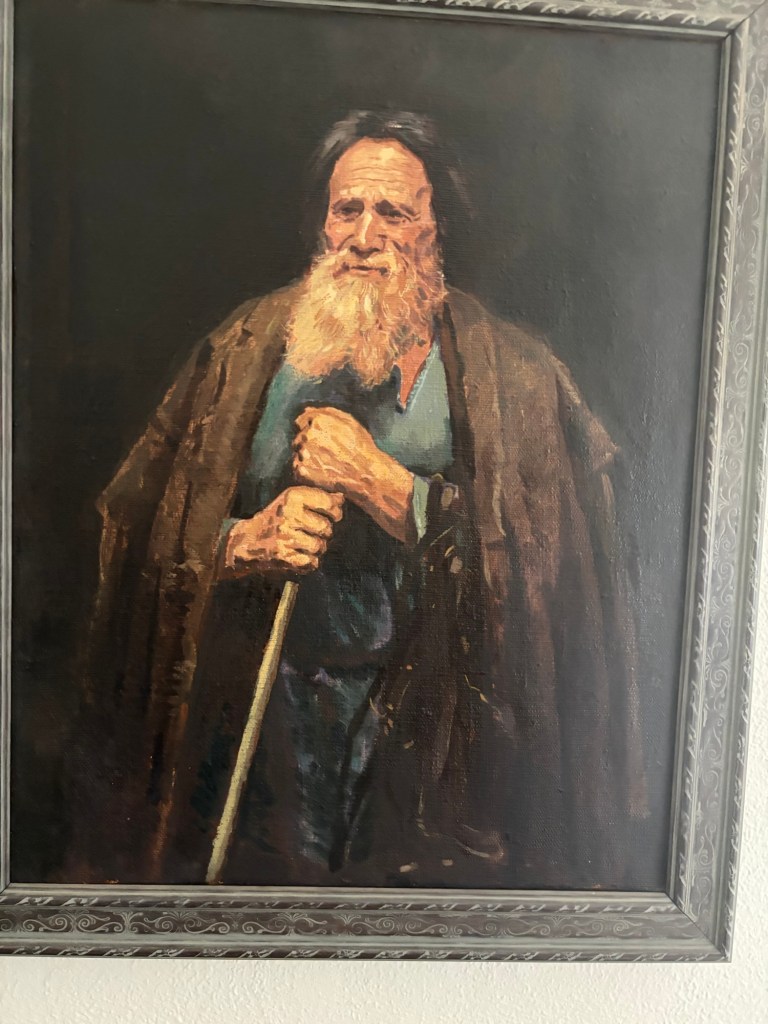
One of my very favorite pieces of art. It’s from Gorky Park, Moscow. Street artist — 1992.
Cameras can transform not-so-friendly people into Mr and Mrs Charming.
You may have noticed cameras and social media often dictate attitudes and behaviors.
Don’t be fooled.
Little reveals integrity and the lack of it more than how so-called powerful people treat all other people. Position and reach and power mean nothing if they lack authenticity and it’s all for the camera.
If he (no matter who he is) looks down on others, shows his power by withholding legitimate tips or generosity to prove a point, you have met an untrustworthy type. If she expresses that she’s surrounded by incompetent idiots and says things like, “If you want something done properly do it yourself,” beware.
Do not trust the “only for camera” smiles or niceness. If everything shifts in the above scenarios when a camera appears, beware.
A kind and generous person is kind and generous when there are no cameras, when there is no applause. A person who can relax and enjoy himself or herself over a meal with people with whom they have little or nothing in common without racing for the camera to publish their goodness and humility for the world to see, is a person of depth and of trustworthy integrity.
Allow yourself to experience your emotions – even the extremes. Don’t cover or hide from your grief. If you are feeling joy, express it. Avoid constructing a wall or barrier between you and your emotions. The day may come when you cannot see over the barrier, let alone climb the wall.
Take time to hear as many “sides” to every story. Don’t rush to judgment. There are usually 7, 8, even 10 sides to every story. Hear them all. Things are often not as they appear. Listeners take all the time needed to hear things out.
As far as you’re capable, go back and make right where you have failed. Often, this may be impossible. Make a list of your regrets, determine never to move in those directions again. Learn, recover, learn recover.
Even if it’s not in your usual habit, try to talk more to people you care about about the things you care about. Don’t rehash hobby horses. Let people into unexpressed parts of your thinking.
Notice your indifference. This is where you’ve been unmoved, unaffected, by things that ought to move everybody, ought to affect everybody. Allow the world about you, near and afar, to have its impact on you.
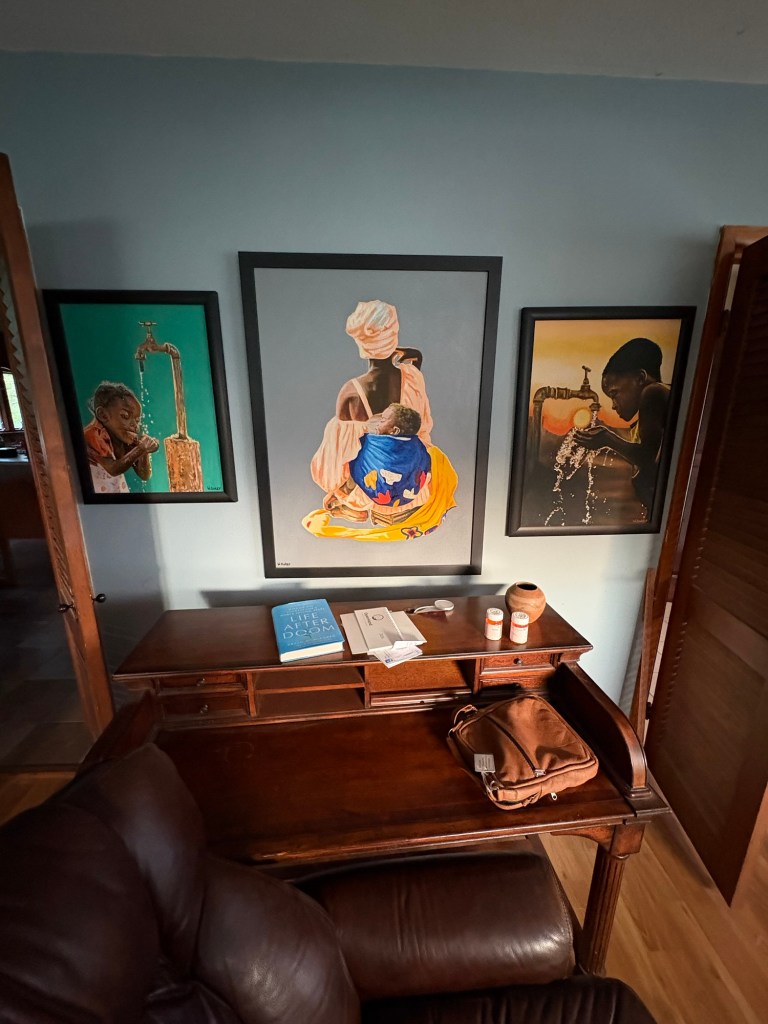
One corner of my home office……. you’re welcome here.
Your “spirituality” is not measured by how much you (or I) read the Holy Scriptures, sing hymns, pray, clap your hands, run around a sanctuary with a purple flag, dance to contemporary religious music or reject those who do.
It’s not determined by how much you visit your place of worship or how much money you donate to its causes.
It’s not affirmed by your title (if you have one) or the ornate design of your robe (if you wear one) or the position you hold in the hierarchy of your faith tradition (if you’re part of one).
But, it is affirmed by your willingness to take responsibility for your life, your choices, and the good use of your skills and talents.
A biopsy of the validity and integrity of our faith and spirituality is revealed in how we treat people, especially loved-ones and strangers; how we love our enemies, offer hospitality, respect, regard, love those who reject our beliefs.
Do you clean up after yourself? Are you wisely generous to a fault? Do you love those who are different from you, whose lives might be in direct conflict with what you believe? Do you love others by listening?
If you take full responsibility for yourself, become extraordinarily generous with what you have, embrace diversity, and love others by listening, you will fast-forward your “spiritual” growth. Actually, you will put it on supercharge.
It’s not your title, the reach of your authority, or the crowds who respect and adore you. Rather, it’s how you respect and love and respond to those who don’t.
I think my disdain for the sheer evil was discerned early on in my military basics when a breath-reeking dirty-mouthed two-striper screamed into my face from such proximity that I could smell and see his back teeth.
Mixing Afrikaans and English he proclaimed with anger that by the time he was finished and done, “finished and klaar,” with me, me specifically, I would be a real soldier, an “ordentlike soldaat.”
He said I would be able to march, not walk, march, in those shiny boots right over my mother’s dead body and feel nothing, nothing at all.
I gathered my thoughts.
He waited.
He expected the routine.
He waited for me to jump to attention and scream, “Ja, Bombardier. Bombardier is always correct, Bombardier,” in Afrikaans.
This response was expected, an individual response when addressed as an individual, or blurted in unison if addressed as a group. There were times it reminded me or 7-year-olds singing their times tables for a teacher.
“Do you know that you are stupid, and you are for nothing good?” would be said to all of us.
“Ja, Bombardier. You are correct, Bombardier. Bombardier is always correct, Bombardier,” we had to reply but in Afrikaans.
Agreement was essential no matter what insults were hurled.
This particular insult, that we were for nothing good, I found amusing. The “for nothing good” is a direct translation from Afrikaans and the bombardier would have had no idea how stupid he sounded in his desire to parade comfort in both official languages.
This time was different.
This was no routine insult.
He was screaming at me about my Mother, a woman he did not know, a woman about whom he knew nothing.
He was addressing me, a man he did not know.
A man about whom he knew nothing.
A man he had spent no time trying to know.
He was shouting so all could hear and be impressed by his evil aspirations with words tailored for me.
I waited.
I did not jump to attention and scream “Ja, Bombardier. Bombardier is always correct, Bombardier.”
I did come to attention and yelled, “Bombardier!”
Then, rather quietly, having now gained his full attention, I told the depraved man, in my faulty Afrikaans, as faulty as his English, that despite all of his efforts, I would indeed never, not ever, not in a thousand years, would I be that soldier.
I talked quietly and I was clear.
The bombardier appeared taken aback that I would dare reply with an unanticipated response.
He backed off.
In his retreat he did not send me or the whole squad running to the fence or make all of us do 30 push-ups. He moved away, stepping backwards, losing eye contact for brief seconds as his eyes darted seeking back-up from fellow bombardiers.
I did not drop my gaze.
I gave him all the eye-contact he ever could want.
Somehow, waiting to reply had knocked him off balance, stopped him in his tracks.
His peers made no moves of support.
He was alone in this and he knew it.
Perhaps it made him think of his mother but I will never know.
A violation had occurred and I refused to cooperate with pure evil.
He kept his distance.
He limited his involvement with our particular squad and seemed to forever regard me with suspicion mixed with a dose of fear and healthy respect.
That’s all I wanted; a lot of respect for my Mother and a little respect for me.
And, I wanted not to be that soldier.
Not ever.
So, I told him.
I wanted him to know I would never be that soldier.