The capacity to FORGIVE is a divine gift. It can precipitate healing within people and among groups of people. The person who initiates acts of forgiveness is usually (but not always) the one who reveals greater strength. He or she may be the one carrying the deeper burden. It is the stronger person (usually) who is first to forgive, and both parties – the forgiver and the forgiven – benefit from the act if apologies are expressed and accepted. When I choose to forgive I seldom have anything to lose, and usually much to gain.
I know I harbor resentment when I am uncomfortable being around a particular person and would rather avoid him or her. I know I am holding onto hurt when I have little or nothing positive to say to or about someone and when I find it hard to think positive thoughts about someone. I will forgive as efficiently as I find it possible and can muster the strength from within to do so.
I will forgive when someone’s actions toward me (real or perceived) seem sealed into my consciousness and I can’t let them out of the prison within my head. I know it’s time for me to forgive when I feel haunted by someone whose acts against me will not let me go. Forgiveness links me with the divine, heals fragile families, calms hurting communities and restores hope within broken people – and – sets the forgiver free.
Our daily walk takes us through this forest — a 5 minute walk from our home
The “outside world” can be a dangerous place for children.
Another exceedingly dangerous environment for children can also be their own homes. While medicine cabinets, cleaning materials and unlocked swimming pool gates are a legitimate threat to the child-safety, the unguarded mouth of an angry adult can inflict grievous harm to a child.
A vigilant parent might install childproof locks yet leave a totally exposed web of anger in every room of the house. Unresolved anger in a parent, expressed through unpredictable displays of frustration and annoyance or rage, can quite effectively sabotage a childhood and even pass a baton of anxiety and rage to unborn generations. It is in their own homes that children might be at most in danger. At home they learn about trust, and exercise the most trust. It is at home they will learn, or fail to learn, by watching and experiencing, almost everything they will ever know about love.
It is at home they will make the most mistakes and receive the most affirmation and correction. It is at home that children will learn about fear and hurt and rejection and empathy and love and acceptance.
Children are constantly seeing, feeling, learning, trying, sometimes succeeding, sometimes failing, watching, waiting and taking it all in.
Monitoring diets is a crucial aspect of childhood health. Another “diet” is the calm, security, predictability and warmth healthy parents can provide.
If you have the opportunity to see “The King of Broken Things” run at it.
Listen to your conversations, yes, eavesdrop on yourself.
I try to do this and I am often embarrassed how regularly I’m on auto-play. I hear the same stuff – the same stories and one-liners – coming out of me over and over again.
It is as if I am bored with myself and those who are part of the “conversation.”
I don’t like this about me and I don’t particularly like it when I’m caught in someone else’s well-worn loop.
Sometimes I hear traces of contempt and sarcasm in my conversations.
I am very careful about avoiding swearing and blasphemy, yet there are times I am apparently okay with using words as clubs and bullying others with snarky sarcasm. These verbal habits are surely at least as toxic as possessing a foul mouth.
The gift of thoughtful conversations, where people listen without waiting to talk and people hear what is really being said is something to which I deeply aspire despite what sometimes comes out of my mouth.
By the way, I am heading to Duban during much of February.
I would be delighted to speak at your school, church, business, or club – and I promise to watch my mouth.
Drop me an email if you are interested.
Let’s see what time permits.
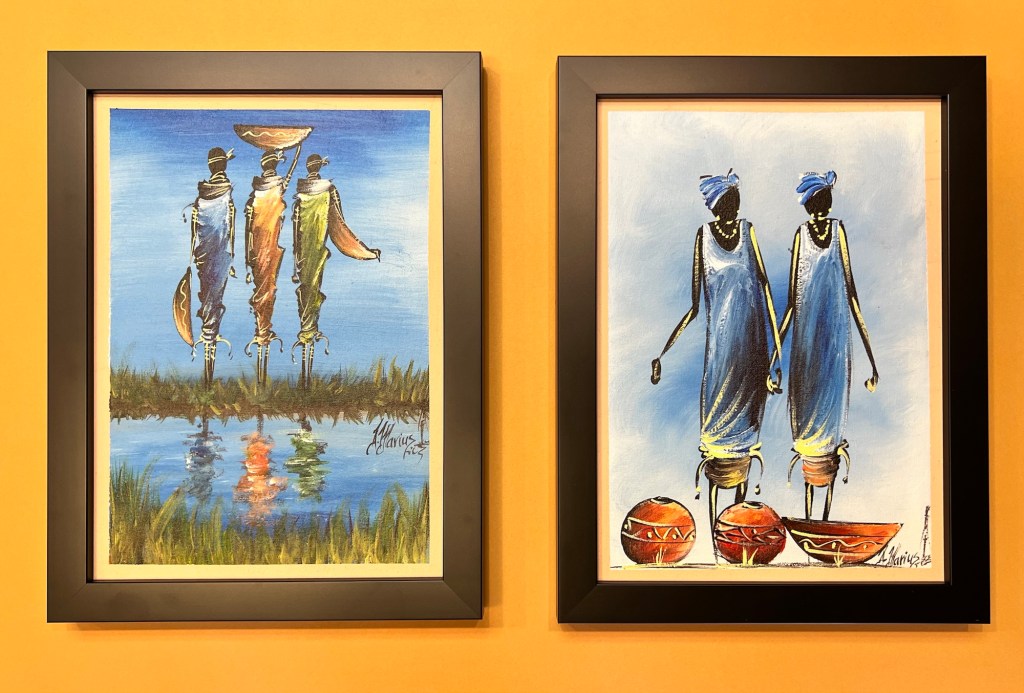
Two new pieces in our home — picked up in Lome, Togo and framed locally.
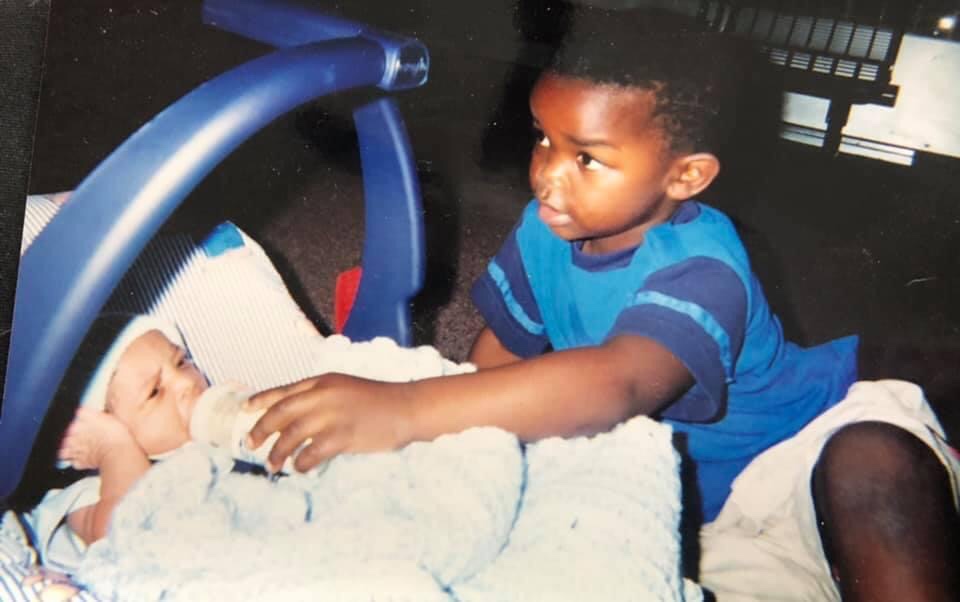
You were “easy” babies, fabulous toddlers and terrific young children.
You were hilarious preteens and mostly cooperative teenagers.
Now, you are productive, employed, adults.
I have written to readers far and wide – often to severe resistance – my belief that parenting ends.
While I will always be your dad, you may have recognized that some years ago, wise or unwise on my part, believing I had imparted all that was necessary, I “pulled back” and gradually stopped parenting each of you. You have been making almost all your own decisions for years and have both been rather good at it.
Now, we are three men (mostly) enjoying our shared relationships and one of us happens to also be your dad.
As far as possible I will be available for you. I probably will “jump in” if I discern a dire need to do so, but generally I will resist any urge to impose my need to parent upon you.
I love you, I will seek your highest good and love all whom you love. Know this: each of you in your own way saved my life. You have made this dad really appreciate Father’s Day and I thank you.
Today, and every day, try to be the adult you hope your children will become. How else will they learn what it means to be an adult? Who else will teach them?
Try to stop blaming the teachers, coaches, or the school for your child’s every challenge, difficulty, or hurdle. Blame restricts maturing, yours and theirs.
Try to stop blaming the government, the economy, or prejudice for every distress or dilemma you face, unless you think blame will be a good tool for your child to take into adulthood. If you want your children to be adults who take responsibility for their lives then show them how it’s done. Your children won’t forget your temper tantrums no matter how young they may be; and they will probably emulate them.
Demonstrate, by your own display of excellent manners, the manner in which you hope your child will navigate life and relationships. It is true, they are going to watch and learn from multiple sources, but you are their primary resource when it comes to how they will respect and treat others. Little eyes are watching.
Respect, visit, and be kind to the elderly so they know exactly how to do it when it’s your turn.
Dismiss no one; look down on no one. Young eyes and ears are absorbing how to be in the world, and we, we parents, are the primary teachers.
Blending families, smoothly and successfully, is not easy.
Each family imports its own set of norms and expectations into the new family configuration and these norms and expectations will inevitably clash. Each person, too, brings expectations into the new family quite apart from what the rest of what his or her original family brings to the party. There will also be remaining scars from the sequence of events that made blending two families possible in the first place.
Blending families calls for super-maturity from the marrying or newly married adults.
They are called to lead in such a manner that all the members of the newly constituted family’s voices are heard and opinions are respected, irrespective of age.
The adults will be wise to avoid blaming others like a former spouse or former in-laws for the inevitable difficulties that will arise.
The adults will be wise to avoid disciplining other people’s children, even if he or she is newly married to the children’s mom or dad.
The adults will be wise to avoid believing the children – no matter what they may say when wanting to please the parent – want this new family as much as the newly married adults do.
The adults will be wise to speak well of the parents who are excluded from this new blended family.
The problem with difficult childhoods in troubled families (pick your conflicts or addictions or stressors or health concerns – or a combination of several) is that children with difficult childhoods have had to dress for self-protection, and, as a lifestyle, have often had to prepare themselves for enduring domestic tensions or wars and regarded it as normal. This is how everyone lives isn’t it?
Once the child becomes an adult its difficult to shed engrained protection measures and essentials and throw off a guarded and conflictual lifestyle even if it’s no longer needed.
Carefree happy children may become carefree happy adults but it’s unlikely a stressed and anxious child will enter realms of stressfree bliss and trusting vulnerability on coming of age.
Adult survivors of difficult childhoods hear things like, “You’re so difficult to get to know,” and “You’re so difficult to get close to,” and “Why does everything have to be a fight?” and proceed with the hard work of adult life that mirrors the hard work of childhood wondering what on earth people are talking about.
************
Unrelated to column: got some new art in our home today: Cameroon artist Patrick Yogo Oumar (see Instagram if interested).
I expect you to tell me the truth to the same degree I have told you the truth. I do not expect you to tell me everything. I know you have parts of your life that has little or even nothing to do with me. I expect and welcome this.
I do expect you to tell me things that reasonably high functioning families consider important. If it, whatever “it” is, impacts you immediately and significantly or is likely to take me by surprise now or in the future, I want to know about it. I want to know about it as soon as possible. Of course, it goes both ways!
I expect you to offer me the same degree of freedom as I have offered you. I do not treat you like room service or 911 and I want the same respect in return.
I expect you will progressively pay your own way beginning around 16. This means you will assume all the costs related to your life as you work and earn more. I hope you will continue to apply the same aptitude to creating your great future as you have to creating your great success at school. While I will always be proud of your successes, they will always be yours, not mine.
I expect you to write well, read well, and communicate well.
It’s easy to knock so-called helicopter parents – the ever-present, ever-serving, ever advocating parents who are perpetually running interference with schools and coaches, often in ways that can be stifling, even damaging the very children around whom they hover.
All behavior has meaning. Parents “helicopter” their children (I’m amused that I used “helicopter” as a verb) for deep, powerful and hidden reasons, reasons often vastly beyond simple formulae or fixes.
What I do know is that it has nothing to do with the child. I’d motivate for understanding, empathy, awareness, and acceptance for the helicopter parent. Perhaps it is fear driven. Perhaps there’s a lack of trust with that lack originating long before the child was born. Perhaps the child is regarded as a lifeline to something saner, something more tolerable than the parent has ever known. Perhaps the parent has been used and discarded in the past and is dead set on safeguarding the child so history will not be repeated. Perhaps the marriage is perched precariously on hopes of the child’s success.
There are reasons to fear, lack trust, to want a life more powerful and meaningful than the parent may have known.
Empathy, awareness, acceptance, and understanding may go a long way to secure the helicopter’s safe landing rather than the humor or rejection used to shoot it down.
Each of us brings to every relationships a backdrop of how we view the world, understand commitment, view, and value people, join groups, terminate friendships, love, and leave home, nurture babies, pack the dishwasher, engage in or avoid conflict, and many things too numerous to mention.
Everything about our relationships is influenced by who, where, and how we were reared – among countless other variables, including natural endowment, and deeply held dreams and desires.
From these countless sources, experiences, and codes, both known and unknown, each of us was handed a Tribal Code or our truth about how life ought to work. How life was done, how relationships were conducted, talked or not talked about, became the folklore, the “correct” or the “right” way to live.
Your formative years did what they were supposed to do: they formed (and informed) you.
They taught you what, and how, to see, think and feel. They showed you what “normal” is to your family, and your experience became your measure of how life is supposed to work.
Then, when entering relationships, be it in marriage or if you are talking with your child’s teacher – the person opposite you has his/her own, and different, tribal code. He/she has his/her own lenses through which to see the world.



 difficultrelationships.com