
Archive for ‘Manipulation’

May 31, 2006

Divorced dads – living without blame and loving your children

by Rod Smith

Children will, at various times, blame both parents for a family’s breakup, no matter who is to blame. Don’t try to get your children to be on your side even if your wife was wrong on every count and you, in your perfection, sprouted angel wings. Two people marry and both contribute to the need for a divorce when it becomes necessary.

I’ve met men (and women) who claim to be innocent victims of divorce but I hardly ever buy it.

Look a little deeper at what you did or did not do in the marriage. Get your focus off your ex-wife and ask yourself what your role was in the deterioration that necessitated dissolution of the marriage. Growth, and healing in your relationships with your children will elude you until you assume full responsibility for your part of the family’s breakup.

Until then, until you are cognizant of your role and take responsibility for it, any strategy you employ to more effectively love your children will serve only to create a further wedge between you and seem to “push” the children further from your urgent love. Until you stop all blame and victim thinking, your toxicity will permeate all your relationships, especially the one you want with your children.

May 18, 2006

Difficult or “high maintenance” people

by Rod Smith

(Published in The Mercury – 05/19/06)

Several years ago you wrote about “high maintenance” people and described my then-girlfriend to a T. Please publish it again. It was hard to believe a person who had never met my girlfriend at the time was able to describe her with such accuracy.

Comments come to me as Emails. I will make time if you want to talk.

Comments come to me as Emails. I will make time if you want to talk.

High maintenance people require constant attention and approval. They crave to be the center of almost every conversation and will often become symptomatic (moody, resentful, loud, threatening) when they are not. They analyze every move, thought, word and action of others, and then read more meaning into things (statements, looks, sighs, attitudes) than was ever intended. They are easily hurt, quickly offended, quick to rebuke when they do not get the kind of attention they think they deserve. Threats of withdrawal or desertion become a way of life.

High maintenance people are difficult, sometimes impossible, even in the most relaxed of circumstances. They pick fights, find fault, and personalize almost everything. They argue with people who are closest to them for no apparent reason. They often pick on strangers (waiters, helpers). They often live in a world of cut-off relationships where others are idiots and no one understands.

What can you do if you are in a relationship with a high maintenance person? You can do very little that will not hurt, offend, or get a reaction – but you must make a stand. High maintenance people seldom benefit from pity or patience or empathy. They will only benefit from being constantly challenged to grow up.

May 16, 2006

My partner’s son (9) is making our alternate weekends miserable

by Rod Smith

REQUEST FOR ADVICE: I am divorced. My son (15) and I live with my partner who is a wonderful man. Every second weekend our home is miserable because his son (9) comes to stay. I find my partner’s son very manipulative. My partner cannot see anything wrong and I am told I continuously pick on his son. I have rules in my home with which my son must abide and when his son comes to visit the same rules apply. Because I am blamed constantly and told that I don’t like his son, it is becoming a reality. I would greatly appreciate some advice. (Letter edited)

ROD’S REPLY: If your partner is so wonderful marry him. This will give you a legal platform for a relationship with his child and then you can legitimately refer to his house – your letter suggests you are living with him – as your home.

In the meantime I’d suggest you (and your son) find alternative accommodation every second weekend while you research what it is about you that a nine-year-old child can wield has so much power over you.

Adult behavior is very important in setting the framework for a child’s behavior. Neither adult is presently offering this boy a stable, trustworthy context and of course he is going to learn to manipulate!

May 6, 2006

Costly dating errors

by Rod Smith

When you first meet someone and decide to have a first date don’t:

1. Get too close too quickly.
2. Get physical.
3. Give or lend money.
4. Tell everything.
5. Allow the person to move in with you.
6. Let them use your credit cards.
7. Let them use your car.
8. Let them sign or use your name on anything.
9. Let them use your address.
10. Let them baby-sit your children.
11. Modify your values or your morals to impress him/her.
12. Go against the advice of people who have loved you for a long time.

There is no love at first sight! Exercise cautious wisdom in all new relationships. While thinking readers might find this list absurdly unnecessary, I have had bright, thinking clients who have done one (or a few) of these things on a first date. Their errors have been very costly to some clients.

April 18, 2006

He is driving me crazy (with his jealousy)

by Rod Smith

He is driving me crazy! He goes through my mail. He scrolls the computer to see the websites I visit. I run a daycare. He accuses me of doing stuff with every dad, grandpa, uncle. I have never cheated but I feel as though I am being treated worse than if had. My daughter is 3 and he is like a step dad and has been there all her life. I am afraid if I leave him she will never get to see him and if she does he will tell her dad to start problems. He even has his mom and dad look down at our house to be sure nobody is here. Please write something about what I can do. (Letter edited)

Jealousy is a virus and he is riddled with it. His jealousy has NOTHING to do with you or your behavior. Is this the kind of man you want showing your daughter what men are like? I would hope not! Behave as you would hope your daughter would behave were she to one day find herself in a similar situation. Focus on your behavior and not on his! Unless you get yourself free, things will only get worse.

April 17, 2006

Triggers – hit hardest in intimate relationships

by Rod Smith

Have you had feelings come over, even overwhelm you, that you recognize from childhood? Has background music, the whiff of a particular perfume, seemed to emotionally cripple you? Unresolved childhood traumas will almost certainly visit victims as they get older.

Sadly, it is in intimacy that negative associations of childhood most strongly stir. It is in the beauty of loving relationships that the memory of an inappropriate or abusive moment tugs eerily from a distance. A forced closeness years ago now hinders you when you long for adult intimacy. It is in love that the traumas of childhood raise ugly heads. So intricate is our human makeup that intimate connections stir positive and also negative memories. It’s negative triggers that are indiscriminate, often unyielding, forming debilitating links to the hidden pain of our lives.

Tensions with a spouse might have nothing to do with the spouse but with what’s unresolved from our adolescents. We fight yesterday’s battles today, with the “wrong” person. The conflict is an attempt to settle childhood scores. There’s benefit to discovering relationship struggles often have their origins a generation from where we might seek resolution. Examination, prayerful consideration of our bundle of triggers can defuse them and peace might be found.

March 19, 2006

Husband denied then admitted affair….

by Rod Smith

I read your “Jack and Jill” column last week and was pleased to see that I am not alone. I found out that my husband of 14 years had been having an affair for months. He denied the affair and through pure digging he admitted it. When I bring the affair up he gets angry and tells me to get over it otherwise our marriage is never going to work. He says I have to control my emotions and I must believe him when he says it is over. He says I have to stop going through his personal slips, his cell phone bill and that he feels like he has no privacy. He has turned that situation around after begging me to please forgive him and promising to do anything to make our marriage work and believe in him again. (Letter edited)

It is not your lack of control but his that landed you both in this unfortunate place. It is his lies, not your discovery of them that eroded your capacity to trust. A regretful man would invite you to talk about it as much as you want and to “dig” anywhere you please. Don’t permit further abuse – it was not you who broke the marriage bond.

March 15, 2006

Three poisons for love: Manipulation, Intimidation, and Domination

by Rod Smith

TUYL

Stay OUT of control...

When people have to use intimidation, manipulation or domination, the relationship is already spoiled or poisoned. It has become a power play of control. Redeeming such a relationship is possible with the implementation of a wise plan, strongly re-defined boundaries, enduring commitment, and the possibility of a time of separation in order that perspective might be gained.

Willingness and desire to be together, equality between people and complete mutuality are the hallmarks of healthy relationships. Where any form of strong-arm tactics are used, the relationship has already taken a turn to become something harmful to both the parties.

Each of these relationship-poisons (manipulation, domination and intimidation) can be very subtle, coming in different shapes, sizes, and intensities.

Here are some of the evidences of manipulation, intimidation, and domination in a relationship:

1. The relationship has been kept on an unequal footing in order that one person might keep power over another. In a severely controlling relationship, both persons might have forgotten there are choices at all.

2. One person tries to get what he or she wants without declaring what is wanted. In attempting to get what the one person wants, both persons are in some way diminished.

3. One person does not see the other as totally free.

Confused boundaries4. One person tries to get what he or she wants through threats or withdrawal.

5. It is expected that every move, thought, and feeling will be reported at least from the less-dominant person to the other. If one person is unwilling to tell all, it is assumed there is something to hide.

6. One person is not free to make plans without consulting or getting permission from the other.

7. One person in the relationship continually evaluates and examines the commitment and love of the other.

8. The dominant person tells the other how they should feel and usually re-scripts any division or disagreement into the appearance of unity.

9. One person feels at liberty to speak for both people and then, is offended when the partner wants to express his or her own views.

10. Desire for self-expression or a distinct voice (by one) is considered betrayal or a lack of trust (by the other).

11. One person expects unilateral support for his or her opinions, choices and desires, declaring somewhat of an attitude which says: If you say you love me then you have to love everything about me, under all conditions, and all of the time.

12. Difference in opinion or having different interests is considered a lack of love, or a lack of respect and commitment.

Simple definitions and a metaphor which might be helpful in considering the three “cancers” of relationships:

Manipulation: playing chess with another person or with people. Maneuvering as if life were an attempt to checkmate others into loving us or doing what we want.Explosive
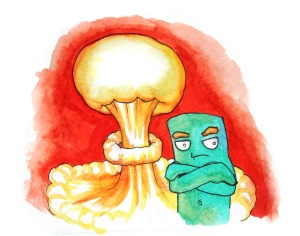
Domination: playing chess with another person or with people as in manipulation. The difference is the dominator has removed the opponent’s pieces without declaring so in the first place.

Intimidation: playing chess with another person or with people where winning and losing comes with either the threat of punishment or actual punishment.

Healthy Relationships: There is no element of either winning or losing; they are not a game of chess at all and are free of tactics and agenda.


March 14, 2006

My boyfriend tells me what clothes to wear and it annoys me. What must I do?

by Rod Smith

Don't feed jelousy....

Don't feed jelousy....

Buy him a mannequin and flee! He can dress the dummy in whatever clothes he deems suitable as often as he pleases. The mannequin will give him the total control he wants over you, and, since dummies are brainless, he will be able to win all arguments and keep “her” in total submission.

That you ask the question suggests you are putting up a fight and resisting his advances on your brain. Small-minded men (any who dictate what “their” women wear, to whom they talk, how they spend and arrange their time) usually flee any sign of independent thinking on a woman’s part if, at first, they cannot kill it. Strong women frighten them since they confuse control and “love.”

Don’t fall for it. Love and control are not even in the same family. A man who wants to dictate how you dress will also want to tell you how to think, feel, and see before long. Men who want to control “their” women do so because they are rarely capable of feeling in control of anything else. A healthy man will leave your clothing choices up to you unless you specifically elicit his opinion.

January 22, 2006

The myth of love at first sight

by Rod Smith

Love requires knowledge and experience

Love at first sight is impossible. Love requires knowledge, time, maturity, conflict, fun, experience, mutual struggles, and a lot more together before authentic love can develop. People can know “at first sight” that love might develop. Such knowledge, in itself, is not love. Every “in love” couple knows they are still learning what love is and means. They know it requires a growth period of twenty, thirty, or even fifty years. Sadly, many couples give up on each other, and on love, before it has the time to mature into something exceptional. When they see it is very hard work, having hoped for something easier, sights are lowered and something approximating love develops, then boredom peaks, and even the divorce court can beckon. Sometimes an affair stands in the wings or a grave brings relief.

Authentic love is about effort, decisions, actions, attitudes, and commitment spread over many years.

Loving someone is about seeking his or her highest interests while, at the same time, not ignoring your own highest interests. It is impossible to love someone more than you love yourself. It is impossible to know someone more deeply and more intensely than you know yourself. Pseudo-love can masquerade as authentic love and, at first, feel very good. In its early stages, manipulation can be confused with caring, intimidation with a “watchful eye” and domination with “strong commitment.” These are the love’s poisons and distorted love follows. True love’s hallmark is freedom for both and a respected, acknowledged voice for each. Anything less is not love.

When a couple, say Anne and Bob, are both healthy people who develop a lasting and loving relationship, she is able to focus on him without losing or compromising herself. They don’t become each other nor are they glued together. Being apart does not mean falling apart or the undermining of the relationship; being together does not deny individuality. She’s decided to love him. Bob has decided to love Anne. It has nothing to do with the performance of either. The love lives inside each one for the other.

Anne and Bob focus on what they can give to each other without giving up themselves. They know a mature loving relationship is about total equality. They desire mutuality in every respect and both work very hard toward it. There is a palpable freedom between them and a team attitude even when they are involved in unrelated or separate activities. They inspire each other toward separate and shared goals. Neither is threatened by the other’s willingness to grow and achieve and both heartily applaud and encourage the success of the other.

They are willing to hear things from each other they would prefer not to hear. Neither changes what they think, feel, experience or believe to accommodate what they believe the other might prefer to hear. Truth is told with kindness. Anne and Bob share a sacred trust. Questions are born out of a desire to participate in each other’s lives and not from suspicion about each other’s activities. They know and often experience that love casts out fear.

Ann and Bob are faithful to each other because faithfulness builds healthy, sound friendships with all people. Ann is faithful to Bob because even if she did not know Bob, she’d be a faithful person. He is faithful to her because he already is a faithful man. In a sense, their faithfulness has nothing to do with each other.

An absolutely private world, holy territory, lies between them. They go to places together in this world that each has never been before. Here, they touch the heart of God through commitment, mutuality, freedom and respect. In this private place of communion, the depth they know in this sacred intimacy is never equaled with another or devalued or soiled through compromise with another. It is highly valued, a protected place for them both, and, like very expensive art, is defended, enjoyed and treasured by each of them.