Archive for ‘Communication’

July 6, 2011

Our intimate life is boring……..

by Rod Smith

“My husband and I were happy until the birth of our son when our relationship changed. After our son was born he started cheating, lying, and drinking everyday. We spent less time together than we used to. I thought we were friends, but now it feels like we are distant cousins. Our sex life is boring.”

Your future must seem painfully endless!

While I am sad that you are victim to your husband’s cruel behavior, I am also sad for your child who is witnessing a marriage he could hardly want to emulate.

Please read David Schnarch’s book entitled Passionate Marriage. I will warn you that it is the very best book on sex and relationships I have ever read.

While the book is very explicit, it is never pornographic.

It is to be read as a whole, cover to cover, before judgments are issued on its worthiness.

The book outlines the journey of couples who have lives as miserable as you describe yours to be, and offers valuable keys for all marriages and all relationships.

I have gotten into hot water for recommending this book to couples.

Not only does it promote strong,  healthy sex lives, it challenges people to live full, complete, and adventurous lives.

July 1, 2011

Power-struggles with a boy…..

by Rod Smith

“The man I am living has a son but when we moved in together I did not think he would be living with us and only see his mother every other weekend. His dad goes easy on him and that’s okay. When I try to say something I’m the bad guy! He told his dad and grandma that I am mean. I just don’t let him get away with stuff like his dad and others do. I have 3 children who know that I don’t let them get away with stuff. The man I am with does not see that his son is running his life. I have been going through this for three years. Please help.” (Edited for clarity)

Three years is a long time to be in a power-struggle with anyone – let alone a child! While you are not married to the father the child will always win. Actually, when you are married, too, your “power” over the father and the son will also be rather limited.

This said, you now occupy no legal position in the family and therefore the father has no motivation to hear what you are trying to say, or to see what it is you see in his son’s behavior.

Give up the struggle. Let the dad and grandma be the “good guys.” Become “silent guy” (regarding the child’s behavior) until you are legally empowered to play your part.

Before I am deluged with mail and told I am advocating for the child to have no boundaries, or advocating lawless behavior for the child, please note, it is not the child who has the issue.

The woman wants power (I am sure for “good” reasons) over the child which she simply does not have. The person who does have the power (the dad), is choosing not to use it!

Marriage might not change anything, but at least it will give dad some incentive to hear his wife about the child.

A legal contract DOES make a difference to a relationship. The woman’s status will change even if the boy’s behavior does not!

June 26, 2011

Four sure-fire ways to increase family emotional health and deal with overly-sensitive people

by Rod Smith

I have received several very welcome and lengthy letters from readers who find themselves in very complicated family relationships.

Here are four broad principles for all members of a family:

1. Get yourself out of “the middle” of other people’s relationships! Don’t carry messages for others, or think for others or feel for (on the behalf of) others. Allow other adults the joy or communicating their own messages, thinking their own thoughts and feeling their own feelings.

2. Regard all other adults as complete adults and your complete equals. If you’re “on eggshells” around anyone (a parent, boss, child, spouse or former spouse) this person has inappropriate power over you that I’d suggest you address. The “eggshells” means you are not seeing yourself as an equal.

3. Never allow yourself to be intimidated, dominated or manipulated. Persons who use intimidation, domination or manipulation (emotional bullies) to get their way must be confronted if you want any degree of healthy dialogue.

4. Despite age, rank or status, don’t “tread lightly” around other adults. While it is unnecessary to knowingly inflict hurt upon others, some people are so inappropriately sensitive that their oversensitivity can restrict others from normal behavior. If your actions are not in themselves hurtful, but are interpreted as such by some sensitive soul, I’d suggest you be yourself and challenge Mr. Mrs. or Ms. Oversensitive to grow up.

June 26, 2011

Essential topics for talks with children……

by Rod Smith

Thulani, Nathanael, Max, and me

Important conversations do not need to be “serious” conversations. Thulani and I talked about my death. I had the distinct impression that although it is a tough concept for him to embrace, he’s rather have had the conversation that not have had it. I told him that he’d bring me most honor and joy through going forward (from my death) to live his own life as powerfully and meaningfully as possible.

Here are the broad topics I believe to be essential

Grief and death

Handled gently, death and grief can become a part of any parent-child conversation. Talking about death and dying does not need to be scary or even sad – and talking about it does not cause it.

Sex and intimacy

Helpful conversations about sex and intimacy do not need to be a “big talk” but an ongoing dialogue. Let your child learn about the joys and beauty of sex from you, the parent, not from a school or “program.”

Space and boundaries

Teach your child where he or she begins and ends – what is and is not his or her responsibility. Teach him or her to responsible to others and not for others.

Money and debt

Showing children how investments grow can become a powerful incentive for a child to save. Pointing out the folly of the misuse of credit cards and how debt can radically accumulate is a lesson every child ought to learn.

Planning a great future

It’s a cliché, but if you aim at nothing it is likely you will get it every time. It is a gift to any child to teach him or her to plan a powerful future.

June 23, 2011

Take back your future…….

by Rod Smith

“A friend brought your column to my notice this morning. I cannot believe it! It’s like you were reading my mind! I’m trapped in my marriage of 27 years. My husband and I hardly communicate as he disagrees with everything I say. I have now chosen to communicate as little as possible in order for us not to get into an argument. I too walk on eggshells of fear of saying or doing the wrong thing. Everything around the home has to be done his way. My suggestions just fall by the wayside. He has not been able to contribute financially for years so maybe this is his way of retaining his ‘head of the family’ role. I think I’ve written to you ten years ago and nothing has changed since. Maybe I need to change. I’ve been unhappy for so long that I may never have a normal relationship again.”

Ten years is a small price to pay to learn that you are the one who might need to do some changing – many people never discover this.  If your husband is unable to manage his own happiness, why on earth would you think he can take care of yours?

Gather trusted women.

Carefully (slowly) hatch a plan.

Implement it.

Take back your future.

[If you want something better in the future than you have had in the past it won’t just happen to you. You must engage in the planning, you have to do something different in the present, if you want the future to look different from the present and the past.]

June 21, 2011

Love Poisons: Manipulation, Intimidation, Domination

by Rod Smith

When people have to use intimidation, manipulation or domination, the relationship is already spoiled or poisoned. It’s a power play of control. Redeeming such a relationship is possible with a wise plan, strongly re-defined boundaries, enduring commitment, and the possibility of a time of separation in order so a modified perspective might be gained.

Willingness and desire to be together, equality between people and complete mutuality are the hallmarks of healthy relationships.

Where any form of strong-arm tactics are used, the relationship has already taken a turn to become something harmful to both the parties.

Each of these relationship-poisons (manipulation, domination and intimidation) can be very subtle, coming in different shapes, sizes, and intensities.

Here are some of the evidences of manipulation, intimidation, and domination in a relationship:

1. The relationship is kept on an unequal footing that one person may keep power over another. In severely controlling relationships both parties may have forgotten there are choices at all.

2. One person tries to get what he or she wants without declaring what is wanted. In attempting to get what the one person wants, both persons are diminished.

3. One person does not see the other as totally free.

Confused boundaries4. One person tries to get what he or she wants through threats or withdrawal.

5. It is expected that every move, thought, and feeling will be reported at least from the less-dominant person to the other. If one person is unwilling to tell all, it is assumed there is something to hide.

6. One person is not free to make plans without consulting or getting permission from the other.

7. One person in the relationship continually evaluates and examines the commitment and love of the other.

8. The dominant person tells the other how they should feel and usually re-scripts any division or disagreement into the appearance of unity.

9. One person feels at liberty to speak for both people and then, is offended when the partner wants to express his or her own views.

10. Desire for self-expression or a distinct voice (by one) is considered betrayal or a lack of trust (by the other).

11. One person expects unilateral support for his or her opinions, choices and desires, declaring somewhat of an attitude which says: If you say you love me then you have to love everything about me, under all conditions, and all of the time.

12. Difference in opinion or having different interests is considered a lack of love, or a lack of respect and commitment.

Simple definitions and a metaphor which might be helpful in considering the three “cancers” of relationships:

Manipulation: playing chess with another person or with people. Maneuvering as if life were an attempt to checkmate others into loving us or doing what we want.Explosive
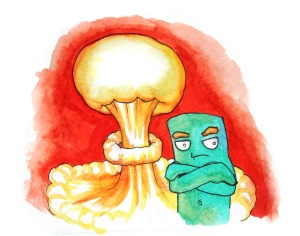
Domination: playing chess with another person or with people as in manipulation. The difference is the dominator has removed the opponent’s pieces without declaring so in the first place.

Intimidation: playing chess with another person or with people where winning and losing comes with either the threat of punishment or actual punishment.

Healthy Relationship: There is no element of either winning or losing; it is not a game. It is free of tactics, ploys, moves, and agendas.

June 20, 2011

There’s yelling, name calling, and pointing……

by Rod Smith

“I’m getting ready for church. He assesses what I’m wearing and suggests a dress he bought me. He wonders why I’m unhappy about it. We get into a fight. There’s yelling and name calling, and pointing. He advances into my personal space. He turns it into me being a victim based on my past. I’m very broken. He also threw out an ultimatum.” (Letter edited)

Destructive exchanges lead couples nowhere worth going. The “thinking brain” shuts down. The “fight, freeze, or flee brain” kicks in, assumes control, and wants ward off the perceived threat. Both people, in the heat of the moment, feel choices are limited and so things to escalate – they fight fire with fire and insult with insult until a domestic war ensues.

While difficult to do, walking away is the more helpful option.

If she’d said something like, “You choose your clothing. I’ll choose mine. I will not fight with you. You do not have permission to ruin my day,” and left for church without him, he’d have had the time and the space to face the unresolved issues that predate his marriage.

Why else would he want to determine what another adult wears?

June 19, 2011

Pushing a book…….

by Rod Smith

image Marriage and Divorce, A Survivor’s Guide by Durban’s own Spike Farrell, is the only book I have ever come across that makes essential reading for both happily married couples and those in the throws of a divorce.

Its 73 short chapters (yes 73!) cover every imaginable topic, some of which, if followed word for word, will spice up and encourage a teetering marriage. Other chapters will help in the uncovering an affair while yet others will assist couples find a meaningful life post divorce when divorce has been unavoidable.

Spike is overwhelmingly for marriage. He wants every marriage to survive. Yet he recognizes that sometimes divorce is inevitable. His book is geared to helping couples on every point of the continuum from blissful happiness to those seeking necessary dissolution.

Spike is unpretentious, he’s quick witted, and he’s thoroughly practical – and I hope his book is a great success.

Contact Spike directly at: spikefarrell@mweb.co.za

June 16, 2011

Step-mother may want to realign her expectations…….

by Rod Smith

“I met my husband when his children were 3 and 7. I thought that I would learn to love someone else’s child and that it would just take time to bond. We are now married with a child of our own. Their biological mom is and has always been trouble and does nothing but try to put both my husband and me down in the kids eyes. The kids are sweet and loving but I still find it hard to bond to them. It’s always ‘my mommy this’ and ‘my mommy that’ and it makes it hard to bond. At times I want it to be me and my child and husband. I know how this sounds but seriously can you tell me I must immediately love and like everyone just because they happen to be smaller. I am not a bad or evil person I simply dislike having to be caring and attentive to another person’s child when I get none of the reward. They will always love their mother more and that’s the way it should be, but I can only take so much rejection. Eventually my heart turns off and I am left wondering why I thought being a step parent would be great.”

Blending families is one of the most difficult relational challenges humans face. Everyone in the family faces difficulties, even the children.

If you feel “unrewarded” you might want to reconsider some of your expectations. Any awards ceremony may only occur, if it ever does, when the children become adults and they reflect that you were a non-possessive, non-anxious, steady presence in their lives at time when their lives had been hit by several large blows all seemingly accosting them at the same time.

So, hold off on expecting much reward. It’s not that you won’t be rewarded; it’s that expecting it in itself suggests you might want to realign the understanding of your role.

Asking young children to love (embrace, accept) a stepmother without feeling disloyalty to their biological mother is asking children to do emotional acrobatics that most adults could not do.

If you want your “new” family to survive the continued presence of his “old” family, then I’d suggest you do not make too much of the distinction. “Us” and “them” doesn’t bode well for any human community let alone a blended family. Also, stay out of being the front line of discipline for “his” children: messing with invisible loyalties is a sure fire way to detonate the anger abiding already in the family system.

June 9, 2011

Son (8) asked if boys can marry boys and girls can marry girls….

by Rod Smith

My son (8) recently asked me if girls can marry girls and boys can marry boys. I didn’t know how or what to answer and so I changed the subject. I know that avoiding his question is wrong and I am mentally preparing myself to answer his question soon. I am not homophobic. One of my close friends is a homosexual.

Attraction is only enduringly poss

Relax, and then talk about anything

Tell your son that in South Africa (origin of Email) men and women can love and marry whomever they want to marry. Inform him that one day he will be old enough and wise enough to marry anyone he loves and who, in turn, loves and wants to marry him.

Now, before I am pummeled with both hate and love mail from all sides, please remember that your answer to your son’s question will not determine or change his sexual orientation. Parent-son conversations are simply not that powerful.

Your openness and comfort in having meaningful conversations about personal topics with your son will not determine his sexual orientation, but it might determine if he keeps talking with you and asking you questions about personal and important matters for many years to come.