Archive for ‘Children’

June 24, 2009

[Over]-parenting Karl

by Rod Smith

A little space goes a long way...

A little space goes a long way...

Over-protection had so overwhelmed Karl (15) that he had perfected the ability to escape from behind his own eyes. His vacant stare allowed him to see and note nothing most of the time. His head did turn slightly and very slowly in the general direction of his parents when they talked, but nothing about his demeanor allowed even a hint of interest. This did not inhibit the determined twosome in their attempts to correct this disconnection. Their every approach to Karl included rapid movements as they tried to prance into his line of vision, which was as difficult to discern, as it was to enter. His only response, which his parents found most encouraging, was a mild trace of disgust that appeared in the very minimal and effortless contortion of his lower lip. The boy had perfected the art of unspoken disdain that served only to have his animated parents increase their efforts to engage him even further. Disdain was something they found unthinkable, and it was quickly, positively, reinterpreted as they reassured each other of the widespread inability of teenagers to be demonstrative with love. They’d made a pact that they’d never believe anything negative from their son and encouraged each other with humor saying, “The Teen Monster abducted Karl.”

“Karl,” said his dad leaning elbows on his knees, “Look at me! Look at your mother. Look at anything.”

“Honey,” his mother said mirroring her husband’s pose, “you know we love you.”

The onslaught of words and emotion struck Karl’s shield, ricocheted off the ceiling and caused a shift in Karl’s posture. This encouraged his parents and they moved nearer to their son. Now his dad’s elbows were on Karl’s knees and his face was but inches from Karl’s nose. His mother had left her chair and hung earnestly over Karl’s shoulder while he pushed himself further into the furniture.

“Look at this Karl,” said father noticing their closeness, “what more could you want?”

“You have caring parents,” she said.

“You are such a popular boy,” he affirmed.

“You are so good looking,” she chimed.

“You have such a nice voice,” said one of them.

They shot their practiced affirmations at him because it was their nature to do so and because they well knew that teens are said to want acceptance and encouragement. Karl’s lower lip registered discomfort. Brief intense shudders raced the length of his face as if he was in shock treatment. He pulled his legs up onto the chair and placed his head between his knees which they saw as a covert invitation to move closer. Dad eased his own legs under the chair in the space Karl’s legs had vacated. Mother reached across the boy so that her arms were enfolding him as she placed her ear onto the exposed crown of his head.

“Karl we are not like other parents,” his dad said.

“We are here for you, Honey,” she interjected.

“You are everything to us!” they blurted.

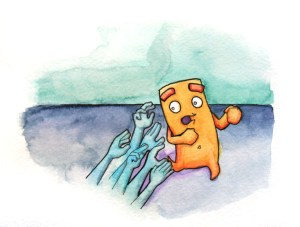
Karl had an entirely new sensation. Somehow he was able to see into his own eyes which turned into a far-off clear inviting ocean. His meek movements toward the ocean became a strong walk which broke into a steady and powerful run. By the time he’d reached the rolling surf, he’d shed his clothes and plunged into the breaking surf. He tore through the waves as they beat upon his torso throwing him briefly into a panic until he surfaced finally in the calm of the open sea. In some dark corner of another world and over some musty chair, his parents were locked, speechless and uncomfortable in a rigid embrace, darting tentative stares into each others eyes looking for boy named Karl.


June 23, 2009

What does Open Hand mean?

by Rod Smith

Pictured at the Sydney Zoo (2010)

Open your hand using all your strength. Stretch your fingers. Allow the lines on your palm to feel as though they might tear apart. Study the contours, colors, ridges and valleys, joints, dents and spaces. Push, pull, and rub. Move your fingers through their paces: together, apart, back, forward, curved, strained and relaxed, cooperative yet unique. Feel the texture and every curve. Touch the crevices. Spread your hand further, turn it at the wrist, examine and compare patterns from every angle. Here are pieces of yourself you might never have studied.

Your hands are your constant companions. They have met the needs of others, pioneered romantic moments and worn rings of commitment. They are the way your heart leaves fingerprints, the eyes at the end of your arms. Hands reflect a person’s being and are the front line agents of your life. If eyes are said to be the windows of a soul, hands express the soul.

Hold other people with your hand thoroughly open. Allow them to know the warmth and welcome of your hand, investigate its curves and benefit from its scars. Invite others to follow the lines into the fabric of your life and see the risks you have taken and the adventures that are yours. Allow them to wrestle and rest, search, see and speak. Let them stay; let them go, but let them find your hand always open.

The Open Hand of friendship, at its widest span, is most rewarding, most challenging and most painful, for it enduringly acknowledges the freedom others have while choosing

Rod@TakeUpYourLife.com

Rod@TakeUpYourLife.com

not to close upon, turn on, coerce, or manipulate others. In such friendships, expectations and disappointments become minimal and the reward is freedom. As others determine a unique pace within your open hand, they will see freedom and possibly embrace their own with excitement and pleasure.

Openhanded people do not attempt to “fix” others, change, or control others even for their own good. Rather, each person is given freedom to learn about life in his own way. Openhanded people, instead, express kindly and truthfully what they think and feel, when asked, knowing even in the asking, others might not be interested or willing to learn.

The Open Hand is not naive. It is willing to trust, while understanding and accepting that no person is all good or all bad, and that all behavior has meaning. The Open Hand is convinced it cannot change others; it cannot see or think or feel or believe or love or see for others, but trusts people to know what is good themselves. It will not strong-arm, pursue or even attempt to convince others because it has little investment in being right, winning or competing. Here is offered a core-freedom of the deepest and most profound nature: allowing others to live without guilt, shame and expectation.

Further, the Open Hand offers oneself freedom that extends to one’s memories, ambitions, failures and successes. This allows for growth of enduring intimacy, greater personal responsibility, authentic autonomy, and the possibility of meaningful relationships with others.

In the discovery of a closed hand, even at the end of your own arm, do not try to pry it open. Be gentle. Allow it to test the risky waters of freedom. As it is accustomed to being closed and fist-like, it will not be easily or forcefully opened. So let the closed-handed do their own releasing and trusting, little by little, and in their own time and manner.

When openhanded people meet, lives connect in trust, freedom and communion. Community is set in motion. Creativity is encouraged. Mutual support is freely given. Risks are shared. Lives are wrapped in the safety of shared adventure and individual endeavor all at the same time.

Rod Smith, July 1997 / Copyright

June 19, 2009

Therapist, if you really want to help a family…

by Rod Smith

Therapist, take up YOUR life!

Therapist, take up YOUR life!

Look for whomever is the most Self-Differentiated: this is not necessarily because they do “good” things. Who is able to express their own voice in the family apart from the togetherness pressures? This person is KEY to the system’s health. They might be the person able to UNDERSTAND what you are all about even if they do not / cannot agree or cooperate. This person may well be the “identified patient.” Listen as much as you can but only focus on process. This means watch for the HOW and WAY (manner in which things occur) not the WHAT, the WHY, and the WHO. Remembering that all behaviors have meaning but not all meaning is necessary for your understanding. In other words knowing that all behavior has meaning on your part is more important than uncovering the meaning behind a client’s (family’s) behavior. Remember that one person’s behavior in a family is somehow everyone’s behavior (and to a lesser degree including yours!) I am thinking here along the lines of everyone is, in a way implicated, with all social problems.

It takes MONTHS to build a relationship even in the BEST of circumstances with WILLING participants. Your work is hard because you are going against every natural grain in the manner in which relationships work. F (your court appointed client) is supposed to avoid you, J (the mother on probation) is supposed to stand you up. Your arrival at the door (for your home-based and court authorized visit) is the most brazen act of relational suicide you could commit. It is a MIRACLE you get allowed in at all. The client’s natural mechanisms scream “Enemy” because of the role within which you function within the system. Once you overcome that you CAN do good work and be really in relationship but it is almost deemed not to LOOK like what the system is asking for. What the system (Child Protection Services) is asking for is the equivalent of wanting a square sphere or a round triangle. Somethings are just not possible but what is possible is BETTER by far! What is possible is …… people begin to see they captain their own ships…and…. their future is in their own hands….. and….

You are likely to do the best work when:

+ you yourself are Self Differentiated (this is no light call. Please study this most misunderstood concept). It is not just BEING DIFFERENT,

+ when you take no sides (even against the system i.e. CPS, Juvenile Justice, Dad, Mom,)

+ when you are non-anxious about the anxious family and anxious system,

+ when you are playful without malice, sarcasm, or pretension, or any whiff of superiority

+ when you track process and help the family or individual to track process,

+ when you nourish your own needs with loving care.

Rod E. Smith 11-03-99 (Written to home-based and court authorized therapists)

June 16, 2009

Take up your life….? (Becoming more personally responsible for your own life)

by Rod Smith

You frequently write: “steel yourself” and “hold onto yourself” and “take up your life.” What do you mean?

Take up your life

Take up your life

Your problems cannot be “solved” or “fixed” by reading this or any column. In fact, they will not be “fixed” even if you read this column, watch Dr. Phil daily and visit a therapist on a weekly basis. These would be, at best, helpful catalysts. At worst, you’d be wasting a lot of time and using yet another means to avoid facing your issues.

The “answer” to your life’s issues (if there is one – you might have to go with an approximation), no matter how large they may appear to you, or how trivial they may appear to others, always rests first with you. Healing begins when you gather up your metal, brace yourself for change, and decide to “take a hold of yourself” and address head-on the problems and complexities you face. “Steeling yourself” is gathering your strength (even if it is minimal) to do what you must do to begin your own process of recovery, healing, or untangling from unhelpful entanglements.*

Even if you have been a victim, grew up in severely adverse circumstances, and both your parents were alcoholics while you were destitute and hungry, your healing and maturity pivots, not on more sympathy, more empathy, or more understanding. it is not “out there” in some book you are yet to read, or on some website you are yet to discover, some guru you are yet to run into, or on some lover you are looking to meet. It is ALWAYS dependent on your acknowledgment of your role in how your life has unfolded (your response to whatever has happened, is currently happening, and will happen to you) and will continue to unfold. It is dependent on you shedding yourself of ALL “victim thinking” and of ALL blame. It is ALWAYS dependent on you taking personal responsibility for your decisions as much as you are able at THIS time (now, today!). This is what I mean by “take up your life.”

I am very aware of this being an unpopular message in an age and a time when “quick-fixes” are offered at every click of the mouse, pointing of the remote, and book shelves abound with every Tom, Dick, and Sally’s offer to deliver you into a perfectly fulfilling life. Sorry, it just doesn’t work like that. Until you become your own “Knight in shining armor” you might always remain a “damsel in distress,” albeit an insightful one!

* For me, a helpful metaphor is to imagine a diver on the edge of a high diving board. He or she STEELS him or herself before taking the leap.

June 11, 2009

He said it isn’t going to work…

by Rod Smith

“My husband is working overseas and I recently gave birth to our second son who is now 4 weeks old. My husband has told me he doesn’t love me anymore and wants a divorce. He told me this when I was 8 months pregnant. I do love him but he said it isn’t going to work.”

Take up your life

Take up your life

While these suggestions might sound harsh or even uncaring, neither you nor the baby will benefit from a search for his reasons for wanting to end the marriage. Attempting to understand what is going on with him will prove to be a wild goose chase. Resist it. Even if you know the answer it is unlikely you will be able to fix whatever it is that he thinks is broken.

[Reminder: it is impossible to communicate effectively with someone who is already moving away from you. He, in this case, will only hear whatever reinforces his case.]

This does not mean I think the marriage will, or even should, end. He’s the one asking for the end of the marriage, let him deal with that. Your first calling is to yourself and to your child – and this is NOT selfish.

In short, try to separate “what went wrong” from “what must happen now.” Your future is in your hands, not his. Your well-being, and the baby’s well-being, are powerfully attached to your persistent ability to remain calm and non-anxious even in this anxious time. This is very tough to do, but the alternatives (chasing after him, falling apart, losing all sense of who you are in the attempt to get him back) are tougher in the long-term. Find your legs AND stand on them. Find your voice and USE it.

It is essential that you reach out to a support network of family, friends, neighbors, who are able to help you with the baby, the physical issues and adjustments of having just given birth, the legal process of divorce, and custody and financial issues.

Parenting is for adults. Even in the midst of these tough circumstances I believe you will have what it takes to be the parent and to be the parent your child both needs and deserves. Mine the rich reserves, the steel, already placed within you and put it to full use.

June 8, 2009

“Under functioning” will get you every time…

by Rod Smith

“I’ve been a stepmother for 7 years. It’s misery. I would never do this again. I have no one to blame. I saw perfectly well that my husband’s ex was a ‘basket case’ for the three years we dated. I saw that my stepdaughter was truly a spoiled brat. Lots of ‘divorce guilt’ led her to getting whatever she wanted. I saw that my husband was not cut out for serious parenting and yet I married him. He’s got many other great qualities including being a good stepfather to my son! Our marriage is solid but the amount of turmoil his daughter stirs

Take up your life

Take up your life

up is more than tiring. His ex hates him so much that she has literally ruined any chance of us having a sincere relationship with my stepdaughter. I have a great relationship with my ex, and his wife, and so does my son does with his stepmother, but my husband and stepdaughter’s is deeply flawed.” (Edited)

Your observation that your husband is not cut out for “serious parenting” is pivotal. Under functioning is more dangerous than a “basket-case” ex. Things will change if he notches up his functioning to fully fulfill his role. You’re protecting him. Your mutual relationship with the daughter is not primarily in the mother’s hands. In a day or two I will write more about ‘under-functioning’ – it is pernicious and has far reaching consequences. Its effects can impact a family for generations.

June 7, 2009

A parent speaks…

by Rod Smith

I will try and teach you to love the power of love more than to love power. I will honor, respect and love your mother/father and hope that you will do so too. I will help you on your journey and tell you the truth even if it might seem easier to lie. I will give you the best of everything I have and everything I own.

I will try to say yes more than I say no. I will risk more, play more, and laugh more than I have in the past. I will respect your freedom (even babies and children need freedom and “space”) and I will allow you as much freedom as possible according to your age.

I will not jump to your every call, wipe your every tear, or give you everything you ask for. I will not protect you from any of life’s “little dangers” or expected risks. I will not be anxious if you are bored, or dissatisfied because things failed to go your way.

I love you, I want you, I am committed to you – but for my sake and for yours, and with wisdom and necessary accommodations I will continue to do many of the things I enjoyed before you were born.

June 2, 2009

He spoils our son

by Rod Smith

“I have a son (7) who is a lovely child who can be manipulative. He gets his own way most of the time which my husband allows and which I find hard to accept. I think my husband spoils the boy because he’s our only child. My son ‘takes’ to my husband more and if I discipline my son my husband gets offended and screams and shouts at me in presence of the child. At the moment I am much stressed and haven’t a clue what to do. My son’s behavior is becoming intolerable and beginning to irritate me. It’s like I’m heading for a nervous breakdown.” (Edited)

Take up your life....

Take up your life....

This is a toxic triangle – one person is trapped by the collusion of at least two others. This common set-up can be particularly painful for the marginalized parent. Screaming at each other will only make the triangle more rigid. While speaking up (no screaming or shouting!) is unlikely to get your husband’s attention I’d suggest you continue to try. Address the issues when the environment is less “charged” or emotionally neutral. If this fails, plan something benign yet radical to amplify or to expose the triangle. If it is clever, even humorous, it might get your husband’s attention.

May 27, 2009

His daughter is hostile…

by Rod Smith

“I am in a relationship with a man who has two children. His younger daughter is making my life hell. She lies to her mother about how I treat her and refuses to speak to me. She is hostile and rude and I am often too uncomfortable to attend family events. She has recently started to not visit her father. I have tried time and time again to get her to like me but nothing has worked. I feel like it is going to come down to her or me. He says he will not allow her to drive me away. How can I stay knowing that she will stop seeing her father if I am around?”

Spend no time or effort trying to get her to like you. Don’t bargain, appease, or allow her to determine your whereabouts. “De-triangle” by openly addressing her accusations. I’d suggest a face-to-face meeting with the mother and child (without dad) would be a good idea. This sabotage must be resisted or she will become a bitter, life-long manipulator. Refusing to visit her father is a ploy. Don’t fall for it. It is dad, not you, who is in the hot seat. I hope he is careful not to give the child more power then she can handle.

May 22, 2009

Her ex is selfish

by Rod Smith

“I am getting married in a few months for the second time. I have two sons (8 and 10) and she has a daughter. My children do not live with us but she has her daughter who pays irregular visits to the child’s father. I want her ex to be more consistent or to not be in the picture at all. We sit around waiting for him to decide what he wants to do before we can make any plans. My fiancé cannot seem to see how selfish this is. Please help.”

You will face much bigger hurdles....

You will face much bigger hurdles....

The child’s father is not “in the picture” for you and nor should he be “out” of the picture simply to make your life easier. Get used to the idea that your soon-to-be wife’s ex-husband is an integral part of his daughter’s life. Until a court of law decides the man is unfit to fill his role as the child’s father I’d suggest you do all you can to make the child’s relationship with her father as uncomplicated as possible.

Yes. Of course you and your fiancé, together, ought to have a conversation with him about how he may assist in making all of your lives less complicated. Be assured your upcoming marriage will confront you with far more complex situations than this one.