You will find the best in others ……. if you look for the best in others. I refer to the best in others as their gold. It’s generosity, kindness, wholesomeness, creativity, and friendliness. These qualities live within all others (no exceptions). Such gold is available to be found. It comes with the human package.
There’s only one condition.
You have to be willing to acknowledge that there is gold within you and be willing to find it within yourself first before you will be able to see it in others. It may be hiding behind the shame and guilt and honed skills of deception you have had to download for protection and survival.
I am aware that “comes with the human package” is quite a claim.
Some will doubt. They will tell stories of those whom they found to be no-good to the core.
The gold within some is easy to find – not too much digging required.
For others it can be deeply buried in shame, humiliation, guilt, deception and in a belief that cruelty or violence or deception are, or were, necessary for survival.
“No-good to the core” has its reasons, its history.
But, the gold is still there.
It cannot be eliminated.
Given time to be heard, time for trust to build, time to tell his or her story, I know that who some regard as the worst of humanity are often bearers of the purest of gold.
The Mercury (this begins my 25th year of Monday to Friday Mercury columns)……..
It is a die-hard custom for columnist to “reflect” on the past year. Here are broad principles I have found to be true. I hope, readers in Southern Africa and elsewhere, that you will share yours with me:
Life is simultaneously beautiful and brutal. It is wiser to embrace both as fully as is humanly possible. Attempting to reject life’s inevitable brutality seems to delay deep appreciation and awareness of its beauty.
Generosity, kindness, openness to all others are more powerful than any politician or army.
My enemies unknowingly serve me, make me think, make me honor my life with greater effort and dedication. Thank you. I owe you. I long to repay you with grace, respect, and honor.
If I think my sons and their friends cannot teach me anything I soon discover I indeed have a lot to learn.
The most difficult people, the most demanding clients, the most trying customers, are those who offer me the most powerful opportunities to grow, learn, and exercise love and grace.
People do what they want to do. No finely designed intervention or battery of therapeutic skills can stop a person doing what he or she really wants to do.
The minute I blame anyone for anything, I regress. The minute I take responsibility for myself, I grow.
All I want for Christmas has nothing to do with two front teeth as one of my aunts usd to sing when we were children.
I prefer a pre-Christmas lunch with friends of all ages seated at a large “let’s-talk-all-afternoon” table.
We’d tell stories. We’d make a concerted effort to listen to each other.
We’d speak of risks that paid off and those that didn’t.
Some of us would cry at least a few times for the losses endured, but even those who cry easily, for some have much to mourn, would also laugh a lot – we humans are like that.
As conversation ebbs and flows I know we’d marvel at our former naivete; the big ideas that turned to nothing, small ones that changed our worlds.
There’ll be talk of lost baggage, delayed flights, expired passports and some will go very quiet and silently recall the pain and the power of deep, trusted friendships lost.
I don’t want a tree or flashing lights tacked around my house but I would like to take friends home a few days before Christmas and have quiet hours together appreciating the simple joys of companionship, undeserved forgiveness, being seen, being heard, laced with supersized helpings of all-round Grace.
Everyday, everytime, under all circumstances, no exceptions, you (and I) get to decide what you (and I) will bring to every, yes, every, interaction.
Yes, this one, right here, right now at Wimpy, the bank, with my sons, with your daughter, at this busy traffic intersection.
We have a question we are answering with our behavior 24/7/365: Will you (and I) be agents of love and forgiveness and long-suffering, or will you (and I) settle for the usual combative or irritable or unloving behaviors that seem to come so naturally and easily to so many?
In the heat of the moment – the bad traffic, the wait at the bank, the poor service in the restaurant when you are hungry, whatever – does not make you (or me) unloving or unkind, it reveals who we are.
Challenging circumstances expose, they do not cause.
They reveal.
Love and loving responses take planning, require decisions long before decisions have to be made or require or evoke a response.
Love and forgiveness can only come from you (and me) if love and forgiveness are living within you (and me) already.
What’s within you (and me), will come pouring out, no matter what the circumstances.
As a caucasian man traveling alone with my African American son (5) and African American infant I realized I was triggering intrigue in some parts of the world, well, most parts.
“Where did you get your boys?” a person may randomly ask.
Yes, I specifically recall it happening on a plane or two and in an airport bus. It even occurred once in the London underground, where in retrospect, the person must have really wanted to know given the “no talk” rule.
I recall being flippant or playful or casual in my reply and I learned quickly a few ways to express “it’s none of your business.”
But, I did not always respond this way.
Sometimes I detected a longing in the questioner, an ache, and, if there was time enough to really answer the question I did.
I found myself answering fully if children asked.
One morning during Nathanael’s kindergarten days one of his classmates approached me.
“Mr. Smith, where is Nathanael’s mommy?” and as gently as I knew how I told Andrew we did not know (which remain the truth) and that I was Nate’s only parent.
Tears steamed down Andrew’s face and he ran off.
All I could imagine was that the boy, in that brief encounter, had imagined his own life without his wonderful mother.
A fellow parent presented me with this painting of Nathanael and me during Nate’s kindergarten years. I did see her taking a photograph of us a few days before she presented me with this treasured gift.
A week later I can think and write — this one time – more objectively about my son, Thulani’s, wedding to Alaina. The lavish event, his in-laws resisted no expense, included 175 guests, was as perfect as I can imagine.
The saxophonist and pianist played a soothing “Have I Told You Lately That I Love You” – Van Morrison’s version was Thulani’s first favorite piece of music, a smidgen ahead of anything Barney –and I was first to walk down the aisle of the historical landmark church to begin and officite my son’s wedding.
On reaching the lectern I turned to face the packed sanctuary.
There were men and women who’d walked with me through every phase of both my sons’ lives and hundreds of members of the bride’s friends, family and extended family.
The groom entered and, after his slow walk down the aisle, he threw his arms around me. Then came his brother, Nathanael, followed by 7 groomsmen. The stunning eight bridesmaids entered one-by-one to the delight of the expressive diverse congregation.
The sanctuary doors closed and we waited.
When the music changed, the congregation stood, and the bride entered arm-in-arm with her dad, and at the end of their walk, the bride’s mother joined her husband for a coordinated kiss and both placed Alaina’s hands into my son’s hands the bride and groom turned to face life-long family and friends, many of whom have loved and supported each from birth.
Allow yourself to experience your emotions – even the extremes. Don’t cover or hide from your grief. If you are feeling joy, express it. Avoid constructing a wall or barrier between you and your emotions. The day may come when you cannot see over the barrier, let alone climb the wall.
Take time to hear as many “sides” to every story. Don’t rush to judgment. There are usually 7, 8, even 10 sides to every story. Hear them all. Things are often not as they appear. Listeners take all the time needed to hear things out.
As far as you’re capable, go back and make right where you have failed. Often, this may be impossible. Make a list of your regrets, determine never to move in those directions again. Learn, recover, learn recover.
Even if it’s not in your usual habit, try to talk more to people you care about about the things you care about. Don’t rehash hobby horses. Let people into unexpressed parts of your thinking.
Notice your indifference. This is where you’ve been unmoved, unaffected, by things that ought to move everybody, ought to affect everybody. Allow the world about you, near and afar, to have its impact on you.
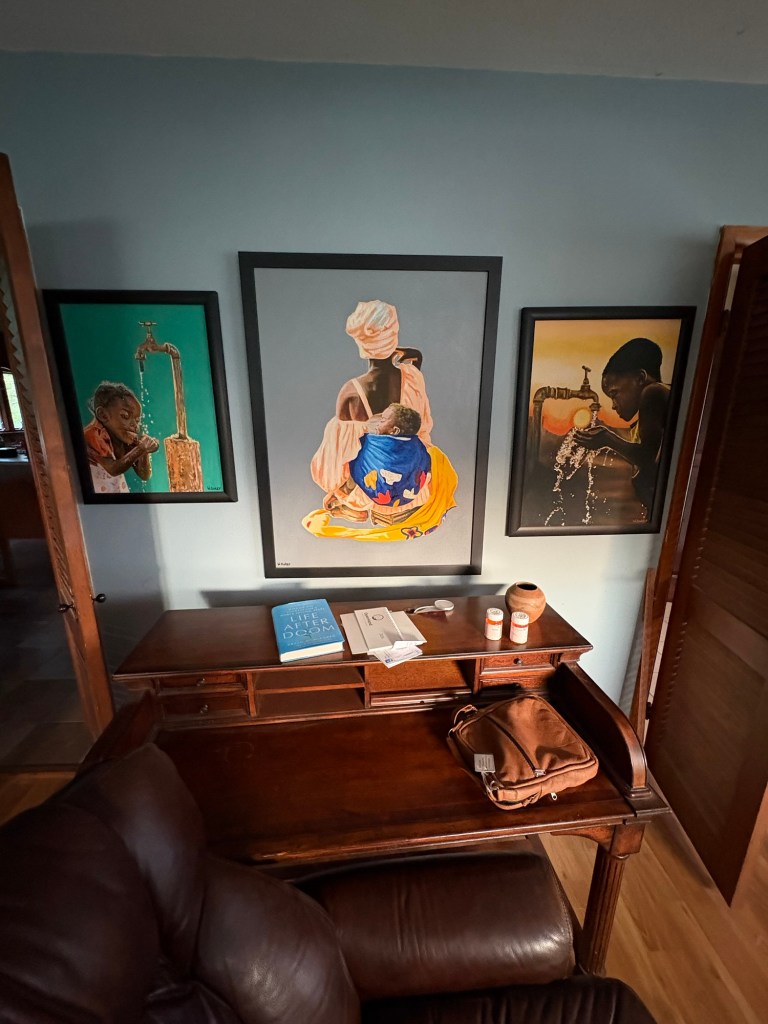
One corner of my home office……. you’re welcome here.
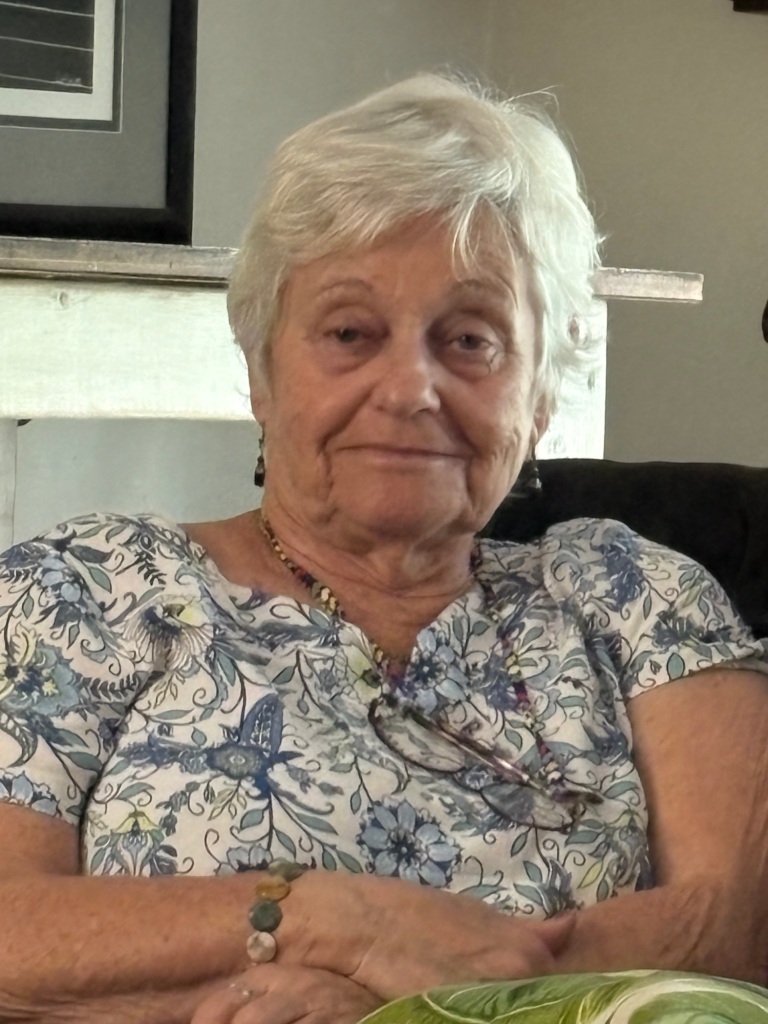
I know competition is tough, really tough, but I think I win the International Best Sister Award. My Australian brother would win a parallel brother award but today I’m celebrating my South African sister, Durban’s own Jennifer Arthur.
As I’ve previously written Jen is the original Facebook. She remembers everyone she’s ever met, be it for 7 minutes on a train or plane somewhere in the world, and somehow gets them a birthday message. She keeps contact with people for years despite the brevity of a first encounter. There’s always a way to stay in touch and Jen finds it.
Jen’s adored by her 9 grandchildren and 1 great grandchild and by my adult sons. I’ve heard children, seen their longing, as they request she be their grandmother. My sister is widely known as Granny Goose.
This week, in fact 3 days ago, my sister landed in the USA for my son’s wedding, a journey booked without awareness that I’d be in need of assistance following my joust with salmonella. My kitchen is organized, my house has beautiful new touches, and recuperation feels 100 times easier.
Even Duke my Lab has switched allegiances and is under her feet as much as possible.
You may earn more than I do and live in a nicer house – but our loneliness is probably the same. When it rips us apart it doesn’t really matter who has the most cash or the nicest home. Loneliness doesn’t care where we live or about our financial status. Invite me in – perhaps we can be friends and ease our common pain.
You may be more educated than I am and you may have graduated from a respected university – but I know that if you regard anyone, anywhere with contempt, your education has given you little worth knowing. I may not be very bright by your standards but I do know that truly educated people never use it as a weapon. Talk to me – I might be able to teach you a thing or two.
You may be more travelled than I am and can talk about places I have not heard of or could afford to visit in my wildest dreams – but if travel has made you contemptuous of your homeland and its peoples then travel has not done its finer work in you. Citizens of the world find beauty and wonder everywhere. Come to my house – my culture is as interesting as any you will find on any distant shore.
Your “spirituality” is not measured by how much you (or I) read the Holy Scriptures, sing hymns, pray, clap your hands, run around a sanctuary with a purple flag, dance to contemporary religious music or reject those who do.
It’s not determined by how much you visit your place of worship or how much money you donate to its causes.
It’s not affirmed by your title (if you have one) or the ornate design of your robe (if you wear one) or the position you hold in the hierarchy of your faith tradition (if you’re part of one).
But, it is affirmed by your willingness to take responsibility for your life, your choices, and the good use of your skills and talents.
A biopsy of the validity and integrity of our faith and spirituality is revealed in how we treat people, especially loved-ones and strangers; how we love our enemies, offer hospitality, respect, regard, love those who reject our beliefs.
Do you clean up after yourself? Are you wisely generous to a fault? Do you love those who are different from you, whose lives might be in direct conflict with what you believe? Do you love others by listening?
If you take full responsibility for yourself, become extraordinarily generous with what you have, embrace diversity, and love others by listening, you will fast-forward your “spiritual” growth. Actually, you will put it on supercharge.
It’s not your title, the reach of your authority, or the crowds who respect and adore you. Rather, it’s how you respect and love and respond to those who don’t.






 difficultrelationships.com