There is brokenness that leads to re-building, improved character, renewed strength, refreshed creativity.
I believe this capacity lives within us all.
I have seen this with my own eyes; men and women build beautiful lives after devastation, loss, betrayal and untold grief.
There’s brokenness that leads to bitterness, regret, desire for revenge and retribution.
It, too, lives in us all.
Stubbornness, coldness of heart, perhaps based in a desire for justification, provokes a tough journey.
I’ve seen men and women “go stubborn” and “go bitter” and be lead by the nose to destinations unbearable.
Brokeness, some, not all, is inevitable, comes packaged with life, time, age, growth and misplaced or misunderstood levels of trust.
Some comes as a result of pride and selfishness — or the rather simple but trustworthy principle of reaping what we’ve sown.
What will you do with yours?
Your brokenness?
What will I do with mine?
Our response — and it need not be immediate for wisdom is seldom knee-jerk — is a crucial choice.
It is not an easy choice, but choice is where it all begins – a little like Robert Frost’s “two roads diverged in a yellow wood.”
A choice to build and learn, a choice not to defend or attack, a choice to love in the face of rejection, a choice to give people what they ask for, a choice to engage, or not – perhaps the choice less travelled, will make the difference.
All I want for Christmas has nothing to do with two front teeth as one of my aunts usd to sing when we were children.
I prefer a pre-Christmas lunch with friends of all ages seated at a large “let’s-talk-all-afternoon” table.
We’d tell stories. We’d make a concerted effort to listen to each other.
We’d speak of risks that paid off and those that didn’t.
Some of us would cry at least a few times for the losses endured, but even those who cry easily, for some have much to mourn, would also laugh a lot – we humans are like that.
As conversation ebbs and flows I know we’d marvel at our former naivete; the big ideas that turned to nothing, small ones that changed our worlds.
There’ll be talk of lost baggage, delayed flights, expired passports and some will go very quiet and silently recall the pain and the power of deep, trusted friendships lost.
I don’t want a tree or flashing lights tacked around my house but I would like to take friends home a few days before Christmas and have quiet hours together appreciating the simple joys of companionship, undeserved forgiveness, being seen, being heard, laced with supersized helpings of all-round Grace.
Everyday, everytime, under all circumstances, no exceptions, you (and I) get to decide what you (and I) will bring to every, yes, every, interaction.
Yes, this one, right here, right now at Wimpy, the bank, with my sons, with your daughter, at this busy traffic intersection.
We have a question we are answering with our behavior 24/7/365: Will you (and I) be agents of love and forgiveness and long-suffering, or will you (and I) settle for the usual combative or irritable or unloving behaviors that seem to come so naturally and easily to so many?
In the heat of the moment – the bad traffic, the wait at the bank, the poor service in the restaurant when you are hungry, whatever – does not make you (or me) unloving or unkind, it reveals who we are.
Challenging circumstances expose, they do not cause.
They reveal.
Love and loving responses take planning, require decisions long before decisions have to be made or require or evoke a response.
Love and forgiveness can only come from you (and me) if love and forgiveness are living within you (and me) already.
What’s within you (and me), will come pouring out, no matter what the circumstances.
Learn the ART of living fully in your own head, and only, in your own head. Think for yourself. Try not to interfere when others think for themselves even when they express thoughts you’d never think. It’s allowed. MINDing yourown business, avoiding crossovers, is a crucial and necessary art in the empowering business. Like everything, it begins at home. Your spouse, adult sons and daughters, your parents, all the adults you know have unique brains capable of their own thinking. You may find this harder than it sounds if you are accustomed to living in multiple heads other than your own, and in yourown.
Why is this important? It’s fundamental to trust, growth, respect, equality, mutuality and all those good things. I’d suggest it would be highly disrespectful of me to assume I am better at doing your thinking than you are at doing yourthinking. If I focus my mind on my business and trust you will do the same, the meeting of our minds has the potential to enhance both of us. Conversely, if every time we talk or spend time together you cross over in my head it is likely much of my energy will be spent, not in thinking and exploring with you, but in attempts to safeguard my head-territory.
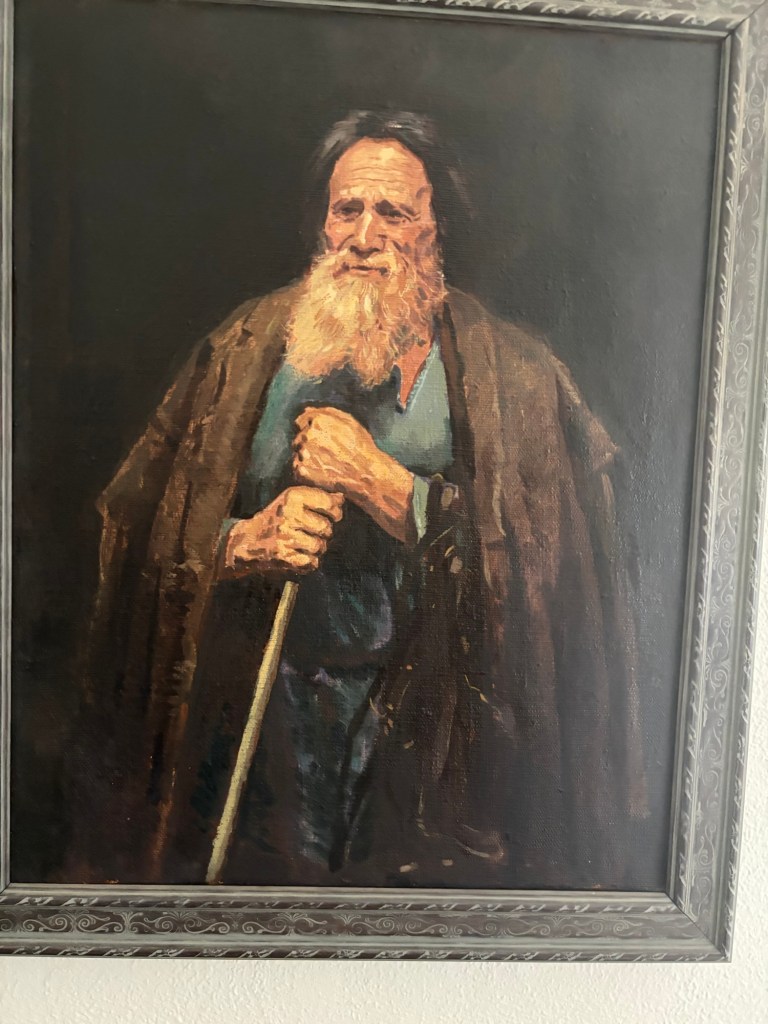
One of my very favorite pieces of art. It’s from Gorky Park, Moscow. Street artist — 1992.
Allow yourself to experience your emotions – even the extremes. Don’t cover or hide from your grief. If you are feeling joy, express it. Avoid constructing a wall or barrier between you and your emotions. The day may come when you cannot see over the barrier, let alone climb the wall.
Take time to hear as many “sides” to every story. Don’t rush to judgment. There are usually 7, 8, even 10 sides to every story. Hear them all. Things are often not as they appear. Listeners take all the time needed to hear things out.
As far as you’re capable, go back and make right where you have failed. Often, this may be impossible. Make a list of your regrets, determine never to move in those directions again. Learn, recover, learn recover.
Even if it’s not in your usual habit, try to talk more to people you care about about the things you care about. Don’t rehash hobby horses. Let people into unexpressed parts of your thinking.
Notice your indifference. This is where you’ve been unmoved, unaffected, by things that ought to move everybody, ought to affect everybody. Allow the world about you, near and afar, to have its impact on you.
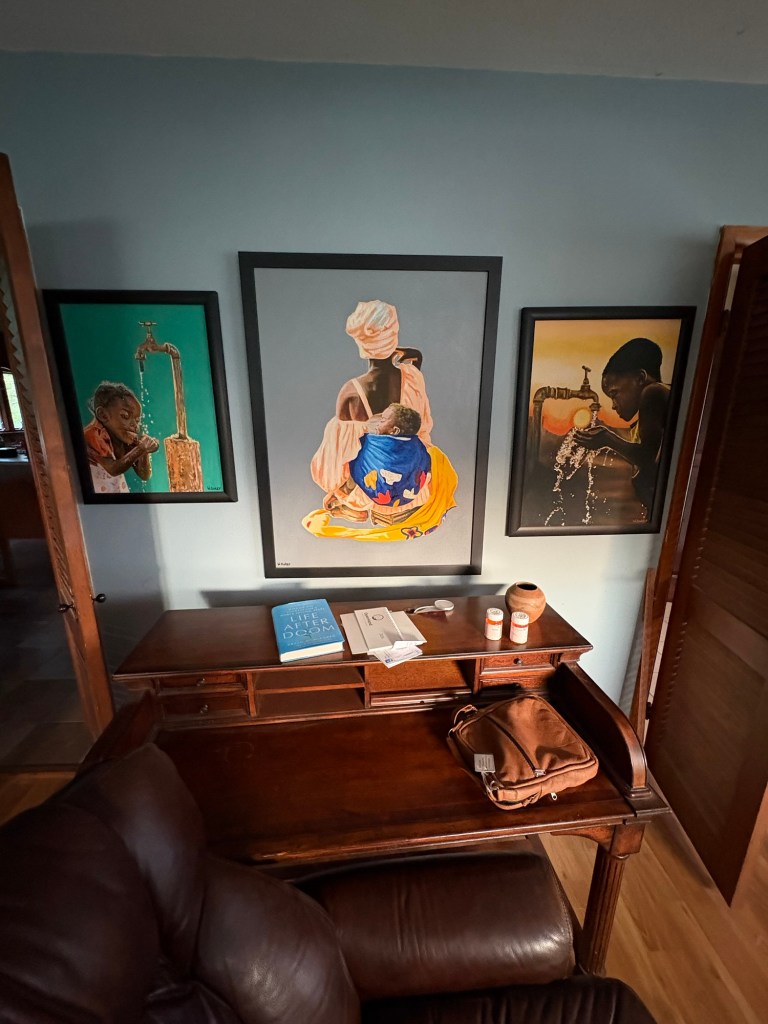
One corner of my home office……. you’re welcome here.
You may earn more than I do and live in a nicer house – but our loneliness is probably the same. When it rips us apart it doesn’t really matter who has the most cash or the nicest home. Loneliness doesn’t care where we live or about our financial status. Invite me in – perhaps we can be friends and ease our common pain.
You may be more educated than I am and you may have graduated from a respected university – but I know that if you regard anyone, anywhere with contempt, your education has given you little worth knowing. I may not be very bright by your standards but I do know that truly educated people never use it as a weapon. Talk to me – I might be able to teach you a thing or two.
You may be more travelled than I am and can talk about places I have not heard of or could afford to visit in my wildest dreams – but if travel has made you contemptuous of your homeland and its peoples then travel has not done its finer work in you. Citizens of the world find beauty and wonder everywhere. Come to my house – my culture is as interesting as any you will find on any distant shore.
Your “spirituality” is not measured by how much you (or I) read the Holy Scriptures, sing hymns, pray, clap your hands, run around a sanctuary with a purple flag, dance to contemporary religious music or reject those who do.
It’s not determined by how much you visit your place of worship or how much money you donate to its causes.
It’s not affirmed by your title (if you have one) or the ornate design of your robe (if you wear one) or the position you hold in the hierarchy of your faith tradition (if you’re part of one).
But, it is affirmed by your willingness to take responsibility for your life, your choices, and the good use of your skills and talents.
A biopsy of the validity and integrity of our faith and spirituality is revealed in how we treat people, especially loved-ones and strangers; how we love our enemies, offer hospitality, respect, regard, love those who reject our beliefs.
Do you clean up after yourself? Are you wisely generous to a fault? Do you love those who are different from you, whose lives might be in direct conflict with what you believe? Do you love others by listening?
If you take full responsibility for yourself, become extraordinarily generous with what you have, embrace diversity, and love others by listening, you will fast-forward your “spiritual” growth. Actually, you will put it on supercharge.
It’s not your title, the reach of your authority, or the crowds who respect and adore you. Rather, it’s how you respect and love and respond to those who don’t.
There is nothing like a good listener for feeding the soul.
A good listener determines there will be no distractions — no phones, text checking, no dings or app notifications or glances to see the time — and will offer complete and uninterrupted and undiluted attention to the speaker.
A good listener listens, says very very little except may offer occasional brief words of encouragement like “tell me more” or “go back to the beginning if you want” or “go into as much detail as you think will be helpful” or “could you tell me that again so it’s clearer for me.”
The good listener knows listening and any attempts at multitasking — even the most subtle — distract the speaker and obliterate listening. A good listener gets all the potential impediments to listening out of the way before sitting down to listen.
The good listener knows a listener’s inner-noise —- things the listener is refusing to hear or address from within — will emerge and sabotage attempts at hearing others and so addresses unresolved personal matters as much as possible so others may encounter a clear-headed listener.
The good listener does not formulate replies or develop counterpoints while listening and does not one-up the speaker with the listener’s own experiences whether they may appear to the listener to be helpful or not.
A good listener sees, hears, knows, acknowledges the speaker by listening — the most powerful and tangible expression of love.
I devised a list of how to participate in the healing of men and women who have been hurt:
Be willing to listen, even if what is being said is what you’d prefer to not hear. Try not to re-engineer (re-frame, recast) what you have heard so it is more fitting with what you’d really like to hear.
Resist understandable attempts to short-circuit growth by trying to ease necessary pain, by offering false affirmations, and by accepting empty excuses for irresponsible behavior. Pain is a very good motivator for change. Resist the urge to remove it when it appears to be helpful.
Offer your presence, not your answers. “I am with you” is more helpful than “let me help you fix it.”
Welcome silence. There are ways to communicate that do not include words. Resist the understandable urge to chase healing and learning away with the incessant use of words and stories.
Avoid minimizing (“it’s not so bad!”) or rationalizing (“What else did you expect?”) or normalizing (“Anyone would have done that!”) the issues that resulted in pain. Do not rob necessary pain of its usefulness.
Promote “future thinking.” Ask questions focused on future wellness and success.
Try to avoid searching for the genesis (the cause) of what has led to pain. Where something comes from is not nearly as important living your way out of it.
Israelite-Nathanael gets an invitation to meet Nazarene-Jesus and responds rather snarkily:
Can anything good come out of Nazareth?
This exchange, recorded early in the Gospel of John, intrigues me and, as a result, I’ve always loved the person and name Nathanael.
He questioned, appeared playful and unintimidated.
On meeting, Jesus greets Nathanael by name, interprets his name, tells Nathanael He had seen him before Nathanael was aware of being seen by Jesus.
In modern parlance Jesus saw through the Israelite, welcomed everything about him, called him into a life-changing journey and Nathanael readily responded
Nothing takes the Son of Man by surprise: Jesus saw Nathanael coming and New Testament Nate more than met his match.
Jesus saw my Indianapolis-born son coming, too.
I didn’t. I had to decide blind.
Privacy laws permitted limited information – African American Male, Date of Birth, Full Term – was all I could know.
Pondering names for my son, whom I was yet to meet, the no guile or nothing false in Jesus’ description of Israelite-Nathanael wrapped it up for me.
Enroute from the courthouse to the hospital, custody papers in hand, with a stop at the K-Mart on Lafayette Road to pick up a few baby-essentials, I named a baby and formed a living link with a favorite character from the New Testament.