Archive for ‘Communication’

June 29, 2009

Four simple steps, one wonderful book….

by Rod Smith

Rod@TakeUpYourLife.com

Rod@TakeUpYourLife.com

Occasionally I like to recommend a book I have found inspiring. Anyone in any form of leadership will benefit from Rabbi Edwin Friedman’s Failure of Nerve, Leadership in the age of the quick fix. While no light reading, it is so very good it ought to be banned!

That said, here’s Tuesday’s MERCURY column:

You want greater emotional health?

1. No blaming. Take full responsibility for you life. It’s impossible to create the future you want while you are convinced you are a victim.
2. Try to separate feeling and thinking. Lead with your head, not with your heart. Thinking (deliberating, discussing) yourself into your future, rather than “feeling” your way, will at least gives you some opportunity for objectivity. “Feelings” will make you feel as if you only have extreme choices – usually all or nothing, fight or flight. Thinking will show you there are more options than you feel.
3. So-called “burnout” is not from working too hard but from living a meddling lifestyle. Remove yourself from the middle. Get out of the way of issues that are none of your business and you will be surprised at how much of a load will be lifted from your shoulders and how much more energy you will have.
4. Forgive everyone, everything, always. (I am not sure commas are necessary – what do you think?)

June 25, 2009

Before marrying with children….!

by Rod Smith

Rod@TakeUpYourLife.com

Rod@TakeUpYourLife.com

1. Plan several sessions of “hard” talking with your potential spouse. It is essential that you temporarily forget the romantic elements of your relationship (I know this is next to impossible) to talk business. Blending families is one of life’s most difficult challenges, which is further compounded when both parties have children.
2. Don’t try to be the stepparent before you legally occupy the role. Prematurely playing a role will create problems once you legitimately occupy it. It is essential you do not assume roles you don’t occupy. If a child (or future spouse) treats you as a parent, it doesn’t mean you are one. Troubles brew when people push themselves, or are pushed by others, into roles they do not occupy. (This is true even beyond families!)
3. Bridges are best built before they are needed. It is essential that you insist on multiple meetings with both parents of ALL the children before you consider marriage (yes, you did indeed read what you just read). These meetings will focus on methods of co-parenting in order to secure everyone’s best advantage. If implementing such meetings seems overwhelming to you, you are probably heading for a minefield of countless unexpected, unwelcome complications – that will seem (believe it or not) even too large for love to overcome! What is avoided (denied, glossed over, minimized) pre-wedding will rise like a rabid monster quite soon (a month, a year, or even ten years!) after the wedding.
4. Financial integrity is as important as sexual fidelity! It is essential that you look into every detail of all financial records of your spouse-to-be and offer your own finances for similar scrutiny — before you plan a wedding. Persons who cannot responsibly handle money are unlikely to be able to handle the pressures of thriving within a blended family. If a would-be spouse suggests information of his or her finances are off-limits to you, wipe the dust off your feet and depart, no matter how much love you may feel. Authentic love, apart from having many other facets, is also measured in the degree of financial partnering established between lovers. Resilient love seeks the wise, open use of combined resources. Because blending families also often involves complex financial arrangements (child support and so forth, divorce costs, education bills for children of a former marriage) hiding the details from a would-be spouse is exceedingly unfair to all involved. I DID NOT say you have to SHARE all the money — I said you have to KNOW about it and plan about it.
5. Flee blamers. An adult who blames his/her former spouse (or parents, or childhood, the new political order) for everything will also, before long, blame you for everything.
6. Avoid people who cannot engage in civil conversations with an ex, with their parents, or their children.
7. Getting Johnny (or Mary) a stepparent will not ease his dissatisfaction with the divorce, school, or his craving for a “real family.” It is essential to understand that getting married will not solve any but the most superficial current family issues. Blending families is likely to unveil and exacerbate more problems than it solves.

All this said, and so much of it sounds negative, blended families hold the potential to enrich and empower all the people involved. Some of the healthiest, happiest families I have met in many years of meeting with families (in all manner of circumstances) have been blended families! Go for it, work through all 7 points above, and you will be all set to go!

June 24, 2009

[Over]-parenting Karl

by Rod Smith

A little space goes a long way...

A little space goes a long way...

Over-protection had so overwhelmed Karl (15) that he had perfected the ability to escape from behind his own eyes. His vacant stare allowed him to see and note nothing most of the time. His head did turn slightly and very slowly in the general direction of his parents when they talked, but nothing about his demeanor allowed even a hint of interest. This did not inhibit the determined twosome in their attempts to correct this disconnection. Their every approach to Karl included rapid movements as they tried to prance into his line of vision, which was as difficult to discern, as it was to enter. His only response, which his parents found most encouraging, was a mild trace of disgust that appeared in the very minimal and effortless contortion of his lower lip. The boy had perfected the art of unspoken disdain that served only to have his animated parents increase their efforts to engage him even further. Disdain was something they found unthinkable, and it was quickly, positively, reinterpreted as they reassured each other of the widespread inability of teenagers to be demonstrative with love. They’d made a pact that they’d never believe anything negative from their son and encouraged each other with humor saying, “The Teen Monster abducted Karl.”

“Karl,” said his dad leaning elbows on his knees, “Look at me! Look at your mother. Look at anything.”

“Honey,” his mother said mirroring her husband’s pose, “you know we love you.”

The onslaught of words and emotion struck Karl’s shield, ricocheted off the ceiling and caused a shift in Karl’s posture. This encouraged his parents and they moved nearer to their son. Now his dad’s elbows were on Karl’s knees and his face was but inches from Karl’s nose. His mother had left her chair and hung earnestly over Karl’s shoulder while he pushed himself further into the furniture.

“Look at this Karl,” said father noticing their closeness, “what more could you want?”

“You have caring parents,” she said.

“You are such a popular boy,” he affirmed.

“You are so good looking,” she chimed.

“You have such a nice voice,” said one of them.

They shot their practiced affirmations at him because it was their nature to do so and because they well knew that teens are said to want acceptance and encouragement. Karl’s lower lip registered discomfort. Brief intense shudders raced the length of his face as if he was in shock treatment. He pulled his legs up onto the chair and placed his head between his knees which they saw as a covert invitation to move closer. Dad eased his own legs under the chair in the space Karl’s legs had vacated. Mother reached across the boy so that her arms were enfolding him as she placed her ear onto the exposed crown of his head.

“Karl we are not like other parents,” his dad said.

“We are here for you, Honey,” she interjected.

“You are everything to us!” they blurted.

Karl had an entirely new sensation. Somehow he was able to see into his own eyes which turned into a far-off clear inviting ocean. His meek movements toward the ocean became a strong walk which broke into a steady and powerful run. By the time he’d reached the rolling surf, he’d shed his clothes and plunged into the breaking surf. He tore through the waves as they beat upon his torso throwing him briefly into a panic until he surfaced finally in the calm of the open sea. In some dark corner of another world and over some musty chair, his parents were locked, speechless and uncomfortable in a rigid embrace, darting tentative stares into each others eyes looking for boy named Karl.

June 24, 2009

The self and “self”-protection….

by Rod Smith

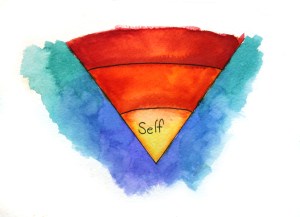
The deepest recess, where soul, spirit, body, intellect collide and connect and have their enduring party

The deepest recess, where soul, spirit, body, intellect collide and connect and have their enduring party


One failure of the so-called dysfunctional family (I prefer “higher” or “lower” functioning family) is a family’s inability to protect the emerging self (the sense of self, soul, spirit, inner being, heart) of persons in the family.

Characteristics of the self:
1. It is beautiful (created by God as the unique expression of who you are to the world). Even the “worst” person has, hidden beneath it all, a beautiful self.
2. It is relational (naturally wants to relate and engage). Every act – think about it – is an act of relationship.
3. It is sexual (naturally wants to procreate, build and nurture something larger than its-self). Nothing can be done to escape our gender; it is inextricably woven deeply within and finds expression in everything we do.
4. It naturally desires to engage in worship (naturally wants to ascribe greatness). This explains why BMWs, children, houses are “worshiped.”
5. It is enduring (it doesn’t change much in a lifetime). Parents say things like, “From the day he could walk he’s been a determined person.”
6. It is regenerative (naturally seeks to mend and heal). Like the body is always in a state of regeneration, so is the self.
7. It is resilient (can tolerate and survive enormous pain and suffering). Humans have endured untold horror when it has been inflicted upon them.
8. It is creative (naturally thinks outside its-self) and resourceful. It is the powerhouse (engine room) within every person.
9. It can be fed, trained, encouraged (one person can take better care of a self than another) and can grow.
10. Unfortunately, it can be starved, neglected (can wilt away without nurturing) and can give up the fight.
11. It is the place from within which people are able to want, to express desire; it is the center of desire within us.

Take Up Your Life

Take Up Your Life

Although the self within us all usually has a huge repertoire of protection mechanisms, when and if it is damaged, it is usually slow in healing. While the self is difficult to damage, considering its incredible resilience, it can be damaged. A damaged self displays the impacts of hurt and trauma most vividly in relational difficulties, in matters of closeness and intimacy. The effects of damage and trauma to a self can apparently leave a person quite unaffected regarding distant or impersonal encounters. It is in intimacy, in close friendships, that the damage most vividly reveals its presence. When in relationship, a person with a damaged self will find himself unable to “be him-self.”

June 23, 2009

What does Open Hand mean?

by Rod Smith

Pictured at the Sydney Zoo (2010)

Open your hand using all your strength. Stretch your fingers. Allow the lines on your palm to feel as though they might tear apart. Study the contours, colors, ridges and valleys, joints, dents and spaces. Push, pull, and rub. Move your fingers through their paces: together, apart, back, forward, curved, strained and relaxed, cooperative yet unique. Feel the texture and every curve. Touch the crevices. Spread your hand further, turn it at the wrist, examine and compare patterns from every angle. Here are pieces of yourself you might never have studied.

Your hands are your constant companions. They have met the needs of others, pioneered romantic moments and worn rings of commitment. They are the way your heart leaves fingerprints, the eyes at the end of your arms. Hands reflect a person’s being and are the front line agents of your life. If eyes are said to be the windows of a soul, hands express the soul.

Hold other people with your hand thoroughly open. Allow them to know the warmth and welcome of your hand, investigate its curves and benefit from its scars. Invite others to follow the lines into the fabric of your life and see the risks you have taken and the adventures that are yours. Allow them to wrestle and rest, search, see and speak. Let them stay; let them go, but let them find your hand always open.

The Open Hand of friendship, at its widest span, is most rewarding, most challenging and most painful, for it enduringly acknowledges the freedom others have while choosing

Rod@TakeUpYourLife.com

Rod@TakeUpYourLife.com

not to close upon, turn on, coerce, or manipulate others. In such friendships, expectations and disappointments become minimal and the reward is freedom. As others determine a unique pace within your open hand, they will see freedom and possibly embrace their own with excitement and pleasure.

Openhanded people do not attempt to “fix” others, change, or control others even for their own good. Rather, each person is given freedom to learn about life in his own way. Openhanded people, instead, express kindly and truthfully what they think and feel, when asked, knowing even in the asking, others might not be interested or willing to learn.

The Open Hand is not naive. It is willing to trust, while understanding and accepting that no person is all good or all bad, and that all behavior has meaning. The Open Hand is convinced it cannot change others; it cannot see or think or feel or believe or love or see for others, but trusts people to know what is good themselves. It will not strong-arm, pursue or even attempt to convince others because it has little investment in being right, winning or competing. Here is offered a core-freedom of the deepest and most profound nature: allowing others to live without guilt, shame and expectation.

Further, the Open Hand offers oneself freedom that extends to one’s memories, ambitions, failures and successes. This allows for growth of enduring intimacy, greater personal responsibility, authentic autonomy, and the possibility of meaningful relationships with others.

In the discovery of a closed hand, even at the end of your own arm, do not try to pry it open. Be gentle. Allow it to test the risky waters of freedom. As it is accustomed to being closed and fist-like, it will not be easily or forcefully opened. So let the closed-handed do their own releasing and trusting, little by little, and in their own time and manner.

When openhanded people meet, lives connect in trust, freedom and communion. Community is set in motion. Creativity is encouraged. Mutual support is freely given. Risks are shared. Lives are wrapped in the safety of shared adventure and individual endeavor all at the same time.

Rod Smith, July 1997 / Copyright
June 23, 2009

Please paste this into your browser and take a look….

by Rod Smith

http://www.blurb.com/my/book/detail/727591

June 23, 2009

How can I get him to talk about marrying me?

by Rod Smith

“I have been seeing a man for two years. We’re both in our early thirties. I really want to get married but he never talks about. How can I get him to talk about marrying me and about where this relationship is going? We need more communication.”

Rod@TakeUpYourLife.com

Rod@TakeUpYourLife.com


1.“No communication” is impossible. You are missing what is already being said. Couples often think the issue is “more communication” and fail to hear what is already being communicated. He is “telling” you that he has no interest in being married to you.
2. The passive “partner” runs the relationship. The frustrations you already feel will become life long frustrations if you do marry. If you have to work this hard before you are married do you think being married will be any easier? There’s power in being passive and he’s got it. You’re working this thing as if your life depends on it and he is silent.
3. The harder you work, the more passive he will become. He has all the power and leverage because, in seeking it, you have given it to him. This is a simple, albeit perverse, law of relationships.
4. He has already decided where this relationship is “going.” You get to decide if you will go “nowhere” with him.
5. Can it be redeemed? Perhaps. Start by completely backing off. Emulate his passivity. It might jump-start him into action. Then again, it might not.

June 22, 2009

Moms Matter

by Rod Smith

Take up your life

Take up your life

Readers regularly ask me for lists of local professionals and resources. While scouring the Web for helpful family resources in Kwa-Zulu Natal I came upon an inspiring, innovative enterprise for Mothers at http://www.MomsMatter.co.za. Go there. Moms, dads, grandparents, teachers, and mental health practitioners, sign up. It’s free! Get the newsletter. Join the community. I believe you will be inspired by the warm welcome and the array of attractive things available for mothers AND fathers AND families right on your doorstep.

The website, initiated and facilitated by Deborah Andrews, is doing its job of connecting mothers with opportunities, mothers with each other, and tries to make life a little easier for all in the midst of rearing children of all ages.

Writes Deborah: “It may be a kid’s world ‘out there’ but Moms Matter too! We strive to provide access to resources that can help make your lives a little easier with heaps of stuff you need to know all in one place.” The site includes a comprehensive holiday activity guide for the mid-year break with tons of suggestions of things for families and children to do. It’s a website created by a Mom for Moms who sees that “we’re all in this mommy-thing together!”

June 20, 2009

The enriched pastor…

by Rod Smith

Pastor, take UP your life!

Pastor, take UP your life!

Enriched is the Pastor who…

1. Has the support, trust, and the encouragement of the congregation even when unpopular decisions become necessary.
2. Doesn’t have to combat or interpret a political minefield within the immediate leadership team and community in order to get meaningful work accomplished.
3. Is sufficiently aware and respectful of the congregation’s history, yet does not allow the history to compromise its future.
4. Is not surrounded by “yes” men and women who, in their inability to appropriately stand up to the pastor, have lost their capacity to think and, as a result of their misplaced loyalties, foster significant disruption in the community. [It’s PEACEMAKERS, not PEACEKEEPERS you want as co-leaders, pastor!]
5. Identifies the inevitable “lunatic fringe” existing in every community and can therefore effectively resist their agendas, ignore and expose their rumors, and be aware of their proclivity to disrupt and damage communities.
6. Is not engulfed by church members who use religious talk, money or threats to implement their will or their understanding of God’s will.
7. Is not too busy to have meaningful daily contact with his family.
8. Knows the most dissatisfied (loud, religiously aggressive, “conspiracy driven”) people in the congregation are usually those who are already unhappy at home and who are already difficult to live with.
9. Does not sacrifice his family or personal life for the sake of the congregation, knowing that success at home and church are inextricably connected.
10. Knows that self-care, self-preservation, self-awareness, are essential, in fact crucial to his or her leadership of a community, and that self-care, self-preservation, and self-awareness are the very antithesis of selfishness despite the chorus (in fact, it is usually the most “needy” members of the choir!) of persons who will try to dissuade him or her otherwise.
11. Knows that the essence of “giving up his or her life” or “laying down his or her life” for the sake of Jesus and the Gospel requires incredible self-knowledge, self-awareness, and self-preservation, in order that he or she may honestly, and with full integrity, make a meaningful gift of self to the service of God and God’s Kingdom.
12. Knows that it is as important for him/her to stay grounded in reading Scripture as it is for him or her to be able to see when he/she is being TRIANGLE-D, and of course, how to get out of it.
13. Knows that so-called “burn out” is not a product of hard work but a product of getting him/herself in the middle of other people’s unresolved problems and issues (or, to be perhaps blunt, to NOT mind his/her own business!)
14. Knows that morality and integrity are about understanding his or her BOUNDARIES and NOT about his or her KNOWLEDGE, or training, success, or the size of the congregation.
15. Understands the fallacy of empathy as a helpful or useful means to growing his/her team for a strong future.

June 19, 2009

Therapist, if you really want to help a family…

by Rod Smith

Therapist, take up YOUR life!

Therapist, take up YOUR life!

Look for whomever is the most Self-Differentiated: this is not necessarily because they do “good” things. Who is able to express their own voice in the family apart from the togetherness pressures? This person is KEY to the system’s health. They might be the person able to UNDERSTAND what you are all about even if they do not / cannot agree or cooperate. This person may well be the “identified patient.” Listen as much as you can but only focus on process. This means watch for the HOW and WAY (manner in which things occur) not the WHAT, the WHY, and the WHO. Remembering that all behaviors have meaning but not all meaning is necessary for your understanding. In other words knowing that all behavior has meaning on your part is more important than uncovering the meaning behind a client’s (family’s) behavior. Remember that one person’s behavior in a family is somehow everyone’s behavior (and to a lesser degree including yours!) I am thinking here along the lines of everyone is, in a way implicated, with all social problems.

It takes MONTHS to build a relationship even in the BEST of circumstances with WILLING participants. Your work is hard because you are going against every natural grain in the manner in which relationships work. F (your court appointed client) is supposed to avoid you, J (the mother on probation) is supposed to stand you up. Your arrival at the door (for your home-based and court authorized visit) is the most brazen act of relational suicide you could commit. It is a MIRACLE you get allowed in at all. The client’s natural mechanisms scream “Enemy” because of the role within which you function within the system. Once you overcome that you CAN do good work and be really in relationship but it is almost deemed not to LOOK like what the system is asking for. What the system (Child Protection Services) is asking for is the equivalent of wanting a square sphere or a round triangle. Somethings are just not possible but what is possible is BETTER by far! What is possible is …… people begin to see they captain their own ships…and…. their future is in their own hands….. and….

You are likely to do the best work when:

+ you yourself are Self Differentiated (this is no light call. Please study this most misunderstood concept). It is not just BEING DIFFERENT,

+ when you take no sides (even against the system i.e. CPS, Juvenile Justice, Dad, Mom,)

+ when you are non-anxious about the anxious family and anxious system,

+ when you are playful without malice, sarcasm, or pretension, or any whiff of superiority

+ when you track process and help the family or individual to track process,

+ when you nourish your own needs with loving care.

Rod E. Smith 11-03-99 (Written to home-based and court authorized therapists)