
Author Archive

March 19, 2006

Husband denied then admitted affair….

by Rod Smith

I read your “Jack and Jill” column last week and was pleased to see that I am not alone. I found out that my husband of 14 years had been having an affair for months. He denied the affair and through pure digging he admitted it. When I bring the affair up he gets angry and tells me to get over it otherwise our marriage is never going to work. He says I have to control my emotions and I must believe him when he says it is over. He says I have to stop going through his personal slips, his cell phone bill and that he feels like he has no privacy. He has turned that situation around after begging me to please forgive him and promising to do anything to make our marriage work and believe in him again. (Letter edited)

It is not your lack of control but his that landed you both in this unfortunate place. It is his lies, not your discovery of them that eroded your capacity to trust. A regretful man would invite you to talk about it as much as you want and to “dig” anywhere you please. Don’t permit further abuse – it was not you who broke the marriage bond.

March 15, 2006

Three poisons for love: Manipulation, Intimidation, and Domination

by Rod Smith

TUYL

Stay OUT of control...

When people have to use intimidation, manipulation or domination, the relationship is already spoiled or poisoned. It has become a power play of control. Redeeming such a relationship is possible with the implementation of a wise plan, strongly re-defined boundaries, enduring commitment, and the possibility of a time of separation in order that perspective might be gained.

Willingness and desire to be together, equality between people and complete mutuality are the hallmarks of healthy relationships. Where any form of strong-arm tactics are used, the relationship has already taken a turn to become something harmful to both the parties.

Each of these relationship-poisons (manipulation, domination and intimidation) can be very subtle, coming in different shapes, sizes, and intensities.

Here are some of the evidences of manipulation, intimidation, and domination in a relationship:

1. The relationship has been kept on an unequal footing in order that one person might keep power over another. In a severely controlling relationship, both persons might have forgotten there are choices at all.

2. One person tries to get what he or she wants without declaring what is wanted. In attempting to get what the one person wants, both persons are in some way diminished.

3. One person does not see the other as totally free.

Confused boundaries4. One person tries to get what he or she wants through threats or withdrawal.

5. It is expected that every move, thought, and feeling will be reported at least from the less-dominant person to the other. If one person is unwilling to tell all, it is assumed there is something to hide.

6. One person is not free to make plans without consulting or getting permission from the other.

7. One person in the relationship continually evaluates and examines the commitment and love of the other.

8. The dominant person tells the other how they should feel and usually re-scripts any division or disagreement into the appearance of unity.

9. One person feels at liberty to speak for both people and then, is offended when the partner wants to express his or her own views.

10. Desire for self-expression or a distinct voice (by one) is considered betrayal or a lack of trust (by the other).

11. One person expects unilateral support for his or her opinions, choices and desires, declaring somewhat of an attitude which says: If you say you love me then you have to love everything about me, under all conditions, and all of the time.

12. Difference in opinion or having different interests is considered a lack of love, or a lack of respect and commitment.

Simple definitions and a metaphor which might be helpful in considering the three “cancers” of relationships:

Manipulation: playing chess with another person or with people. Maneuvering as if life were an attempt to checkmate others into loving us or doing what we want.Explosive
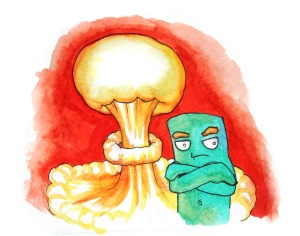
Domination: playing chess with another person or with people as in manipulation. The difference is the dominator has removed the opponent’s pieces without declaring so in the first place.

Intimidation: playing chess with another person or with people where winning and losing comes with either the threat of punishment or actual punishment.

Healthy Relationships: There is no element of either winning or losing; they are not a game of chess at all and are free of tactics and agenda.

March 15, 2006

I am having anxiety attacks while driving. What can I do?

by Rod Smith

READER WRITES: I have been suffering with anxiety attacks for about 12 years now. The strange thing is it seems to affect me mostly when driving my car, especially if I get stuck in a traffic jam. I get really anxious and start to get all the symptoms of a panic attack. The trouble is it affecting my life and narrowing down my routes, as I won’t go on certain freeways in case there is any kind of hold up. I am not afraid of flying or of elevators, escalators. It is only when I drive and I am a fairly good passenger. Is there any kind of cure of this phobia, which seems to be ruling my life now?

ROD RESPONDS: Twelve years is a long time to suffer anything. It is when seemingly irrational fears impede functioning that face-to-face medical help becomes necessary. Please, seek it. My therapeutic counsel would question you about the frequency and the intensity of the episodes, which I’d have you describe in great detail. I’d ask you for a painstaking process of self-monitoring with the view to identifying commonalities that predicate your most intense attacks. Having encouraged you to write these observations, I’d suggest you’d be able to identify ways to accommodate, rather than expel, the anxiety from your life altogether.

March 14, 2006

My boyfriend tells me what clothes to wear and it annoys me. What must I do?

by Rod Smith

Don't feed jelousy....

Don't feed jelousy....

Buy him a mannequin and flee! He can dress the dummy in whatever clothes he deems suitable as often as he pleases. The mannequin will give him the total control he wants over you, and, since dummies are brainless, he will be able to win all arguments and keep “her” in total submission.

That you ask the question suggests you are putting up a fight and resisting his advances on your brain. Small-minded men (any who dictate what “their” women wear, to whom they talk, how they spend and arrange their time) usually flee any sign of independent thinking on a woman’s part if, at first, they cannot kill it. Strong women frighten them since they confuse control and “love.”

Don’t fall for it. Love and control are not even in the same family. A man who wants to dictate how you dress will also want to tell you how to think, feel, and see before long. Men who want to control “their” women do so because they are rarely capable of feeling in control of anything else. A healthy man will leave your clothing choices up to you unless you specifically elicit his opinion.

March 13, 2006

Jack was unfaithful and Jill can’t get over it…….

by Rod Smith

“Jack” and “Jill” have been married for twelve years. “Coincidences” lead Jill to stumble on Jack’s affair. She is “mortified.” He confesses. He wants to “get on with my life and marriage.” Jack is angry because Jill can’t “get over” the affair. She wants to talk about it “all the time.” He cannot understand why she doesn’t trust him or want intimacy. He says she can’t forgive. (Theme from several letters)

Dear Jack: Thank God your wife talks with you at all. Be surprised if she is ever willingly intimate again. Your betrayal challenges the foundation of your lives. Forgiving you, and desiring you, have very little in common. Marriage without fidelity is not a marriage. You are lucky to still have one.

Dear Jill: Trusting Jack is up to you, it is not up to him! I’d suggest “guarded trust” for about two years. Request, if you are up to it, that Jack arrange for you to meet the “other woman” so that, in your presence, he can tell her he really wants his marriage and that he was at fault for deceiving and hurting you. Decide how long you need to refrain from physical intimacy. Challenge yourself not to let it linger indefinitely. Marriage without sexual intimacy is not a marriage – and he is lucky he still has one.

March 13, 2006

For parents, teachers, and coaches

by Rod Smith

Rearing children is perhaps the arena or avenue where you, parent, coach or teacher, will make your most profound impact on the world.

Surely the strongest influence upon how we will raise our children might be the manner in which we ourselves were raised? Much can be gained from trying to remember what childhood was really like. If ignored, and if your childhood was difficult, it will color and influence everything about you, including the manner in which you treat children.

I would strongly suggest that any adult who lives or works with children periodically finds a comfortable place to be alone and undisturbed. Then, as a form of meditation, he or she reaches into the memory bank of his or her childhood to see it all again.

Can you see the world through the eyes of a child?

Can you immerse yourself and get into the experience of a child?

Can you feel, see, think, believe and trust others from the perspective of a child (as if you were still a child)?

Are you able to reach into your own childhood and capture the feeling of childlike vulnerability again?

Perhaps, you never knew such vulnerability at anytime in your life.

March 11, 2006

How do I survive a long distance relationship?

by Rod Smith

Distance intensifies, and idealizes “love” sometimes to the point that it is easier to love an absent lover than it is to love someone real and present. Few people are as wonderful as our imagination, coupled with distance, can create them to be. (Which is one of many reasons pornography is so damaging and the reason why an Internet relationship is not a relationship in the “real” world.)

1. Don’t call each other or email every day. Rather agree to something more random like three times a week or when it is possible. This sets each person free from feeling tied to the phone waiting for it to ring or the Email to arrive. Such “free” scheduling also allows for persons to avoid some of the letdown of waiting in vain.

2. Don’t put your life “here” on hold because he or she is “there.” Long-distance relationships can rob you of the present, while you long for someone a long distance away. This is not fair to dear and near family and friends.

3. Don’t marry a person with whom you have had ONLY a long distance relationship no matter how “close” or “bonded” the “contact” makes you feel.

March 11, 2006

Are you an adult? It has very little to do with your age

by Rod Smith

I believe we are fully adulthood when:

1. We can be authentic with all people, including our parents, treating all others respectfully as equals, despite rank, position or the apparent lack of it.
2. We respect mutuality and equality and want them in all of our relationships.
3. We have acknowledged our hurts, grieved appropriately and decided to live to the fullest. We can delay gratification.
4. Confusion, ambiguity and uncertainty are allies, not enemies. We can “hold” seemingly conflicting thoughts and beliefs without becoming unsettled.
5. We can take full responsibility for our lives despite past trauma or neglect. We are able to recognize when and how we were victimized but no longer think, speak, feel or behave like victims.
6. We do not victimize others.
7. We have a small group of people to whom we talk about almost everything, but feel no compulsion to tell everybody or anyone everything.
8. We stop apologizing for things for which we could never be held responsible in the first place.
9. We clear misunderstandings as quickly as possible.
10. We can stand up for ourselves without pushing others out of the way.
11. We can see that all things are related and are therefore careful to apply quick solutions to problems because quick solutions are likely to foster new, unexpected problems.
12. We learn to appreciate and love “the moment” rather than live as if we are perpetually waiting for a day when things will be better.
13. We can perceive when others do not have our best interests at heart but are not afraid to remain in relationship with such people, confident of our ability to self-protect.

March 9, 2006

Identifying people who can be trusted

by Rod Smith

Trustworthy people…
1. … can be trusted with information; however, they do not pry into, or invade your life for information.
2. … are usually as willing to speak about themselves, as they are to hear about you.
3. … do not need access to the details of your life and are comfortable if you say that you are not ready to talk about something.
4. … are helpful with insight only when you have requested it.
5. … have a wide, diverse, enduring circle of friends.
6. … take full responsibility for their own lives and are not given to blaming others for anything.
7. … display integrity at every level.
8. … do not turn every conversation to focus upon themselves or their interests.
9. … do not persistently attempt to be “one up” with their stories or jokes.
10. … have developed a good sense of humor about themselves.
11. … do not offer unsolicited guidance.
12. … are highly respectful of other people under every circumstance.
13. … do not use put-downs.
14. … can track a conversation and respond to others rather than appear to have already made up their minds about a matter.
15. … can enjoy long silences without feeling the need to ensure there is conversation.
16. … don’t gossip about anyone.

March 8, 2006

Sometimes a person you once loved (or still love) can be unnecessarily cruel

by Rod Smith

I am getting divorced after twenty years of marriage. While discussing financial matters, my soon-to-be ex-husband told me that in his “new life” he has found love that he has never before experienced with me. After all the feelings of betrayal and the on-going tension with the three children, when he said this it still hit me very hard. Was there nothing in 24 years he thought was real love? He has no clue about how hurtful it was to hear such a thing? Should I be angry or sad?

Be both! Each is appropriate. Knowing it is very difficult, I encourage you to shift your focus off him. Divorce is often a cruel form of warfare and he deployed a weapon to inflict unnecessary pain. His words have no benefit to anyone but to underscore that the man you once loved has resorted to unnecessary cruelty. Perhaps he is looking affirmation, some way of telling himself that he has done the right thing; that his move was worth it. Leaving children carries a great price. Somehow blaming you (for not really giving him “real” love) puts some of that payment at your feet. Don’t believe a word of it!