We have repeatedly discussed each of the 8 Bowen Concepts and looked at discussed genograms. I think you have worked very hard. I have tried to demonstrate how the concepts interlock and how they are Bowen’s observations about how families and groups and society “works” and evolves.
In closing today I would like to look at:
ANXIETY (3 kinds) / NON-ANXIOUS PRESENCE
Definitions of Growth and Holiness and Spirituality
Group Study: Luke 10:25-37 – an attempt to get a glimpse at how dangerous this parable really is, how brave Jesus was to tell it, and how dangerous it is to water it down to simply mean helping someone who is in distress. It is about far more than that.
Within milliseconds the drawbridge – we each have one – may go down with a hearty welcome or remain up and sealed shut.
There may be Immediate comfort or discomfort, or levels of both.
Suspicions may be endorsed or deleted.
Information and misinformation transmission occurs at a speedy rate.
We read and misread and read and misread each other constantly – all within the backdrop of our unique experiences and training, our hurts, pains, goals, and desires – known and unknown.
The accent (if one party is not from “here”) is loaded with meaning. Clothes (anything unusual); laid-back or dominant stance; voice tone, volume, intonations; levels of energy or lack thereof, are cumulatively processed.
Triggers can be triggered. Stereotypes ignited. Warmth flows, or doesn’t.
The wave, the handshake, the hug, smile or frown, degrees of sincerity or insincerity are downloaded by the “who-are-you” antenna and the “can I trust you” antenna issued to all at birth to be processed with the morass of stored history, experience, memories, good and bad.
Every encounter is a miracle.
And, yes, with all that, we — you and I – are called to be neighbors and to love one another.
Introduction to Bowen Theory and to the week ahead.
Exercise: PSALM 23
Genograms.
This is a drawing of any client’s family relationships covering at least three generations. It is always a “drawing in progress and process” as people and families are constantly evolving (chabing, growing).
The genogram is a predictive tool (it is not determinative) revealing what’s likely to occur within a family (where and when there is no intervention) by seeing what’s set in motion by preceding and passed on from generations.
My hope is that each student and staff member will complete his or her Genogram.
All family members are deeply connected to all other family members. The manner in which people are connected either nourishes or drains individuals and the entire network – and, of course – many relationships do both and at the same time.
Size (power, perceived importance, lack of boundaries) matters in all relationships – family or not.
What is desired and the goal for all of our relationships? Respect, Mutuality, Equality.
If we had a chance to talk and listen to each other, here are a few things I would enjoy talking about:
I’d like to talk about what each of us is really good at and hear and tell a few stories to demonstrate our identified strengths.
I’d like to hear about three or four defining moments in your life – when things shifted or directions changed – and tell you about a few of mine.
I would like each of us to hear about the people who love us or have loved us and for us to tell a few stories about how the love is (or was) expressed.
I would like to hear about how you see your future – no matter what your age – and have an opportunity to tell how I see mine.
I would like to hear of occasions when you have been misunderstood and what others tend to misunderstand about you. I’ll be more than ready to let you in on my experiences of being misunderstood.
I would like to hear about what you want and tell you about what I want. If we get this far in our talking I hope we are both ready for the most spiritual discussion possible which is deciding and declaring what we really want.
The Art of Adulthood demands the practiced skill of knowing when to remain silent, when to speak, and to hold onto the tongue when do speak.
Self-monitoring, self-awareness, an appreciation for the impact we each have on ourselves and others – are crucial gateways to adult emotional health.
I have left a gathering knowing I have talked too much, over-shared, made unnecessary comments, even, and this pains me to write, hurt another, someone present or absent.
Have you done this, too?
You got a little thrill the moment the words came out of your mouth, a brief high of apparent inclusion. The tid-bit shared became a window or door or crack to the “inside” of who knows what. But, given time, which could be seconds or hours, there was regret.
You let yourself down.
Said too much, hogged the floor, or bruised another with an unnecessary comment or story. Yet, at the time and in the context it felt real, important, or playful enough to get a giggle.
Then you were hit with a feeling you’d rather not have had.
I know about this. In a desire for some weird or momentary high or sense of importance I added content to a conversation that was unnecessary, even harmful.
Silence would have been wiser.
Live. Learn. Decide.
Apologize if necessary and possible (it is not always possible).
Do better next time.
I am now finally available for Zoom consultations – email me if you are interested.
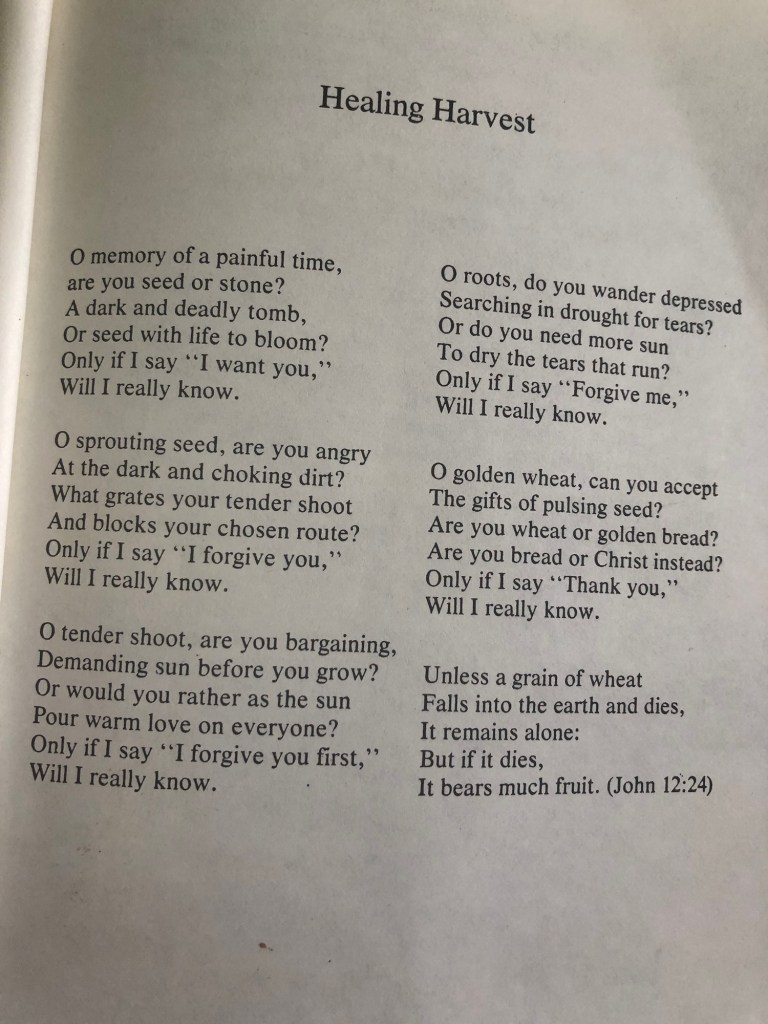
A poem I rather love —- by Dennis and Matthew Linn — from their book “Healing Life’s Hurts”
The “outside world” can be a dangerous place for children.
Another exceedingly dangerous environment for children can also be their own homes. While medicine cabinets, cleaning materials and unlocked swimming pool gates are a legitimate threat to the child-safety, the unguarded mouth of an angry adult can inflict grievous harm to a child.
A vigilant parent might install childproof locks yet leave a totally exposed web of anger in every room of the house. Unresolved anger in a parent, expressed through unpredictable displays of frustration and annoyance or rage, can quite effectively sabotage a childhood and even pass a baton of anxiety and rage to unborn generations. It is in their own homes that children might be at most in danger. At home they learn about trust, and exercise the most trust. It is at home they will learn, or fail to learn, by watching and experiencing, almost everything they will ever know about love.
It is at home they will make the most mistakes and receive the most affirmation and correction. It is at home that children will learn about fear and hurt and rejection and empathy and love and acceptance.
Children are constantly seeing, feeling, learning, trying, sometimes succeeding, sometimes failing, watching, waiting and taking it all in.
Monitoring diets is a crucial aspect of childhood health. Another “diet” is the calm, security, predictability and warmth healthy parents can provide.
If you have the opportunity to see “The King of Broken Things” run at it.
My recent South African trip led to many conversations during which I tripped over some glorious new-to-me one-liners. Perhaps they’re old hat to many South Africans, grafted into common usage, but I found each rather refreshing.
“Keep your head out of that noose,” said a woman to a friend on hearing of a complex domestic issue and an invitation to comment. A rather graphic picture I thought, an ear-catching way to alert others to being trapped in toxic triangles and a rather hard image to forget.
“My mother would always encourage us to be a ‘rainbow in someone’s cloud’,” said an avid Mercury reader I bumped into at the mall.
I chuckled, asked her to repeat it and, when she did, she said, “please use it in a column soon.”
“That’s a wave you don’t want to ride,” said the seasoned surfer who confessed he’d almost forgotten Mothers Day was just around the corner.
While I did enjoy multiple cups of tea in both homes and restaurants and repeatedly heard that tea makes everything feel better — and I affirm it often does — I also heard a man say in passing and in competition with the inherited British belief in a good cup of tea that “there’s nothing like a good bunny* with lots of gravy to make everything feel better.”
*Durban and surrounding areas “bunny chow” — an Indian Curry served in a half-loaf of white bread.
Join me as I continue my journey toward being a low-maintenance person:
Take care of yourself as best as you are able. If possible, pay your own way. Live in your own head, but more important, get out of the heads of others. Others want — or don’t — want to do their own thinking.
Offer information as needed and only to those who need it. Listen to yourself. Filter content. Negative talk about others reveals nothing about others but everything about you.
Delete “you should, – ought, – must,” from your vocabulary even if you do think you know better or are more experienced.
Take others at their word unless you have solid reasons not to. Believe people when they tell you who they are. People constantly communicate who they are but if you are already convinced you already know you will miss what they are telling you and only hear and see what fits with your already-made-up-notions. Observe without prejudice.
Chase no one for anything.
Resist the urge to convince others of what you think, believe, support, and desire to defend and know it is impossible to persuade the already convinced.
People are always communicating. There is no such thing as “no communication.” This is a cop-out catchphrase used when a person prefers to avoid or deny what is being communicated.
What thoughts keep you awake or greet you first on waking?
What thoughts can you not shake?
I will let you in on what’s on my mind if you are interested.
If you are not, I understand.
I often sigh and move on when I receive a parallel invitation.
In November 2023 had the joy of teaching young adults near Lome, Togo.
I noticed groups of children walking to and from school. The chatter (in French) caught my ears; the neat and proudly worn uniforms, my eyes. The shared joy and delight of the children touched and warmed my soul.
I asked questions here and there to find that the school is indeed on the same property where I was teaching and run by the same organization.
I requested a visit.
It’s a bamboo L shaped structure. In one corner of a sandy play area there is a single netball hoop with no net. The student body of about 250 children, Kindergarten to about Grade 6, under the tutelage of about 10 faculty, using merger supplies, are heads down and studying, reading, or writing notes off more-than-used chalkboards.
In one room there was beautiful singing.
As I walked through each bamboo room I saw joy and serious study occurring.
I found out that when the weather changes all are sent home to safety until bad weather passes.
Contact me if you’d like to assist – and build a classroom or two.
If you are a taxpayer in the USA and give a gift (large or small) your gift to OPENHAND INTERNATIONAL, INC will be tax deductible.





 difficultrelationships.com