
Archive for ‘Sex matters’

May 7, 2006

What can I do to make be someone who doesn’t seem to notice me become attracted to me?

by Rod Smith

You might become more seductive, pretend you are wealthier or more educated than you are, change you hair, nose, breasts, accent, interests and lose weight – but none of it will work in helpful ways. Trying to be something you are not, is most unattractive, and nothing you re-create of yourself will be real, convincing, enduring, or – ironically – attractive.

The energy you spend will exhaust you and distort the natural beauty afforded all people. Who you are cannot be successfully hidden for long and hiding behind some fabrication is deceitful and unkind.

If it were possible to do something to make a person become attracted to you, your efforts would have to be more than doubled to maintain that person’s interests.

If you want to increase the possibility of being noticed by healthy people (the unhealthy, who are worth avoiding, are willingly fooled by pretense) master appropriate social skills, personal hygiene; dress well, work hard, be honest, read widely; avoid gossiping and gossips; pursue your faith, loves, skills and interests. Apart from these things, do nothing. Remember: if you think of yourself as bait you might just get eaten!

May 6, 2006

Costly dating errors

by Rod Smith

When you first meet someone and decide to have a first date don’t:

1. Get too close too quickly.
2. Get physical.
3. Give or lend money.
4. Tell everything.
5. Allow the person to move in with you.
6. Let them use your credit cards.
7. Let them use your car.
8. Let them sign or use your name on anything.
9. Let them use your address.
10. Let them baby-sit your children.
11. Modify your values or your morals to impress him/her.
12. Go against the advice of people who have loved you for a long time.

There is no love at first sight! Exercise cautious wisdom in all new relationships. While thinking readers might find this list absurdly unnecessary, I have had bright, thinking clients who have done one (or a few) of these things on a first date. Their errors have been very costly to some clients.

April 17, 2006

Triggers – hit hardest in intimate relationships

by Rod Smith

Have you had feelings come over, even overwhelm you, that you recognize from childhood? Has background music, the whiff of a particular perfume, seemed to emotionally cripple you? Unresolved childhood traumas will almost certainly visit victims as they get older.

Sadly, it is in intimacy that negative associations of childhood most strongly stir. It is in the beauty of loving relationships that the memory of an inappropriate or abusive moment tugs eerily from a distance. A forced closeness years ago now hinders you when you long for adult intimacy. It is in love that the traumas of childhood raise ugly heads. So intricate is our human makeup that intimate connections stir positive and also negative memories. It’s negative triggers that are indiscriminate, often unyielding, forming debilitating links to the hidden pain of our lives.

Tensions with a spouse might have nothing to do with the spouse but with what’s unresolved from our adolescents. We fight yesterday’s battles today, with the “wrong” person. The conflict is an attempt to settle childhood scores. There’s benefit to discovering relationship struggles often have their origins a generation from where we might seek resolution. Examination, prayerful consideration of our bundle of triggers can defuse them and peace might be found.

April 11, 2006

Sex education, puberty, and your children:

by Rod Smith

1. Be the first to talk to your child about sex. Do not leave this facet of your child’s life in the hands of the school, Hollywood, television, church, or other children. Your avoidance of this topic, when it is so prevalent in the culture, sends your child a confusing message.

2. Rather than wait for some “big talk,” have many “small talks” about all manner of human matters. This will make a “big talk” unnecessary.

3. Don’t assume your child is a “blank slate” when it comes to matters of sex and relationships. Try to access what he or she already knows by allowing the conversation to take on a life of its own. Adults who “steer” conversations usually end up where the adult desires rather than where the child wants or needs to be.

4. Don’t trick or trap children into conversations. Parents trick or trap children and then wonder why children cease trusting parents.

5. Parents ought not to rely on “Spot had puppies” or “we visited a farm” to avoid warm and pointed talk about sex with their child. Animals have nothing to teach humans about human sexuality.

6. Parents who are guilt-ridden about sex and sexuality ought to work through their own hang-ups if they want their children to be less complicated than themselves. Married adults who cannot engage in meaningful conversations about sex are unlikely to be capable of helpful conversations about sex with their children. Talk with each other about this beautiful human gift without embarrassment, without trivializing its importance, or regarding it as taboo.

7. While it is often believed men should talk with sons and women with daughters about puberty and sexuality, both parents can do equally well in talking with both boys and girls.

8. Physical changes accompanying puberty ought not surprise children. Ideally many positive conversations will predate these changes for your child and therefore will be changes he or she knowledgeably expects and welcomes.

9. While physical changes might be “old hat” to other family members, the changes are likely to usher in a heightened sensitivity for the child. This journey ought not become a source of humor, teasing or belittling. Don’t announce Johnny’s “broken” voice or the hair on his upper lip. If you want a child to be willing to speak with you about important, private matters, respect the child long before such conversations become necessary.

10. Don’t be surprised when your carefree preadolescent, who has hardly closed a door in his life, wakes up one day and becomes Mr. Private, double locking doors everywhere he goes! The innocent child, who once gave no thought to running naked from the shower to his room, will probably stop this completely. He or she may also want you and other family members out of the room when he or she is dressing. Respect this without drawing attention to it.

11. Respect closed doors. The child who says he or she would rather not talk about matters of human sexuality ought to receive a secret gift of an age-appropriate book on the topic. Wrap it. Leave it for your child to find.

12. Your child’s transition into adulthood, along the often-troubled road of adolescents, ought to be as guilt-free as possible. Almost all teenagers engage in regular, lone, sexual self-gratification. The heavy layers of guilt so frequently associated with such activity are, in my opinion, more damaging than the act could ever be. As a parent, do your part in alleviating potential for guilt.

April 7, 2006

The Pledge of a Growing Person

by Rod Smith

I am a person with a history to be respected, a present to enjoy and a future to build. I am fully capable of living my life to the full. I do not need a man or a woman to make me complete, although a respectful, equal and mutual relationship will enlarge both of our lives.

But, I will not be sidetracked by unhealthy relationships again.

Therefore: I will not build friendships, go out with, or become intimate with anyone who does not regard me with utmost respect. I want equality, honesty and trust in my relationships. I am better off single, alone and lonely than I am “sharing” my life with a man or woman who lies to me, cheats on me and disrespects me. I will not engage in sexual behaviour that I do not want or that my partner does not want.

I will move my life in a healthy direction despite the difficult hurdles that are in my path.

March 15, 2006

Three poisons for love: Manipulation, Intimidation, and Domination

by Rod Smith

TUYL

Stay OUT of control...

When people have to use intimidation, manipulation or domination, the relationship is already spoiled or poisoned. It has become a power play of control. Redeeming such a relationship is possible with the implementation of a wise plan, strongly re-defined boundaries, enduring commitment, and the possibility of a time of separation in order that perspective might be gained.

Willingness and desire to be together, equality between people and complete mutuality are the hallmarks of healthy relationships. Where any form of strong-arm tactics are used, the relationship has already taken a turn to become something harmful to both the parties.

Each of these relationship-poisons (manipulation, domination and intimidation) can be very subtle, coming in different shapes, sizes, and intensities.

Here are some of the evidences of manipulation, intimidation, and domination in a relationship:

1. The relationship has been kept on an unequal footing in order that one person might keep power over another. In a severely controlling relationship, both persons might have forgotten there are choices at all.

2. One person tries to get what he or she wants without declaring what is wanted. In attempting to get what the one person wants, both persons are in some way diminished.

3. One person does not see the other as totally free.

Confused boundaries4. One person tries to get what he or she wants through threats or withdrawal.

5. It is expected that every move, thought, and feeling will be reported at least from the less-dominant person to the other. If one person is unwilling to tell all, it is assumed there is something to hide.

6. One person is not free to make plans without consulting or getting permission from the other.

7. One person in the relationship continually evaluates and examines the commitment and love of the other.

8. The dominant person tells the other how they should feel and usually re-scripts any division or disagreement into the appearance of unity.

9. One person feels at liberty to speak for both people and then, is offended when the partner wants to express his or her own views.

10. Desire for self-expression or a distinct voice (by one) is considered betrayal or a lack of trust (by the other).

11. One person expects unilateral support for his or her opinions, choices and desires, declaring somewhat of an attitude which says: If you say you love me then you have to love everything about me, under all conditions, and all of the time.

12. Difference in opinion or having different interests is considered a lack of love, or a lack of respect and commitment.

Simple definitions and a metaphor which might be helpful in considering the three “cancers” of relationships:

Manipulation: playing chess with another person or with people. Maneuvering as if life were an attempt to checkmate others into loving us or doing what we want.Explosive
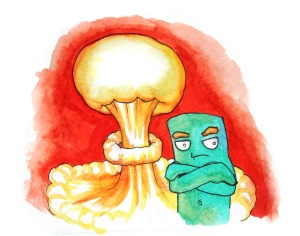
Domination: playing chess with another person or with people as in manipulation. The difference is the dominator has removed the opponent’s pieces without declaring so in the first place.

Intimidation: playing chess with another person or with people where winning and losing comes with either the threat of punishment or actual punishment.

Healthy Relationships: There is no element of either winning or losing; they are not a game of chess at all and are free of tactics and agenda.

March 11, 2006

Are you an adult? It has very little to do with your age

by Rod Smith

I believe we are fully adulthood when:

1. We can be authentic with all people, including our parents, treating all others respectfully as equals, despite rank, position or the apparent lack of it.
2. We respect mutuality and equality and want them in all of our relationships.
3. We have acknowledged our hurts, grieved appropriately and decided to live to the fullest. We can delay gratification.
4. Confusion, ambiguity and uncertainty are allies, not enemies. We can “hold” seemingly conflicting thoughts and beliefs without becoming unsettled.
5. We can take full responsibility for our lives despite past trauma or neglect. We are able to recognize when and how we were victimized but no longer think, speak, feel or behave like victims.
6. We do not victimize others.
7. We have a small group of people to whom we talk about almost everything, but feel no compulsion to tell everybody or anyone everything.
8. We stop apologizing for things for which we could never be held responsible in the first place.
9. We clear misunderstandings as quickly as possible.
10. We can stand up for ourselves without pushing others out of the way.
11. We can see that all things are related and are therefore careful to apply quick solutions to problems because quick solutions are likely to foster new, unexpected problems.
12. We learn to appreciate and love “the moment” rather than live as if we are perpetually waiting for a day when things will be better.
13. We can perceive when others do not have our best interests at heart but are not afraid to remain in relationship with such people, confident of our ability to self-protect.

March 1, 2006

Don’t confuse sex and intimacy: sometimes the two never meet!

by Rod Smith

Finding Intimate Relationships

Different people can give words very different meanings. For some, intimacy means physical sex. Intimacy is about much more than sex. It is about much more than what people can do with their bodies.

Here are some points about intimacy for consideration:

1. It is the ability to see another’s worlds as his or her world really is without bringing pressure to change what is seen in that world. It is the ability to accept another person’s reality even if it is not what we want it to be.

2. It is the recognition that physical sex is not automatically intimate. People who are very “far apart” can join their bodies for sex. Physical sexual activity can feel close without being at all intimate. Sex can be very misleading and is often a way to avoid intimacy and love.

3. Intimacy is sharing life and keeping what is shared within the framework of that relationship. It is possible, and not “dangerous,” as I have heard promulgated in some quarters, to have many intimate relationships (nothing to do with sex) at varying levels with different people.

4. In an ideal world, intimacy is first intellectual, then spiritual, then emotional and, when appropriate, sexual. It is easier to perform an impersonal sex act than it is to have an intimate relationship that is also sexually intimate. It is unlikely that a relationship that begins with sexual activity will be able to grow into a truly intimate relationship, sexual or otherwise. (Unlikely: not impossible.)

5. The person, with whom we are sexually intimate, will share with us the deepest intimacies of all. The relationship will penetrate deeper into all facets of our lives than all the other relationships we have. (This might help people understand why breaking up is hard to do).

6. It is so very seldom understood and appreciated that intimacy is an individual pursuit and is not dependent on the cooperation of another. One person can be very intimate with another when that other person might be choosing not to be intimate at all.

7. Casual sex, by definition, cannot be intimate. Casual sex is an act of the avoidance of intimacy.

Copyright 1998, Rod Smith, MSMFT

February 5, 2006

Four sure-fire ways to increase family emotional health and deal with overly-sensitive people

by Rod Smith

I have received several very welcome and lengthy letters from readers who find themselves in very complicated family relationships. Here are four broad principles for all members of a family:

1. Get yourself out of “the middle” of other people’s relationships! Don’t carry messages for others, or think for others or feel for (on the behalf of) others. Allow other adults the joy or communicating their own messages, thinking their own thoughts and feeling their own feelings.

2. Regard all other adults as complete adults and your complete equals. If you’re “on eggshells” around anyone (a parent, boss, child, spouse or former spouse) this person has inappropriate power over you that I’d suggest you address. The “eggshells” means you are not seeing yourself as an equal with this person or these people.

3. Never allow yourself to be intimidated, dominated or manipulated. Persons who use intimidation, domination or manipulation (in other words, emotional bullies) to get their way must be confronted if you want any degree of healthy dialogue.

4. Despite age, rank or status, don’t “tread lightly” around other adults. While it is unnecessary to knowingly inflict hurt on others, some people are so inappropriately sensitive that their oversensitivity can restrict others from normal behavior. If your actions are not in themselves hurtful, but are interpreted as such by some sensitive soul, I’d suggest you be yourself and challenge Mr., Mrs., or Ms. Oversensitive to grow up.

February 3, 2006

Wife never wants sex…

by Rod Smith

My wife complains when I want sex. When we do have sex she just doesn’t really get involved and says it is all to keep me quiet. I have never been unfaithful and I don’t ever want to be.

There are no easy answers to this deep human issue. You might begin with viewing your bedroom as a metaphor of what is, or is not, occurring in your broader relationships.

Before you look at your wife’s lack of interest in sex with you, you might want to assess your contribution to the wholeness of your marriage and family.

Sexual behavior cannot be understood or “helped” by isolating it from everything else occurring in your marriage and family.

The person who wants sex least, is the person who is holding the reigns of control in the relationship. I’d suggest your wife is tired of “bad” or boring sex, which it sounds to me, is what she experiences with you. Any person with a smidgeon of a “sense of self” would want to stop engaging in “bad” or un-fullfilling sex.

There is no good reason for unfaithfulness. Such action on your part will not help you with the dissatisfaction that exists between you and your wife. It would lead to no long-term good.

I’d suggest you read David Schnarch’s PASSIONATE MARRIAGE. This is a wonderful book for all relationships. While it is very graphic about matters relating to sex, it is never pornographic. Couples wanting to read the book would be wise to invest in two copies rather than try to share one copy! Sharing one copy of this book could ruin the very relationship you want to mend.