Of course I want you to have a “happy” new year. What exactly do I mean?
• May you find authentic inclusion with a group of caring friends.
• May you enjoy significant connection and derive mutual satisfaction with members of your immediate and extended family and family of choice.
• May you have meaningful work, work that respectfully uses your talents, strengths and imagination.
• May your capacity for humor enrich those whom you love and bring joy.
• May you discover new and wonderful things about yourself and others despite your years of experience.
• May regret over past failures provide you with healthy awareness rather than weigh you down.
• May you be part of the solution and not part of the problem in matters large and small.
• May you become more skillful in defining your boundaries and therefore more able to love your friends, family, colleagues, strangers and foes.
• May you resist urges, subtle or gross — all of which may be socially acceptable — to exploit others to accomplish your personal or professional goals.
• May you do no harm and may no harm be done to you.
• May we be agents of peace.
————— The Mercury is one of South Africa’s longest running weekday morning newspapers. It is published in KZN, a province of South Africa.
I have enjoyed the privilege of writing daily for this newspaper since March 21, 2001. This affords me the unusual joy of occasionally being able to surprise friends. Pictured below is a couple whom I married in Prague (earlier this year). A few days before the wedding I discovered they were going South Africa for their honeymoon. Here they are reading a welcome column in The Mercury while in Umhlanga.
“Now what would Jesus do?” asked the woman glancing at her WWJD bracelet.
“Grape nuts,” replied the companion instantly, as if he’d served Jesus breakfast that morning. I slipped away pondering how the will and the ways of the greatest political, religious and social reformer of all time got reduced to a formula for grocery shopping.
I am glad the use of these bracelets appears to be waning. It remains a great question, but wearing it on a wrist somehow suggests that the answer is easily accessible. It suggests that if you will simply stop and think a little, having eyed the bracelet, you’ll get the answer. Then, as you act on your newfound knowledge, your predicaments will be resolved, you will have a better life, and conditions in the world will improve all around for everybody.
Quite the contrary: Answering the question and doing what Jesus would do in any situation is neither easily established nor executed. Finding the answer itself would take a lot of work, like tunneling back though a couple of thousand years, researching culture, geography and weather conditions and the varying political and religious climates. Then we’d have to identify, and then decipher, metaphor, understand and interpret tone and intent, and immerse ourselves in at least a few ancient languages. Besides all this, we’d need a working knowledge of the subcultures and the prejudices that existed within those subcultures. Then, with all this done, we might be able to decide what Jesus would do given some, but not all, situations we face.
The next challenge, once we’ve established the answer, would be to have the courage to do what Jesus would do. WWJD is not about “doing the right thing.” Jesus did not always do the “right” thing. If that were so, no cross would have awaited him. Doing the “right thing” would have endeared him to those who mattered and would not have required him to buck authority.
Essentially Jesus laid a platform for his followers to live differently. It doesn’t take more than a reading of the New Testament to see that he despised pretentiousness and empty religious “performance” and was particularly vocal wherever he found religious zeal that was without internal transformation. He despised abusive systems and was a particular critic of those who ripped off others.
I do not think Jesus cares what cereal you buy, or for that matter, what dress or suit you wear or how your hair is or is not cut. But I do believe he cared about what kind of person you are and whether you love mercy, humility, truth and justice, and challenge the systems where these qualities are absent. It is apparently forgotten that Jesus was hardly a nice guy. Today he’d be a threat to our political order and might not be able to find a church he’d attend, let alone one that would permit him to preach! Consequently doing what Jesus would do could significantly reduce your popularity, The real question, by the way, is not “what would Jesus do” but rather what will you do in response to what he has done?
Shed the bracelets. It’s not grape nuts or cheerios, but love and truth, mercy and justice, that might bring us all a little closer to reflecting who and what Jesus was. But be careful, you might shed the bracelet and exchange it for a cross – and it won’t be hanging around your neck.
—————————
When published in The Indianapolis Star, this column certainly got me some fans – and enemies. The morning it appeared my email was as hot! I was called brilliant, I was called stupid. One reader said that finally he’d read something by an intelligent Christian about a really stupid gimmick. Another said he’d be praying for my salvation even though he was convinced I was a lost cause.
The louder and bolder mine are, I’ve learned over the years, the less likely they are to last.
I do tend to follow through a little better on silent, private resolutions.
Prior to making hopeful decisions about the coming year I also try to elucidate three or so learnings or observations from the last 12 months.
Repeated questions gave shape to my 2023:
“What kind of person do you want to be?” I asked myself almost daily. Answering it, trying to live according to my answers, I believe saved me some pain and expense. The joy of the question is that it removes others from the equation. It removes all elements of blame and any potential desire for pay-back. It obliterates all traces of victim thinking and victim living.
“How would you like your sons to behave in any parallel circumstances at a similar age?” Trying to live the answer to this question has, I believe, provided me with safe guidance.
“Seed or stone; bloom or tomb?” Answering this question, posed in a poem by Dennis and Mathhew Linn, has been life-transforming. Seeds grow, feed — represent life; stones are hard and lifeless, can hurt and wound. It’s far easier to stone others than it is to resist the urge and transform whatever it is into life-giving seeds. This metaphor has guided my responses to many challenging circumstances. I like to think I have chosen seeds and have been determined to throw no stones.
Love one another is surely among life’s hardest, crucial, most fabulous assignments.
Jesus commanded it.
He did not suggest it or consider it a good idea.
If we claim faith in Jesus, His commands leave us no options, no outs, or off ramps.
We are to love those who love us back and those who do not.
We are to love even those who for whatever reason, have chosen to reject and hate us. Hardest perhaps, we are to love those for whom we are invisible, those who regard us, if they even notice we exist, with indifference.
We are to love modern day Samaritans (the commonly rejected change from culture to culture, group to group) and Pharisees (today’s know-it-all blowhards who peer down at we lesser mortals) and teachers of the law and hookers and addicts and bankers and Rev. Private Jet pastors and prostitutes. We are to love those who treat us with the contempt shown to New Testament Samaritans.
Yes.
Everyone.
As you, my sons, love others well and as you learn to love even more people – it doesn’t come naturally – from the most distant or platonic of relationships, to the most intimate and sacred love and trust in marriage, you will be guided, sometimes cajoled, driven, even bullied by deep inner impulses.
Strong tides, forces unseen, forces felt but unknown will rise within you.
These inner pressures are sufficiently powerful that words expressed on any page will not be able to quell the force they will try to exert over you.
Love drills down deep for discovery of the opposite spirit, the counter-intuitive approach, the unexpected, the unanticipated means toward a loving, kind end.
Love your enemies is not some insurmountable-Jesus-hurdle.
He did not command it to trick anyone.
Loving your enemies is the gateway to loving all people, even to love those whom we may consider easy to love.
No one is easy to love.
Remember, what you can do to anyone you can do to everyone.
Love is really understanding the parable of the “good” Samaritan and trying to live it out daily.
Love, to imperfectly and briefly quote Paul, the Apostle, doesn’t return evil for evil.
Finally, read Paul’s summary of love in 1 Corinthians 13 and remind yourself over and over again, Paul did not have wedding sermons in mind when he put his heart on paper.
“The thing to remember always is that you’re surrounded by idiots. Once you get that right in your own head things start moving in your favor.”
“Everyone has something to teach me. I try to learn from everyone.”
“I never fly economy. Who’d ever do that? It’s like moving cattle. See you later.”
“It’s such a privilege to see the world. My company policy is everyone flies economy. Even the top brass.”
“I make all the decisions in our home. He leaves it all up to me. I wouldn’t have it any other way.”
“I just go straight to the top. I don’t mess with the lower rank employees, the paid by the hour sorts of people.”
“I try to live without blaming others. Yes, bad things have happened to me but I’m an adult now. I’ve got to live with what I’ve got and make the best of everything.”
“Wait for a table? Not me. I get what I want when I want or I don’t go back. I vote with my feet and they know it.”
(Said to me —- or overheard in a variety of settings)
May this question help you to plan your day. I confess, it’s constantly in the back of my mind with almost all my daily interactions.
You’ve seen him demanding to see the boss, insisting on getting his way, banging fists on the counter. He becomes aggressive and threatening when things don’t go his way. You can be this person if you want. It all depends on what kind of person you want to be.
You’ve heard and seen her, raising her voice at a waiter in a fine restaurant because something wasn’t up to her standards. She plays dirty and attempts to humiliate helpers to land a free meal. You can be this way if you want. Everything depends on who you want to be.
You’ve seen him, kind and patient under stress, generous and openhearted, even when facing difficulties. You can be this way if you want. It’s always, and there are no exceptions, up to you.
You’ve seen her, helping the poor, serving the sick, making meals for neighbors, all-the-while undergoing her own stresses, suffering beneath her own burdens and loads. She serves while she herself deserves to be served. You can be this way if you want. Everything pivots on what kind of person you want to be.
My friend Michael — a finer human (than Michael) I’m yet to meet.
Genuine kindness expressed today, among us all –– colleagues at the office, the teachers in the staff room, doctors and nurses who pass each other running the hallways of a busy hospital –– wherever we find ourselves at work or at play, expressed kindness will be helpful to all.
Expressing kindness will change your mood and enhance your day.
Small acts of kindness might not change the world, but they will enhance our individual experiences of work, and add joy and meaning to the most repetitive of tasks.
Kindness in a nutshell:
Don’t gossip, or spread rumors, or tell tales about others. Don’t speak negatively about other people. Don’t lie. Try not to ignore people, or regard others as a means to getting your way — no one wants to be your stepping stone.
Be generous, and wide-hearted, open-handed. Offer accurate compliments to those who might least expect to hear kind words. Tip well, even if the service or food is not up to scratch. How you tip is about you, not the service or food.
Most of all, and this is a well-known secret to great fulfillment, do your job — whatever it is — very well. It is a powerful way to be kind both to yourself and to your boss!
Thulani (center) in Togo in 1999. We were there for a week after being refused entry into Ukraine. We were returned to Frankfurt, spent the week in Munchin, flew to Togo, before returning to the USA.
I saw Santa at the Children’s Museum with a feather of a child pleading her case. They were locked in discussion, a confessional of sorts, as she entered into detail of her every Christmas wish. Hands, eyes, and all of her face enticed Santa closer lest he miss a detail living so clearly in her head.
“Oh, you want, oh, I see it. Why yes, of course. Perfectly,” Santa said, his voice tapering off into her ear, “I will see what I can do about that.”
Then she nestled into his side, her shoulders comfortably enveloped by his plush red suit as if to declare her mission accomplished. He was a perfect depiction of everything I imagined him to be and the sight easily immersed me in the voices and music of my own Christmases past.
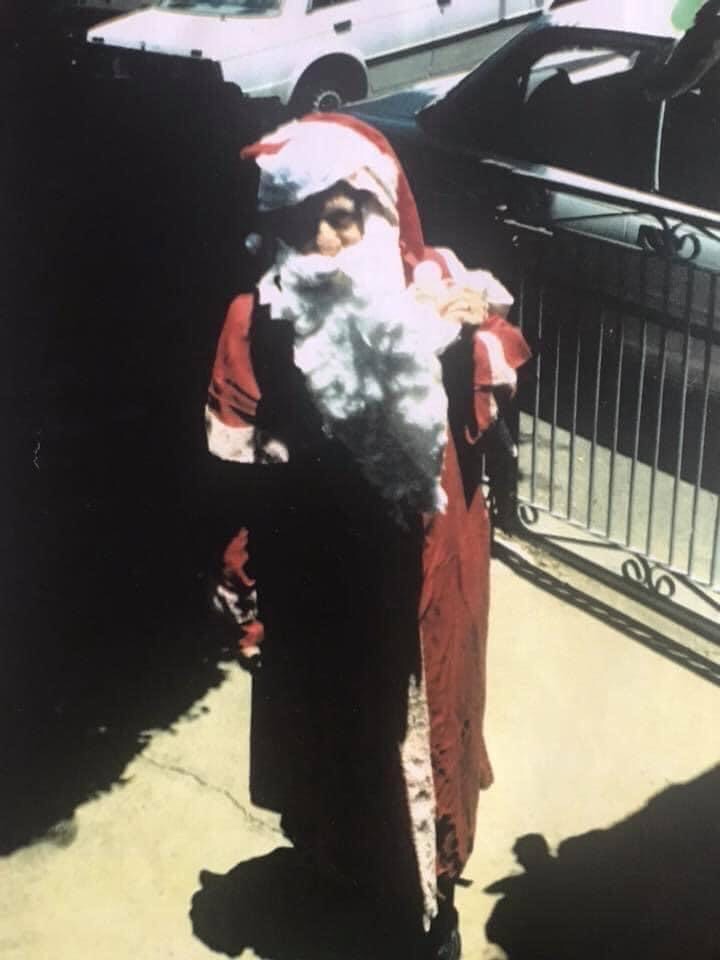
Santa came all year round to our home. I’d look through the window in April or mid-August and Santa would be strolling up the driveway on his return from visits to every home on the street. He’d be wearing dad’s shoes and one of his ties underneath the tatty red coat, but I knew better than to expose his identity. I wanted to believe in Santa and he in turn needed me to believe. Such faith had rewards. I knew better than to dash my own hopes. I wasn’t ready to lose my trust in Santa for anyone and certainly not by my own hand.
He couldn’t resist visits to the whole neighborhood and would drop in from time to time and inspire children toward good behavior, perfect obedience at school, and remind them to count their blessings one by one. At every appearance in our home we’d sing “The Little Boy that Santa Clause Forgot” and we’d all have to cry. He insisted on it.
The lines “he didn’t have a daddy” and “went home to play with last year’s broken toys” really got us going.
It was clear he sang to all the children of the world who’d had to skip childhood and who had known poverty; children who’s fathers had gone to war or whose fathers or mothers had fled their families.
Donning the suit, surprising the children, was our Santa’s way of making the world right.
His visits created intrigue in the neighborhood, and to every child he repeated the promise that this Christmas, no child on this street would be forgotten. As far as I could tell none ever was.
The last Christmas we had together was in August of 1994. We were riding in a car and in the curves of Bluff Road when spontaneously he began to sing, “Christmas comes but once a year.”
The car became a holy place as I heard once more of the boy who “wrote a note to Santa for some soldiers and a drum and it broke his little heart to find Santa hadn’t come.”
The tears we both shed required no encouragement for we both somehow knew this would be the last time he’d sing this nostalgic hymn.
Now this old song is top of my list of Christmas songs.
The melody emerges randomly in my awareness, most particularly when faced with children who are in need. I have had to silence it at all times of the year.
It was the little girl’s confidence, Santa’s grace, and the loving parents looking from the side that caught my attention last week. She touched his flowing beard and told him her every Christmas dream and I found myself listing my own requests with childlike zeal.
It gave me renewed hope that you and I, the real Santas of the world, could deliver a more hopeful tomorrow for “those little girls and boys that Santa Claus forgot.”
(First published December 9, 2000 in the Indianapolis Star)
You say you want to return to its real meaning, identify with Jesus more than you see done in the surrounding culture.
I have a few suggestions to facilitate your desire.
Please understand this is not easy. Most of whom we know do not live in a territory occupied by a foreign power whose despot representative despises locals and is especially violent toward infant boys after getting wind that one will be born who will be greater than he.
In your journey to be in touch with the birth of the Christ-child, I’d suggest you start by walking to Chicago, Cleveland or Cincinnati from wherever you live in the midwest. Take a donkey, or ride a camel, to St Louis. Wherever you choose to go, plan to arrive by Christmas Eve. Have at least one very pregnant teenager (a non-relative) of about 14 or 15 years old in your party.
The ride, the discomfort, the lack of certainty about accommodations, and the welfare of mother and soon-to-be baby along the way will enhance your appreciation of the season and sharpen your perceptions of how ridiculously off-target are our current traditions with sterile stables, plastic donkeys, unbounded shopping, people trampling over, killing each other, to buy a cheap TV in a world hung with mistletoe.
Take no money. Be prepared to be turned away by family and motel managers alike. You are accompanied by a pregnant, delusional teen who, apart from being no one’s wife, claims “innocence” regarding the pregnancy. Her claim that an angel said she’d conceive a child by God more than alienates your party from usual societal pleasantries, and you end up with a makeshift accommodation between two dumpsters at the rear of a very cheap motel.
On the journey, chat here and there about the political leader who slaughters all the boys in the Midwest. He has spurts of uncontrolled lustful power and an inordinate degree of submission from the troops who carry out his wishes. Remind yourself that for weeks, months and years to come, parents will mourn over the slaughter of their infant boys.
You get to successfully hide your infant from the brutal eye of the murderous leader, but this is little consolation, for although you are very grateful that the baby will not be murdered as an infant, you can hardly dispel the knowledge that he will, nonetheless, be ruthlessly murdered as an adult.
As you choose a parking lot behind a rundown motel in South Bend or Toledo, reflect on the oddness of the child’s conception and the rumor you hear that he will “save” people from their sins. This thought both encourages and disturbs you. You literally fall to the ground and worship a God who has given such a privilege while remaining aware of how those who seek no salvation usually treat self-proclaimed saviors.
The cattle are lowing, yes, but have you ever spent the night with an ox? Have you noticed how much distance you keep from the animals at the state fair? There’s a good reason you do. Somehow the lowly manger has become a sanitized, cozy corner. Live in a dumpster, add a few stray farm animals and let a few wild goats, dogs and rats enter regularly from stage left and stage right, and you are more likely to create something of the environment of the first Christmas.
Let there be no gifts, no tree, no glitter. Christmas earmarks the beginning of the second phase of a remarkably courageous journey of love, adventure and commitment on behalf of a determined God.
The gift is within the risk.
The value is within the danger.
The generosity is within the sheer lunacy that God constantly loves a recalcitrant humanity.
The UPS truck arriving at your door with a gift from Aunt Joan in Ohio does nothing to reflect the spirit of generosity that was evident with the coming of the Christ-child unless Aunt Joan has given everything she ever owned or valued, and, at the cost of her life, packed it off to you for Christmas.
—————— I paid a quick visit to a private school recently and was deeply moved by the commitment to quality education. The “building” has been declared unsafe and the administration is attempting to replace it……. If you’re interested in assisting let me know. Contact me privately. The student body is about 200 students from K to 5th or so……






 difficultrelationships.com